




Pompeii is one of the world's most extraordinary archaeological sites. Its streets, houses, temples, baths, theatres, workshops and gardens preserve an exceptionally detailed picture of life in an ancient Roman city. The city lies on a volcanic plateau overlooking the Sarno valley, close to the Bay of Naples. Archaeological evidence places the first clearly recognisable phases of the settlement between the late 7th and the first half of the 6th century BC, although the origins of Pompeii remain complex and cannot be attributed to a single people.
From its earliest centuries, Pompeii developed within a cultural environment shaped by indigenous Italic communities, Etruscans and Greeks. These influences can still be recognised in some of the city's oldest religious areas, including the Sanctuary of Apollo and the sacred area of the Triangular Forum.
For a detailed account of the city's development, see History of Pompeii.
Towards the end of the 5th century BC, Pompeii became part of the Samnite cultural and political world. During the following centuries the city expanded considerably, with new fortifications, monumental public buildings and increasingly elaborate private residences.
Many of the houses of Pompeii preserve traces of this long history. Large atrium houses were repeatedly enlarged, decorated and adapted as the social and economic ambitions of their owners changed.
Pompeii gradually entered the Roman sphere of influence during Rome's expansion into Campania. After taking part in the Social War, the city was besieged by Lucius Cornelius Sulla in 89 BC and became a Roman colony in 80 BC.
The establishment of the colony brought important political and architectural changes. New monuments appeared alongside older buildings, while Latin increasingly became the language of public life.
The city prospered through agriculture, craft production and trade. The fertile land around Mount Vesuvius and the Sarno plain supported vineyards, orchards and farms, while workshops, bakeries, shops and food outlets filled the urban area.
Public life centred on monumental spaces such as the Forum and the city's temples. Religion, politics and social prestige were closely connected, while domestic religion was practised inside houses through lararia and other household shrines.
Entertainment also played an important role. The Pompeii Amphitheatre, built around 70 BC, hosted gladiatorial contests and other public spectacles, while the theatres of Pompeii were used for dramatic, musical and other performances.
The city's thermal baths were another important part of everyday life. They provided facilities for bathing and exercise but were also important places for social interaction.
Pompeii was not simply a city of wealthy villas. Its population included members of elite families, craftsmen, traders, freedmen, enslaved people, agricultural workers and many others. Their lives can be reconstructed through buildings, objects, inscriptions and thousands of messages written or scratched onto walls.
A major earthquake struck the region in AD 62, seriously damaging many buildings. Extensive reconstruction followed, and archaeological evidence shows that numerous projects were still under way when Mount Vesuvius erupted seventeen years later.
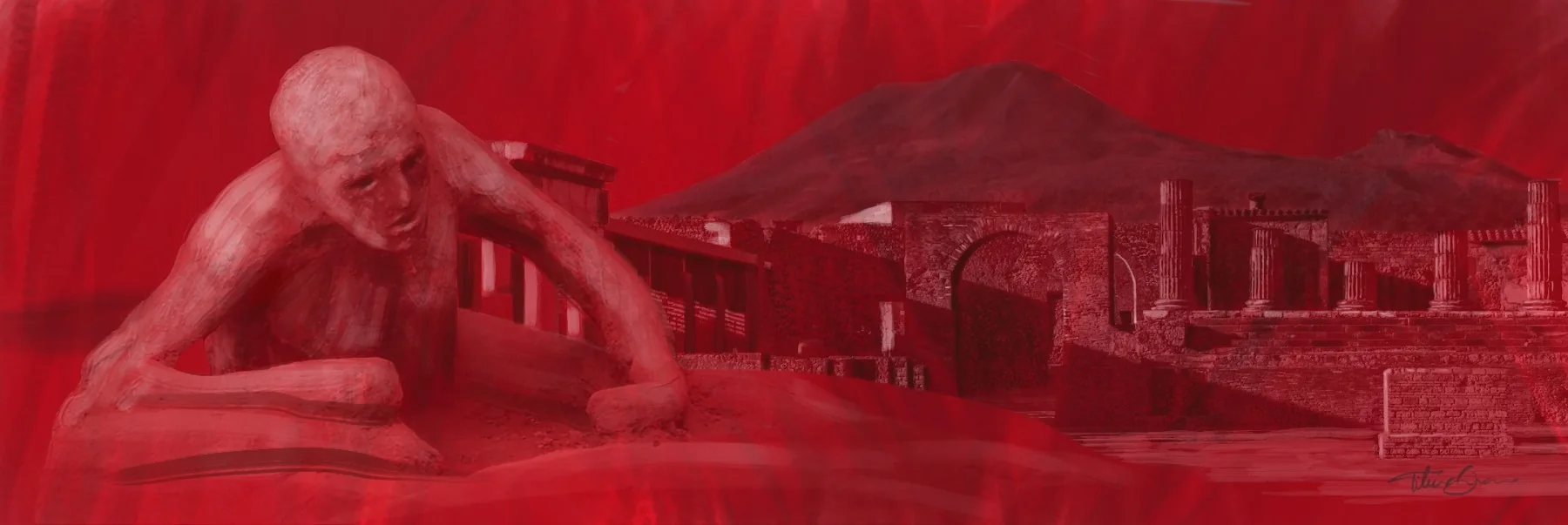
In AD 79, the eruption abruptly transformed the city. During its first major phase, Pompeii was buried under a heavy fall of pumice and other volcanic material. Roofs collapsed under the accumulating weight and many inhabitants fled.
Later, high-temperature pyroclastic currents of ash, gas and volcanic particles swept through the city, killing those who had remained.
Pompeii was therefore not buried by a river of lava. The extraordinary preservation of the archaeological site resulted principally from layers of pumice, ash and other volcanic deposits that rapidly covered buildings, objects and victims.
The precise calendar date of the eruption remains debated. The traditional date of 24 August AD 79 comes from the manuscript tradition of Pliny the Younger's letters, while archaeological evidence has encouraged scholars to consider a later date in the year. It is therefore safer to refer simply to the eruption of AD 79 unless discussing the dating problem specifically.
The catastrophe destroyed the ancient city, but the volcanic deposits also preserved an extraordinary amount of information that would normally have disappeared: wall paintings, mosaics, graffiti, household objects and even traces of organic materials.
Systematic excavations began in 1748. Over the following centuries, archaeological methods evolved considerably, particularly with Giuseppe Fiorelli's reorganisation of the excavations and his development of the plaster-cast technique for recording cavities left by decomposed bodies and organic materials.
Today, Pompeii is not a finished archaeological site. New excavations, conservation projects and scientific studies continue to reveal information about the city's inhabitants, buildings and environment.
Modern archaeology increasingly combines excavation with anthropology, archaeobotany, archaeozoology, architectural analysis, digital documentation and scientific examination of materials.
The ancient urban area covers approximately 66 hectares, and significant sectors remain unexcavated. These areas are deliberately preserved as an archaeological resource for future research rather than simply waiting to be uncovered.
Pompeii should therefore not be understood only as a city “frozen in time”. Its streets and buildings record centuries of change, from the earliest settlement to the Samnite city, the Roman colony and the final decades before the eruption.
Walking through Pompeii today means exploring both the final moments of a Roman city and the many centuries of history that came before them.
To plan your visit, see Pompeii opening hours, how to get to Pompeii and the Pompeii map.