



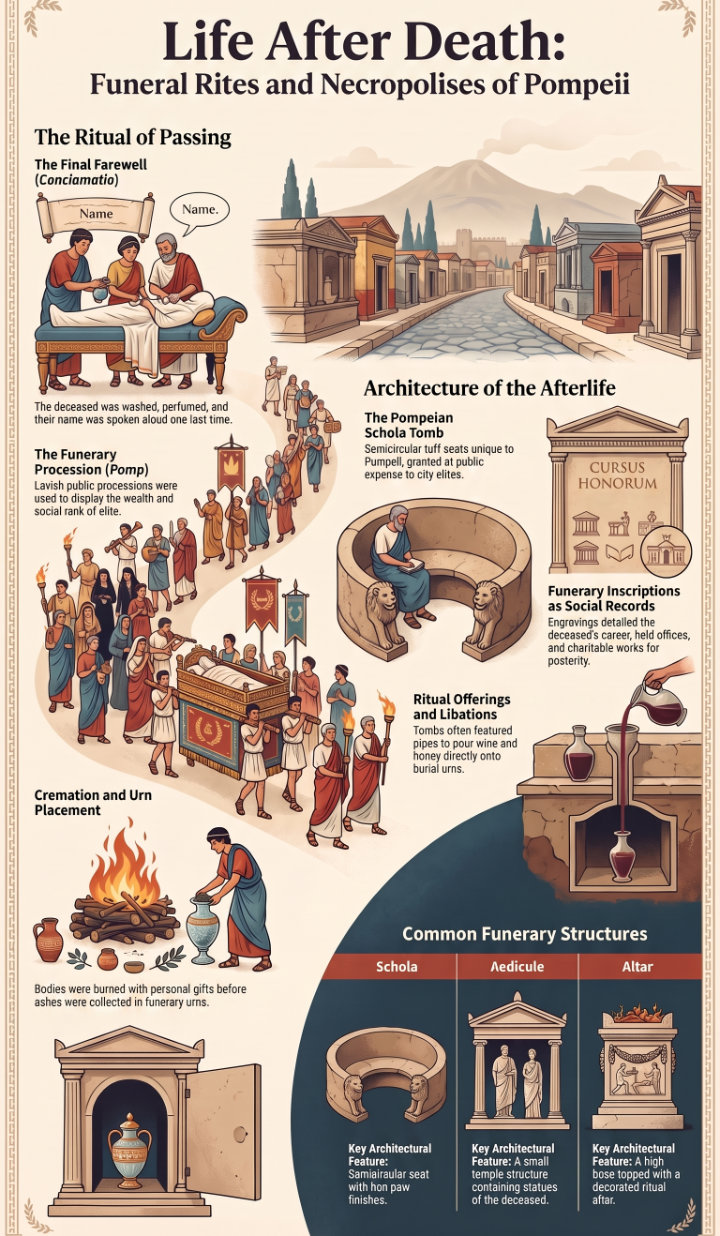
Death was an important part of the religious and social life of ancient Pompeii. The city's necropolises, arranged outside the walls along the roads leading from its gates, preserve an exceptional record of funerary customs, social identities and the ways in which families sought to maintain the memory of the dead.
The archaeological evidence shows that funerary practices changed over the long history of Pompeii. For the earliest phases of the city, burials are known especially outside Porta Ercolano, where graves of the Samnite period, dating mainly to the 5th and 4th centuries BC, contained inhumed bodies placed in pits or stone coffins together with grave goods. In the Roman period, however, cremation became the predominant funerary practice represented in the necropolises surrounding the city.
Roman burial grounds developed outside the city walls, principally along the roads leaving Porta Ercolano, Porta Vesuvio, Porta Nola, Porta Nocera, Porta Stabia and Porta Sarno. Their location was significant. Tombs and funerary monuments stood beside roads travelled by inhabitants and visitors, making the memory and social identity of the deceased visible to anyone entering or leaving Pompeii.
The Necropolis of Porta Ercolano, to the north-west, contains important burials belonging to prominent citizens and was closely associated with the aristocratic residential areas of Regio VI. The Necropolis of Porta Vesuvio also preserves monumental tombs of members of the local elite, including the richly decorated monument of Caius Vestorius Priscus. At Porta Nola, the archaeological evidence includes monumental tombs, cremation burials and the graves of members of the Praetorian Guard.
The Necropolis of Porta Nocera, south-east of the city, is the most extensive funerary area currently known at Pompeii. It developed from around the foundation of the Roman colony in 80 BC and remained in use until the eruption of AD 79. Its tombs and funerary enclosures belonged to people from different sectors of society, including many freedmen. Archaeological research has also revealed the presence of individuals who are much less visible in literary sources, including enslaved people and children who died at a young age.
Recent archaeological research at Porta Nocera has transformed our understanding of funerary practice in Pompeii. The exceptional preservation of the ground surfaces sealed by the eruption of AD 79 allows archaeologists to study not only tombs but also cremation areas and traces of the gestures performed during funerals and later commemorations.
In some cremation areas, archaeologists have found perfume bottles, cups and oil lamps that were deliberately broken during the funerary ritual. Burned human bones and remains of the funeral pyre make it possible to reconstruct how the body was cremated and how the bones were subsequently collected for burial. Detailed excavation has also identified carbonised grain and fruit, wood used for the pyre, animal bones and other small remains associated with funerary activity.
This evidence is particularly important because it reveals practices that ancient written sources describe only imperfectly. The Pompeian necropolises preserve the material traces of actions performed by families and attendants during and after the funeral, allowing archaeologists to reconstruct local customs rather than assuming that every community followed an identical Roman ritual.
In Roman-period Pompeii, cremated remains were commonly collected and deposited in an urn. The position of a burial within a funerary enclosure could be marked by a stone object known as a columella, usually shaped as a simplified human head or bust. A vessel containing the ashes of the deceased was buried at its base or nearby.
Not every inhabitant of Pompeii received an elaborate monument. The archaeological record ranges from modest cremation burials to imposing tombs constructed for some of the most prominent members of the community. These differences provide important evidence for the complex social structure of the city.
For wealthy and politically important individuals, a tomb could become a powerful statement of identity, prestige and civic status. Its architecture, location and inscriptions communicated with passers-by, preserving the name of the deceased and sometimes recording public offices, honours and acts of generosity towards the city.
Among the most distinctive monumental forms preserved at Pompeii are the schola tombs, characterised by a large semicircular stone seat. They were associated with prominent individuals who had been granted particularly prestigious burial places, often on public land close to the city gates.
One of the best-known examples is the tomb of Mamia, a public priestess whose monument stands outside Porta Ercolano. By decree of the city council she was granted a burial place on public land. Her tomb consists of a semicircular seat of tuff more than six metres wide, with an inscription on its backrest commemorating her name and status.
Another important example was discovered in 2024 near the San Paolino complex, in the funerary area associated with Porta Stabia. Archaeological excavation revealed a schola monument whose inscription identifies Numerius Agrestinus Equitius Pulcher, a prominent Pompeian who had pursued an important military and civic career. The monument adds valuable evidence for the relationship between funerary commemoration, civic honours and the elite of Augustan Pompeii.
The monumental tomb of Eumachia at Porta Nocera develops the semicircular form of the schola on a much larger scale. Eumachia was a public priestess and one of the most prominent women known from Pompeii. Her funerary monument, dedicated to herself and her family, reflected the exceptional social and economic position also demonstrated by the monumental building she financed beside the Forum.
The archaeological evidence shows that funerary areas continued to be visited after burial. Objects and deposits found around the graves preserve traces of commemorative practices, demonstrating that the relationship between the living and the dead did not end with the funeral. Research at Porta Nocera has shown that the cemeteries could be frequented regularly and that different families developed their own patterns of commemoration.
Funerary inscriptions played a central role in preserving memory. Placed beside heavily travelled roads, they allowed the deceased to remain symbolically present within the community. Names, family relationships, public offices and achievements could continue to communicate with passers-by long after death.
An exceptional example was discovered outside Porta Stabia in 2017. The marble-covered funerary monument bears the longest funerary inscription so far discovered at Pompeii and records important episodes in the life and public activity of a prominent citizen, probably Gnaeus Alleius Nigidius Maius. The monument demonstrates how closely funerary memory could be connected with civic reputation and public spectacle.
Research in the Necropolis of Porta Sarno has added important new evidence. Investigations have revealed funerary monuments, cremation burials and decorated structures belonging to different phases of the necropolis. One painted niche contained two tuff funerary stelae corresponding to a male and a female burial, together with two cinerary urns.
In 2024, further excavation east of Porta Sarno revealed a monumental tomb with several niches in its façade and a relief representing a married couple. The attributes carved beside the woman may identify her as a priestess of Ceres, while stylistic characteristics suggest that the monument may date to the Republican period. The discovery is especially significant because it adds new evidence for the funerary landscape of Pompeii before the establishment of the Roman colony.
The discoveries at Porta Sarno also include the remarkable tomb of Marcus Venerius Secundio, discovered in 2021. His funerary inscription identifies him as a freedman of the colony who became associated with the cult of Venus and later attained the status of Augustalis. It also records that he personally financed Greek and Latin performances lasting four days, providing exceptional evidence for the cultural life of Pompeii.
His burial was unusual within the funerary landscape of Roman Pompeii because his body was inhumed rather than cremated, while cremation was the dominant practice represented in contemporary Pompeian cemeteries. The discovery demonstrates that even within a society governed by strong traditions, funerary choices could vary according to individual, family and cultural circumstances.
The necropolises therefore provide much more than a collection of tombs. Their careful excavation allows archaeologists to reconstruct the sequence of the funeral itself: the preparation and burning of the pyre, the ritual breaking of objects, the collection of cremated bones, their deposition in the grave and the later acts performed by relatives when returning to commemorate the dead.
They also reveal a broader social world. Monumental tombs belonging to prominent citizens stood beside modest burials of freedmen, children and other inhabitants whose lives are far less visible in Pompeii's grand public buildings and houses. Funerary archaeology therefore provides one of the most important ways of studying the entire population of the ancient city.
The dead remained symbolically connected with Pompeii. Although burial normally took place outside the walls, tombs lined the roads used by inhabitants, visitors and travellers. Anyone approaching the city moved through a landscape populated by the names and monuments of previous generations.
The necropolises of Pompeii thus preserve an extraordinary record of the relationship between death, family, social identity and civic memory. From simple urn burials marked by a columella to the monumental tombs of Mamia, Eumachia and Numerius Agrestinus, each discovery contributes to a more detailed understanding of how Pompeians confronted death and remembered their dead.
Essential bibliography:
M. Paoletti, Usi funerari e forme del sepolcro, in Civiltà dei Roamni, Milano 1992
J.M.C. Toynbee, Death and Burial in the Roman World, London 1971