




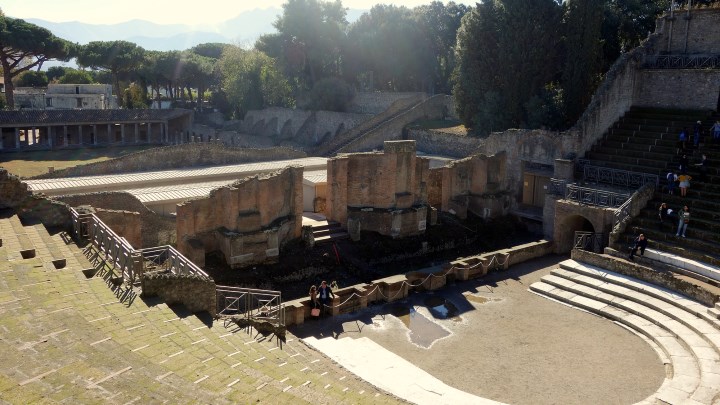
The theatres of Pompeii formed one of the most important centres of entertainment and public life in the ancient city. Located in the south-western area of Pompeii, close to the Triangular Forum and the Temple of Isis, the theatre district contained two very different buildings: the Large Theatre and the Small Theatre, or Odeion.
Together they illustrate the development of theatrical architecture at Pompeii from the Samnite period through the establishment of the Roman colony and into the age of Augustus.
The two buildings served different types of performances. The Large Theatre could accommodate thousands of spectators for dramatic productions, while the smaller covered Odeion was particularly suited to musical performances, singing and poetic recitations.
The Large Theatre
The Large Theatre was built around the middle of the 2nd century BC, making it one of the major public buildings created during the period of monumental development that preceded the Roman colony.
Its design took advantage of the natural slope of the hill. Rather than supporting the entire seating area on a complex system of arches and vaults, as became common in later Roman theatres, much of the cavea rested directly against the terrain.
This arrangement reflects the influence of Greek theatrical architecture, which frequently exploited natural hillsides for spectator seating.
The theatre could accommodate approximately 5,000 spectators, making it one of the largest places of public entertainment in Pompeii.
The seating area, or cavea, was divided into different sections. The best positions closest to the orchestra were reserved for magistrates and members of the local elite, while other spectators occupied progressively higher areas according to social status.
This organisation was not merely practical. Like many Roman public buildings, the theatre physically reflected the social hierarchy of the community.
Orchestra and stage
At the foot of the cavea was the orchestra, the semicircular area between the spectators and the stage.
During the Roman period, the orchestra of the Large Theatre received an elegant pavement of coloured marble, emphasising the prestige of the seats reserved for the most important spectators.
Beyond it stood the stage, where actors performed.
The stage building changed considerably during the theatre's long history. Important alterations were carried out during the reign of Augustus, when the entire complex was modernised according to contemporary Roman taste.
An inscription records the architect Marcus Artorius Primus, an unusually valuable reference because ancient architects are only rarely named in surviving inscriptions.
The Augustan works included major alterations to the stage and other parts of the theatre, transforming an older building into a more monumental Roman performance space.
The Augustan restoration
The Large Theatre underwent extensive renovation during the Augustan period.
Members of Pompeii's wealthy local elite contributed to these works. Among the most prominent figures associated with the theatre was Marcus Holconius Rufus, one of the city's leading citizens.
The Holconii were an important Pompeian family whose wealth and political influence are documented by inscriptions and monuments.
A prestigious seat in the theatre was associated with Marcus Holconius Rufus, demonstrating how public buildings could also become places in which the status and benefactions of leading citizens were permanently displayed.
The Augustan renovation also introduced a system for supporting a velarium, a large fabric awning that could provide shade for spectators during performances.
Unlike the roof of the nearby Odeion, this was not a permanent covering over the entire theatre.
What was performed in the Large Theatre?
The Large Theatre hosted comedies and tragedies belonging to the Greek and Roman theatrical traditions.
Performances were part of public festivals and celebrations and could attract large audiences.
Roman theatre also included lighter and highly popular forms of entertainment, including mime and other comic performances.
Music was an important element of theatrical culture, accompanying many dramatic productions.
The theatre therefore combined entertainment, religion, civic ceremony and politics. Public performances could be financed or organised by magistrates, providing members of the elite with another opportunity to demonstrate generosity towards the population.
For a more detailed look at actors, masks, comedy, tragedy, mime and other genres, read Theatrical Performances in Pompeii.
The Small Theatre – Odeion
Beside the Large Theatre stands the Small Theatre, generally known as the Odeion.
The Romans called this type of building a theatrum tectum, literally a covered theatre.
It was constructed during the first years of the Roman colony, around 80-79 BC, at the request of the magistrates Marcus Porcius and Caius Quinctius Valgus.
The same two men were also associated with the construction of Pompeii's Amphitheatre, demonstrating the scale of the programme of public building undertaken during the early years of the Roman colony.
The Odeion was much smaller than the Large Theatre, accommodating approximately 1,300 spectators.
Its reduced size and enclosed architecture created a more intimate performance space.
A theatre designed for acoustics
One of the most distinctive characteristics of the Odeion was its permanent roof.
Covering the building improved the acoustics, making it particularly suitable for music, singing and the recitation of poetry.
The interior was richly decorated.
The orchestra had a coloured marble pavement, while sculpted male figures known as telamones formed part of the decoration of the seating structure.
These architectural and decorative elements demonstrate that the Small Theatre was not simply a reduced version of the larger building. It was a carefully designed space intended for performances in which sound and acoustics were especially important.
Mime and popular entertainment
The Odeion could also host mime, one of the most popular forms of entertainment in the Roman period.
Unlike the elevated subjects of traditional tragedy, mime frequently drew inspiration from everyday situations, relationships and comic or provocative themes.
Performances could involve acting, music, movement and humour and were often less formal than traditional Greek-inspired drama.
The popularity of these forms of entertainment helps explain why Pompeii required different theatrical spaces capable of accommodating both large public productions and more intimate performances.
For further information about theatrical genres in the ancient city, see Theatrical Performances in Pompeii.
Graffiti in the Odeion
The exterior walls of the Small Theatre preserve numerous ancient graffiti scratched into the plaster by spectators.
Some of the people represented by these inscriptions appear to have come from regions far beyond Pompeii, suggesting that theatrical performances attracted visitors as well as local inhabitants.
These apparently casual inscriptions are valuable evidence for the people who used the building and for the social atmosphere surrounding public entertainment.
Pompeian graffiti can record names, comments, personal messages and drawings, preserving aspects of everyday life that rarely appear in official inscriptions.
Read more in Pompeian Graffiti.
The Quadriporticus of the Theatres
Behind the Large Theatre was a large rectangular courtyard surrounded by a colonnade, today known as the Quadriporticus of the Theatres.
Originally created around the beginning of the Roman colonial period, it probably served as a foyer and sheltered gathering area for theatre spectators.
People could meet or wait there before and after performances and take shelter beneath the porticoes.
Its function changed dramatically during the final years of Pompeii.
Following the earthquake of AD 62, the complex was converted into accommodation and training facilities associated with gladiators. Rooms were constructed around the perimeter and an upper level was added.
For this reason the building is also traditionally known as the Gladiators' Barracks.
The transformation from theatre foyer to gladiatorial facility provides an excellent example of the way Pompeian buildings could acquire completely new functions during their history.
For more about arena entertainment in Pompeii, see Gladiatorial Games in Pompeii.
The theatre district
The Large Theatre and Odeion formed part of a particularly important monumental quarter.
Nearby stood the Temple of Isis, the Triangular Forum, the Doric Temple and the Samnite Palaestra.
The concentration of religious buildings, performance spaces and areas associated with physical activity made this part of Pompeii an important centre of communal life.
Its development over several centuries also reflects the changing cultural identity of the city. Older architectural traditions inspired by the Greek world remained visible alongside buildings and alterations introduced after Pompeii became a Roman colony.
The theatre district therefore provides a particularly clear example of how Greek, Italic and Roman traditions became integrated within the urban landscape.
The audience and social hierarchy
The organisation of the seating reflected the social divisions of Roman society.
The lowest and most prestigious part of the cavea, the ima cavea, contained seats for magistrates and members of the elite.
Above it were other sections intended for progressively broader groups of spectators.
Public entertainment therefore brought a large part of the population together in the same building while simultaneously reinforcing distinctions of rank and social status.
Special seats and inscriptions could publicly honour important citizens who had contributed financially to the city.
The theatre was consequently both a place of entertainment and a stage on which Pompeian society displayed its own political and social structure.
The theatres after the earthquake of AD 62
The powerful earthquake of AD 62 caused extensive damage throughout Pompeii.
Like other public buildings, the theatre district was affected by the reconstruction and reorganisation that followed.
The conversion of the Quadriporticus into a gladiatorial facility belongs to this period, while repairs and alterations continued elsewhere in the city during the seventeen years preceding the eruption.
When Mount Vesuvius erupted in AD 79, Pompeii was therefore not a static city but an urban centre still undergoing reconstruction and transformation.
The theatres preserve traces of this long history, from their early construction to their Roman modifications and final use during the city's last decades.
The theatres today
The Large Theatre was one of the first major public monuments of Pompeii to be completely cleared during the early excavations, beginning in the 18th century.
Today the theatre district remains one of the most impressive parts of the archaeological site.
The Large Theatre is still used on special occasions for performances and cultural events, reconnecting the ancient building with its original function after almost two thousand years.
Access to individual monuments can vary because of conservation work, events or visitor management. Before visiting, check the official list of buildings currently open at Pompeii.
The theatres of Pompeii provide an exceptional insight into Roman entertainment, architecture and social life. The monumental Large Theatre, intimate covered Odeion and neighbouring Quadriporticus reveal how performance formed part of the cultural and political life of the ancient city.
Together they allow visitors to imagine Pompeii not as a silent archaeological site, but as a crowded city filled with actors, musicians, spectators and public performances.