



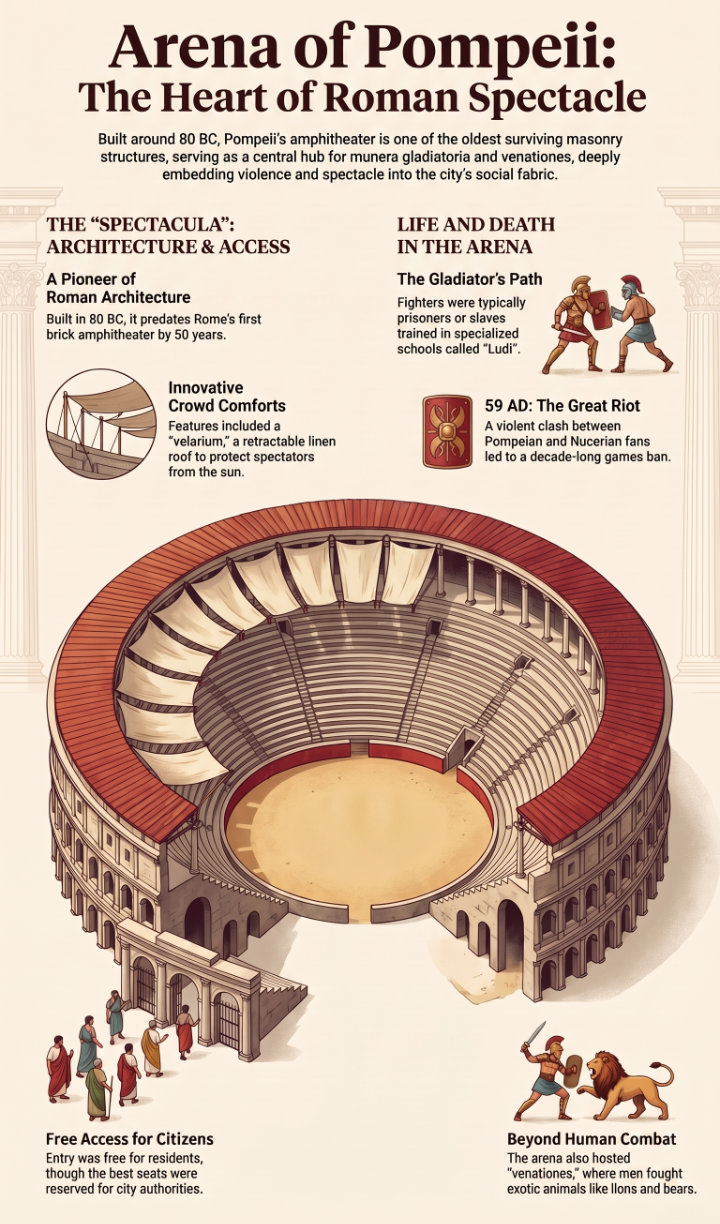
Gladiatorial games were among the most popular public spectacles in ancient Pompeii. Far from being occasional entertainments, they formed part of the social, political and cultural life of the city. The amphitheatre, inscriptions advertising forthcoming spectacles, graffiti left by spectators and gladiators, paintings and archaeological discoveries provide an unusually detailed picture of the world of the arena in the decades before the eruption of AD 79.
Pompeii's Amphitheatre was built around 70 BC, shortly after the establishment of the Roman colony, on the initiative of the magistrates Caius Quinctius Valgus and Marcus Porcius. It is the oldest surviving permanent amphitheatre known in the Roman world. Located near the south-eastern edge of the city, it could accommodate a very large audience, including visitors from neighbouring communities. The official guide of the Archaeological Park estimates its capacity at around 20,000 spectators.
Gladiatorial combats were generally known as munera. Their organisation was closely connected with public generosity, political ambition and the prestige of wealthy citizens. Sponsoring games allowed members of the local elite to display wealth and generosity before a large audience and could reinforce their reputation within the community.
Pompeii preserves exceptional evidence for this system. Painted notices on walls announced forthcoming spectacles and recorded the people responsible for organising them. The epigraphic material collected from the city shows that advertisements could provide information about the event, its sponsor and the gladiatorial programme. The extensive corpus of Pompeian announcements remains one of the principal sources for the study of gladiatorial spectacles in the Roman world.
A monumental funerary inscription discovered near Porta Stabia provides further evidence for the political importance of public entertainment. The inscription commemorates an influential Pompeian whose acts of generosity included public banquets, distributions of money and the organisation of major spectacles involving gladiators and wild animals. The man's identity is not preserved in the surviving inscription, although an association with Gnaeus Alleius Nigidius Maius, one of Pompeii's most famous sponsors of gladiatorial spectacles, has been proposed.
The gladiators themselves did not form a single social category. Many were enslaved men, prisoners or condemned individuals, but the Roman gladiatorial world also included free men who voluntarily entered the profession. It is therefore misleading to describe all gladiators simply as slaves or criminals.
Gladiators were trained to fight according to specialised categories distinguished by their weapons, shields and protective equipment. Archaeological evidence from Pompeii provides particularly vivid examples. A fresco discovered in Regio V in 2019 depicts a combat between a murmillo and a Thracian, two traditional gladiatorial types.
The murmillo is represented with a large rectangular scutum, a short sword and a substantial helmet, while the Thracian carries the smaller shield characteristic of his category. The scene is unusually dramatic: the defeated fighter is wounded and blood is visible on his body, while his gesture appears to ask for mercy.
The painting is important because it also reminds us that defeat did not necessarily mean immediate death. A defeated gladiator might request missio, or release from the fight. The decision could depend on the circumstances of the combat and those responsible for the spectacle, with the reactions of the audience also playing a role.
The familiar modern image according to which a simple “thumbs up” or “thumbs down” gesture automatically determined whether a gladiator lived or died is therefore an oversimplification. Ancient literary and visual evidence does not support such a clear modern code, and the Pompeian fresco itself shows a more complex gesture associated with an appeal for mercy.
The popularity of gladiators extended well beyond the amphitheatre. Their names and images appear in graffiti and paintings throughout Pompeii. Some gladiators became recognisable public figures and could attract devoted followers. The walls of the city preserve traces of this popular enthusiasm in the form of names, records and informal drawings connected with the arena.
One area particularly associated with this world is the Quadriporticus behind the Large Theatre. Originally used in connection with the theatre complex, it was adapted after the earthquake of AD 62 to accommodate gladiators. The surrounding area has produced an exceptionally high concentration of graffiti connected with gladiatorial life.
Gladiatorial imagery was not confined to professional or adult contexts. One of the most remarkable discoveries of recent years comes from the House of the Second Colonnaded Cenaculum (IX 12,4) in the Insula of the Chaste Lovers.
Excavations documented charcoal drawings made by young children on the walls of a service courtyard that was still being worked on when Vesuvius erupted. The drawings include gladiators, hunters, animals and fighting figures. Specialists studying the drawings have proposed that at least some of their creators were very young children.
The study published in the E-Journal degli Scavi di Pompei in 2024 is particularly important because it provides direct evidence for the way the culture of public spectacles entered children's imagination. Rather than learning about gladiators only through formal images or stories, Pompeian children lived in a city where arena spectacles formed part of the surrounding visual and social environment.
The E-Journal study also draws attention to the wider context of Roman arena entertainment. The programme of a day at the amphitheatre could include different forms of spectacle, such as animal hunts, gladiatorial contests and, in certain circumstances, public executions. The precise programme varied, and the evidence for individual Pompeian events must be reconstructed from inscriptions, archaeological material and comparisons with other Roman cities.
The popularity of these spectacles sometimes had serious consequences. The most famous incident occurred in AD 59, when a gladiatorial event in the Pompeian amphitheatre led to a violent confrontation between spectators from Pompeii and Nuceria.
The historian Tacitus describes how verbal insults escalated into stone throwing and then armed violence. Many Nucerians were killed or wounded. The affair became serious enough to reach Emperor Nero and the Roman Senate.
Following the investigation, the Pompeians were prohibited from holding similar gladiatorial gatherings for ten years, unlawful associations were dissolved and Livineius Regulus, the former senator who had organised the games, was exiled together with others considered responsible.
The funerary inscription found near Porta Stabia has added new information to Tacitus' account. According to its interpretation, even Pompeii's two highest-ranking local magistrates may have been forced into exile following the riot. The archaeological discovery therefore demonstrates how new evidence from Pompeii can modify or expand information preserved by ancient literary authors.
Despite the prohibition imposed after the riot, gladiatorial activity eventually returned to Pompeii. Evidence from inscriptions, paintings and the buildings themselves shows that the world of the arena remained present during the final decades of the city's existence.
The amphitheatre itself also illustrates the social organisation of spectators. Different areas of seating reflected distinctions of rank and status, while the building's location on the edge of the city helped manage the movement of the enormous crowds that could gather for major spectacles.
Arena entertainment could also include venationes, displays or hunts involving wild animals. The Porta Stabia funerary inscription explicitly refers to spectacles combining gladiatorial combats with wild beasts, demonstrating how ambitious such events could become when sponsored by wealthy members of the Pompeian elite.
Gladiatorial games should therefore not be understood simply as isolated acts of violence. They were embedded in a complex social system involving political competition, civic generosity,