



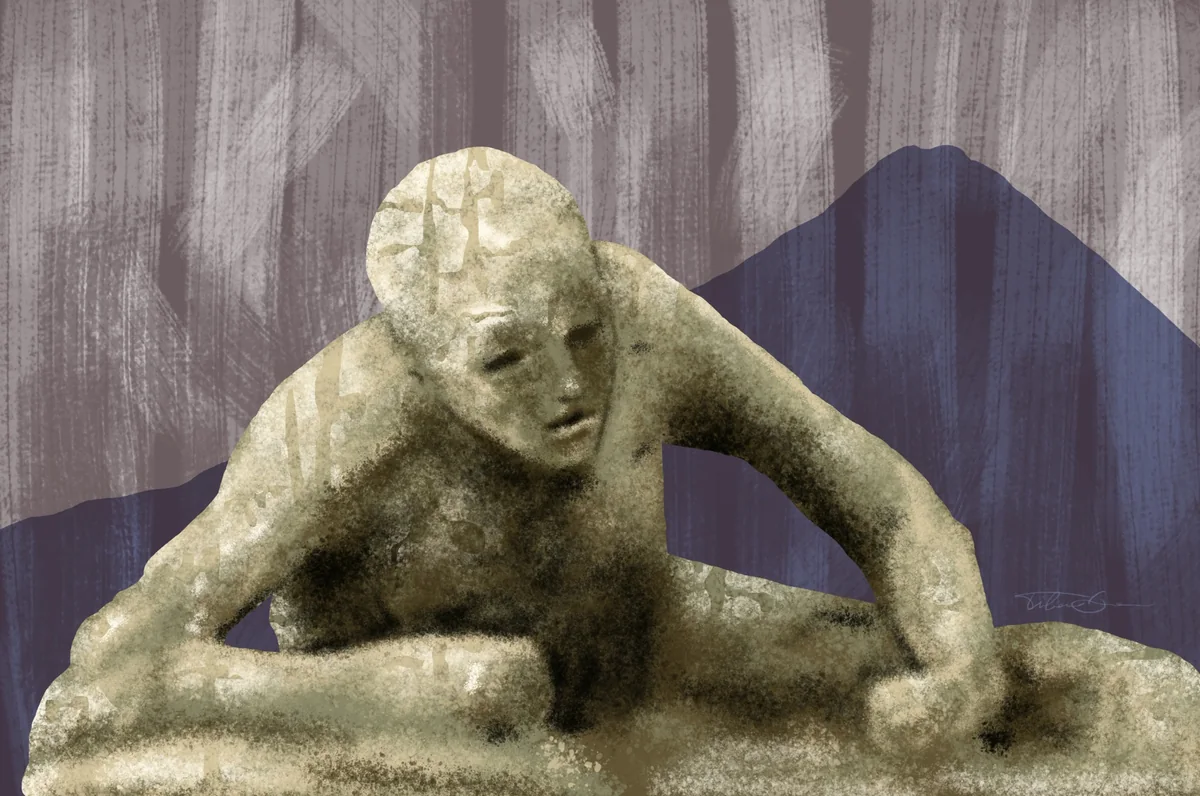
The Great Palaestra of Pompeii now hosts a permanent exhibition dedicated to the victims of the AD 79 eruption and to the extraordinary organic remains preserved by the volcanic disaster.
The exhibition brings together archaeology, scientific research and human history. Its purpose is not simply to display the famous casts, but to explain how they were formed, what they can reveal about the people who died at Pompeii and how modern scientific techniques are changing interpretations that were sometimes accepted for decades.
The Great Palaestra stands beside the Pompeii Amphitheatre. Built in the Augustan period, it originally provided a large open space for the physical and cultural training of young Pompeians. Today part of the complex is used for the permanent exhibition of casts and organic remains.
The eruption of Mount Vesuvius in AD 79 destroyed Pompeii but also created exceptional conditions for preservation. During the first major phase, pumice and other volcanic material accumulated over the city. Later, pyroclastic currents composed of hot gas, ash and volcanic particles swept through Pompeii.
For a broader account of the destruction of the city, see History of Pompeii.
The casts are often mistakenly described as petrified bodies. In reality, they were created from voids left in the compacted volcanic deposits after the victims' soft tissues decomposed.
In 1863, Giuseppe Fiorelli developed the method that made it possible to recover the shape of these cavities. Liquid plaster was poured into the void; once it had hardened and the surrounding volcanic material was carefully removed, the external form of the victim became visible.
The technique could preserve remarkable details such as body position, folds of clothing, footwear and objects carried by the victim. In many casts, original skeletal remains are still embedded inside the plaster.
For a detailed history of Fiorelli's technique and the latest research, see The Casts of Pompeii.
The importance of the casts is therefore both archaeological and human. They are not simply reproductions made for display: many contain the actual remains of people who died during the eruption.
This is why their conservation and exhibition today require particular care and sensitivity.
Modern scientific techniques are revealing information that could not have been obtained when the casts were first made. Radiography, CT scanning, 3D documentation, anthropological examination, isotope analysis and ancient DNA can all contribute to the study of the individuals preserved inside them.
One of the most important recent developments concerns the victims from the House of the Golden Bracelet.
Four individuals discovered close together in the house had traditionally been interpreted as a family group. One adult wearing a heavy gold bracelet and holding a child was commonly described as the child's mother.
Ancient-DNA research published in 2024, however, demonstrated that this interpretation was incorrect. The adult wearing the bracelet was genetically male and was not biologically related to the child. More broadly, the four individuals traditionally described as parents and their children were not genetically related to one another.
The discovery is important not only because it corrects an old identification. It also demonstrates the danger of reconstructing personal identities and family relationships solely from jewellery, physical proximity or assumptions about gender.
The researchers therefore recommend combining genetic evidence with archaeology, anthropology and historical information rather than replacing one simplified story with another.
The exhibition also places the human casts within the wider context of the eruption.
Pompeii has preserved not only human remains but also animals, plants, food, wooden objects and other organic materials that would normally have disappeared.
In some cases the same casting technique used for human victims was applied to cavities left by decomposed organic objects. Casts and impressions have helped archaeologists reconstruct doors, furniture, roots and other elements of everyday life.
Plant and animal remains provide a different kind of evidence. Seeds, fruit, cereals, legumes and other botanical remains contribute to our understanding of Pompeian agriculture and food production, while animal bones and other remains reveal information about livestock, diet and the use of animals in transport and work.
For more information on these aspects of everyday life, see Pompeian Agriculture and Food Preserves in Pompeii.
The exhibition therefore does not present the eruption only as a moment of destruction. It also uses the exceptional preservation produced by the catastrophe to reconstruct aspects of diet, work, domestic life, mobility and personal identity.
This approach is particularly important because the victims of Pompeii should not be reduced to dramatic images of death.
Scientific research increasingly focuses on who these people were before the eruption: their health, diet, ancestry, movements and the social environments in which they lived.
Ancient DNA has already shown how misleading traditional interpretations can be. The inhabitants of Roman Pompeii belonged to a highly mobile Mediterranean society, and genetic evidence from the studied individuals reflects substantial ancestry connected with the eastern Mediterranean.
These results fit a broader picture of the Roman Empire in which people, goods and cultural traditions moved over long distances.
At the same time, the casts must be treated with respect. Many contain human skeletal remains and therefore occupy a position somewhere between archaeological artefacts, scientific evidence and the remains of deceased individuals.
The permanent exhibition encourages visitors to look beyond the dramatic poses and consider the people themselves.
The title “The Imprint of Pain” captures this dual character. The casts preserve the physical consequences of catastrophe, but they also provide information about lives that existed before the eruption.
The exhibition in the Great Palaestra is therefore an important complement to a visit to the archaeological city. Streets, houses and public buildings reveal the urban environment of Pompeii, while the casts and organic remains restore a more immediate human dimension to that landscape.
Nearly two thousand years after the eruption, research continues to change what we know about the victims.
New technologies allow archaeologists to investigate the plaster without unnecessarily damaging it, examine skeletal material hidden inside the casts and test old assumptions against new scientific evidence.
The permanent exhibition demonstrates that Pompeii is not simply a site discovered in the eighteenth and nineteenth centuries whose story is already known. It remains an active archaeological research centre where new methods continue to transform our understanding of the ancient city and its inhabitants.
Visitors can also consult the Pompeii Map when planning a route through the archaeological site.
Essential sources
Archaeological Park of Pompeii, permanent exhibition of casts and organic remains in the Great Palaestra.
Pilli E. et al., 2024, Ancient DNA challenges prevailing interpretations of the Pompeii plaster casts, Current Biology 34.
Osanna M., Capurso A., Masseroli S.M. (eds.), 2021, I calchi di Pompei da Giuseppe Fiorelli ad oggi, Rome.