



Childhood in ancient Pompeii was shaped by family, social status, education, religion and the everyday life of the city. Children lived alongside adults in houses, workshops, streets and public spaces, and the archaeological evidence preserved at Pompeii offers unusual glimpses into their experiences. Graffiti, drawings, household objects and images allow us to recover aspects of a world that ancient written sources, generally composed by adult men from privileged backgrounds, often describe only indirectly.
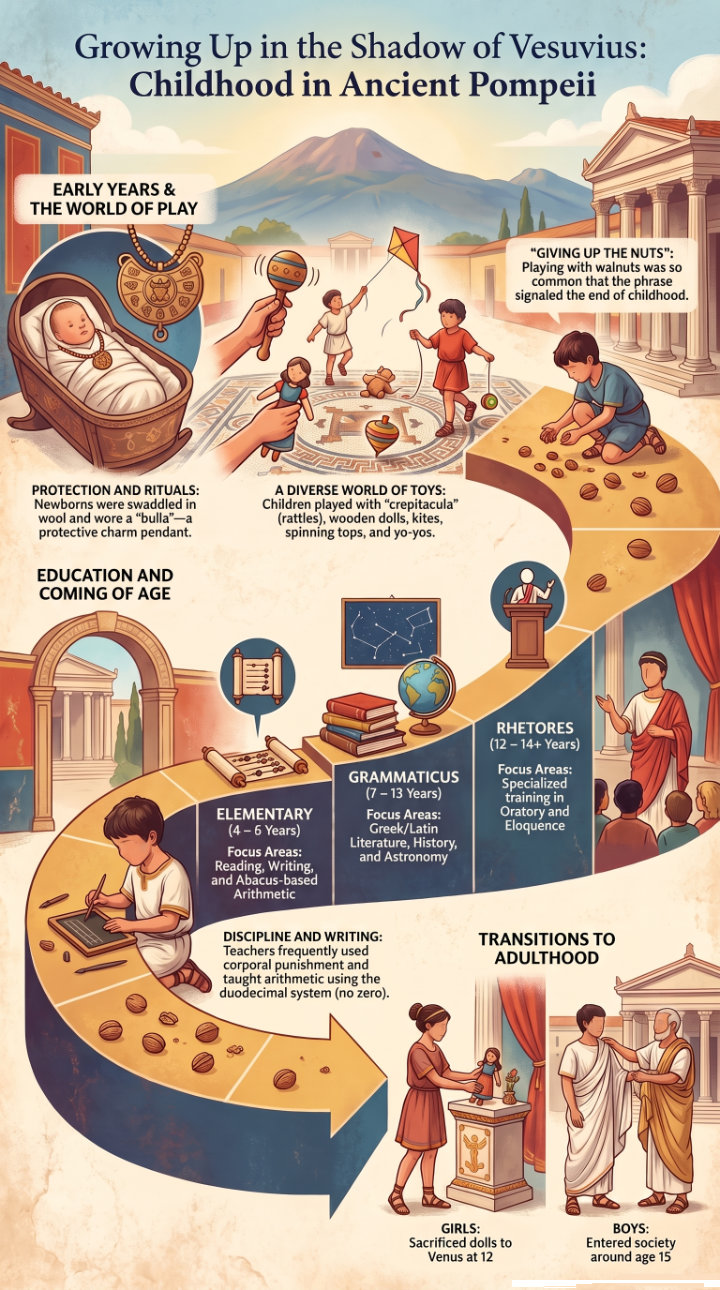
The first years of life were particularly vulnerable. Infant and child mortality was high throughout the Roman world, and families used religious rituals and protective objects in an attempt to safeguard children. Amulets were common, and freeborn Roman boys could wear the bulla, a pendant containing protective objects or substances, which also expressed their status as freeborn citizens. Boys traditionally laid it aside when they assumed the toga virilis and formally entered adult civic life.
The care of young children varied considerably according to the wealth and social position of the family. Mothers could nurse their own children, while prosperous households might employ wet nurses, nurses and other servants or enslaved people involved in childcare. Childhood therefore cannot be reconstructed as a single experience: the son or daughter of a wealthy Pompeian household lived under very different conditions from a child born into poverty or slavery.
Children learned first within the family and through observation of the adults around them. They accompanied everyday activities and became familiar with the social, religious and economic environment of the city from an early age. Play was also an important part of childhood. Across the Roman world, children played with balls, nuts, dolls, small figurines, hoops and simple wheeled toys, although the archaeological record does not always allow us to determine whether an object belonged exclusively to a child.
Education likewise depended strongly on wealth, gender and family circumstances. There was no universal system of compulsory public schooling comparable to the modern one. Some children were taught at home, especially in wealthy families, while others received lessons from private teachers. Elementary instruction concentrated on reading, writing and arithmetic, and exercises could involve copying letters, words and passages.
Pompeii preserves particularly valuable evidence for these activities. Alphabets and writing exercises scratched onto walls have been found in different parts of the city. Examples from the Grand Palaestra include sequences of Latin letters that may be connected with learning and writing practice. Similar graffiti found in domestic contexts demonstrate how writing could be practised outside a formal classroom. Archaeologists have proposed several possible locations for schools or teaching activities in Pompeii, but such identifications must be treated cautiously because Roman teaching did not require a purpose-built school building.
Children from families able to afford further education could progress beyond basic literacy. More advanced study concentrated on Greek and Latin literature, grammar and rhetoric, particularly for boys expected to participate in public and political life. Greek culture remained highly prestigious among the Roman elite. Girls could also receive an education, especially in prosperous households, although opportunities for advanced formal study were generally more restricted and varied greatly according to family circumstances.
One of the most remarkable discoveries concerning Pompeian childhood was made in the House of the Second Colonnaded Cenaculum, in the Insula of the Chaste Lovers. Archaeologists found charcoal drawings made on the walls of a service courtyard by young children shortly before the eruption of AD 79. The drawings include gladiators, fighters, hunting scenes and human figures, together with outlines of small hands. Specialists studying their graphic development have suggested that some of the children responsible were approximately five to eight years old.
These drawings are exceptionally important because they allow us to see ancient Pompeii from the perspective of children themselves rather than through adult descriptions. The subjects they chose also reveal something about the images surrounding them. Gladiatorial combat and animal hunts were part of the public entertainment culture of Roman cities, and the children's drawings suggest that such spectacles had entered their imagination at a very early age. Researchers have therefore considered whether the children may have reproduced scenes they had actually witnessed or knew through the visual culture around them.
The context of the discovery is equally revealing. The courtyard belonged to a house that was undergoing work at the time of the eruption, and researchers have suggested that the children who made the drawings may not have belonged to the privileged elite. This reminds us that many children at Pompeii grew up in environments connected with workshops, commercial activity and manual labour, rather than in the luxurious domestic world represented by the city's most famous houses.
The transition from childhood to adulthood occurred gradually and differed for boys and girls. For freeborn boys, one of the most significant stages was the assumption of the toga virilis, normally during adolescence, which marked entry into the adult civic community. Girls were legally and socially considered ready for marriage at a younger age than would be acceptable today, although the actual age of marriage varied considerably. Objects associated with childhood could also acquire ritual significance when young people left childhood behind.
Pompeii therefore provides a uniquely vivid but incomplete picture of Roman childhood. We know much more about some children than others, and archaeological evidence must be interpreted with caution. Yet the scratches of an alphabet on a wall, a protective amulet, a child's handprint or a charcoal drawing of gladiators can reveal aspects of everyday experience that monumental buildings and official inscriptions rarely preserve.
The children of Pompeii were not simply passive inhabitants of the ancient city. They played, learned, observed, imitated and drew the world around them. The traces they left behind offer one of the most immediate connections between the people who lived in Pompeii before the eruption of AD 79 and those who walk through its streets today.