



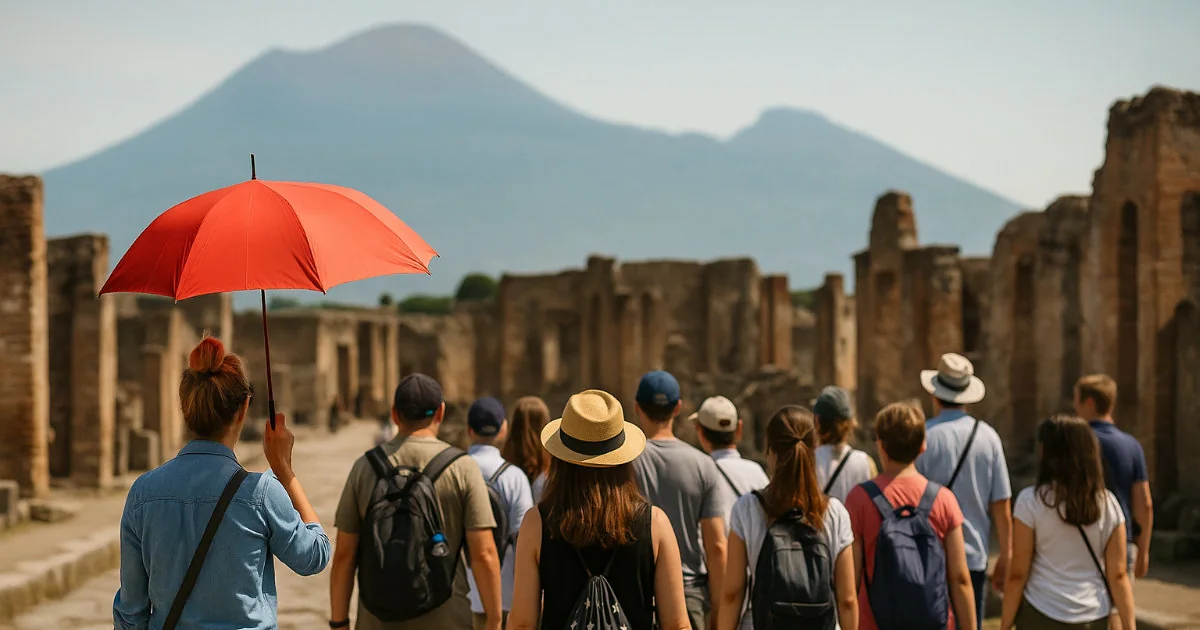
A visit to Pompeii Archaeological Park involves several hours of walking through an ancient city with original Roman streets, uneven paving, steps and changes in level. A little preparation can make the experience considerably easier and help you spend more time exploring the monuments rather than trying to find your way around the site.
If you are still organising transport, tickets and visiting times, see our Complete Guide to Visiting Pompeii.
Choose the right entrance
Pompeii has three main entrances:
Porta Marina, close to Pompei Scavi – Villa dei Misteri station;
Piazza Esedra, also convenient for visitors arriving at Pompei Scavi – Villa dei Misteri and for access to the Antiquarium;
Piazza Anfiteatro, on the eastern side of the archaeological city and convenient for visitors arriving through modern Pompeii.
Choosing the entrance according to your transport and planned itinerary can save a considerable amount of walking before and after the visit.
For train, car and bus connections, see How to Get to Pompeii.
Use a map before you start walking
Pompeii is much larger than many first-time visitors expect. Trying to navigate the site without a map can result in unnecessary detours, especially if you want to visit specific houses or monuments.
Before entering, decide which areas are most important to you and organise them into a realistic route.
You can consult our Pompeii Map, which also provides a link to the official PDF map published by the Archaeological Park.
Remember that individual houses and buildings may temporarily close because of restoration, conservation or operational requirements.
How long should you allow?
A short visit of around two to three hours is enough to see a selection of major monuments, but it does not allow a complete exploration of Pompeii.
Visitors who want to explore different districts, houses and public buildings should ideally allow most of a day.
Rather than trying to see everything, it is usually better to select a manageable route and spend enough time understanding the places you visit.
Guided tour or independent visit?
Both options can work well.
Exploring independently gives you complete freedom to choose your route and spend as much time as you want at individual monuments.
A guided tour is particularly useful for a first visit because many buildings can be difficult to understand without historical and archaeological context. A professional guide can explain how houses, temples, baths and public buildings were used and point out details that are easily missed when walking through the site alone.
The guided experience available through Pompeionline combines entrance with a two-hour live guided visit, after which visitors can continue exploring the archaeological park independently.
See the Pompeii guided tour with entrance ticket
What shoes should you wear?
Comfortable footwear is essential.
Many streets retain their original Roman paving stones, which can be uneven, polished or slippery. There are also raised pavements, stepping stones and frequent changes in level.
Wear comfortable shoes with a good grip. Sandals with poor support, high heels and other footwear unsuitable for irregular stone surfaces can make a long visit unnecessarily difficult.
The Archaeological Park itself recommends comfortable footwear because of the physical effort required to explore the site.
What to wear
Much of Pompeii is outdoors and exposed to the weather.
During hot weather, light clothing, a hat, sunglasses and sun protection are useful. In cooler or unsettled weather, bring an additional layer and protection from rain.
Shade is limited in many parts of the archaeological site, so summer visits can be demanding during the hottest hours of the day.
Check the weather forecast before travelling and consult Pompeii Opening Hours before your visit.
Water and refreshments
Bring drinking water, particularly during the warmer months.
Drinking-water fountains are available inside the archaeological park and can be used to refill a reusable bottle.
Visitor services and refreshment facilities are available in specific areas, but Pompeii is a very large site. It is therefore better not to rely on finding food or drinks immediately whenever you need them.
Bags and luggage
Large bags and suitcases are not permitted inside the archaeological area.
Under the current regulations of the Archaeological Park, bags, backpacks and luggage larger than 30 × 30 × 15 cm must not be taken into the site.
Paid luggage-storage facilities are available at Porta Marina and Piazza Anfiteatro.
Travellers arriving with luggage should therefore organise storage before beginning their visit.
Photography
Personal photography and amateur video are generally permitted, but visitors must respect the archaeological structures and current Park regulations.
Do not climb onto walls, fountains, counters or ancient structures to obtain photographs, and never cross barriers or enter closed areas.
Flash, tripods, professional filming and other equipment may be subject to additional restrictions or authorisation requirements.
Visiting with children
Pompeii can be fascinating for children, but the size of the archaeological area and the irregular paving need to be considered when planning the visit.
A shorter itinerary with regular breaks is generally more suitable for younger visitors than attempting to cover the entire ancient city.
Families with pushchairs should also remember that original paving, steps and changes in level can make some streets difficult to negotiate.
Visitors with reduced mobility
The Archaeological Park provides the Pompeii for All accessible route, with access from Piazza Anfiteatro.
The route makes a substantial part of the archaeological area easier to visit, but Pompeii remains an ancient site. Some sections contain slopes, uneven surfaces and small changes in level that may still require assistance.
Accessible buildings and routes are marked on the official map.
See the Pompeii Map and accessible route.
Respect the archaeological site
Pompeii is not a reconstruction: the walls, streets, paintings and architectural elements around you are original archaeological remains.
Do not touch decorated surfaces, climb on ancient structures, enter restricted areas or remove stones, plants or other material.
Smoking is prohibited except in designated areas.
Visitors should also follow instructions from Park staff and any temporary signs indicating closures or changes to the normal route.
Check which buildings are open
Not every house is open every day.
Individual buildings may close temporarily for conservation, restoration, maintenance or safety reasons. Some houses also operate according to specific opening schedules.
If a particular domus or monument is essential to your visit, check the latest information from the Archaeological Park before travelling.
Before your visit
For the latest practical information, also consult:
Visit Pompeii: Complete Travel Guide
A successful visit to Pompeii does not depend on seeing every building. Choosing a realistic route, wearing suitable footwear and allowing enough time to stop and understand the places you encounter usually provides a much better experience than rushing through the entire archaeological city.