



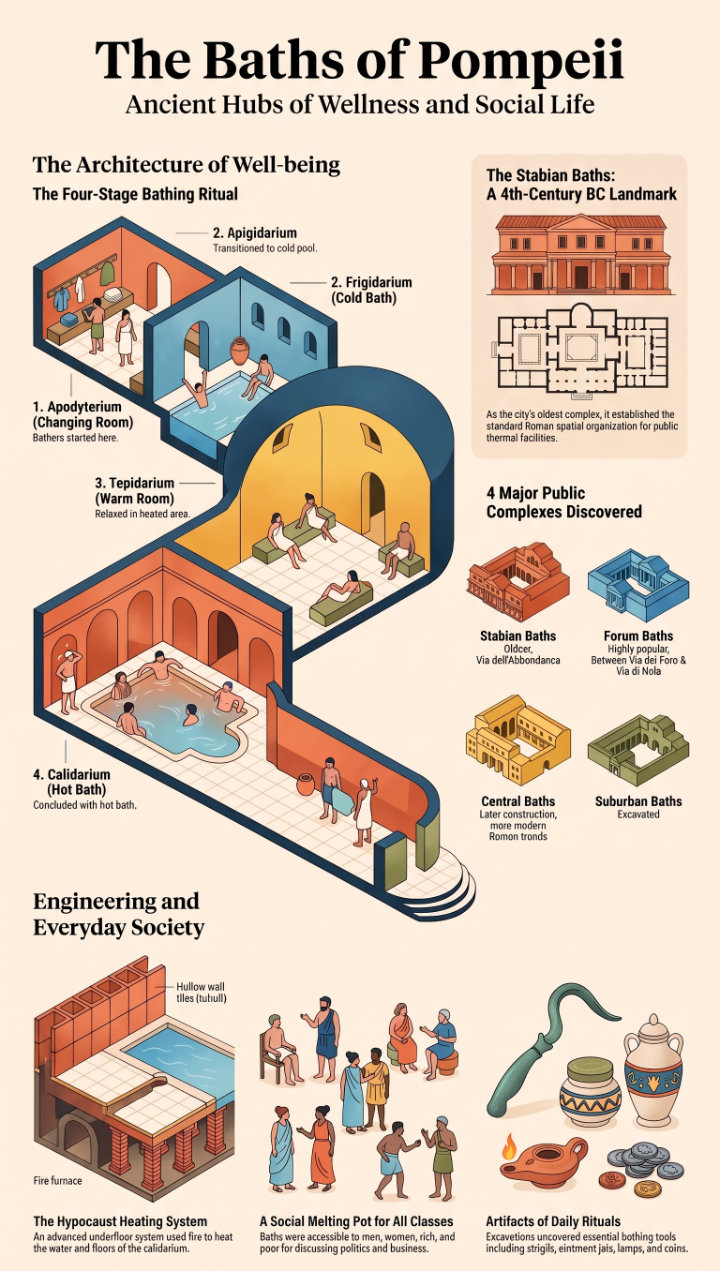
Bathing was an important part of daily life in ancient Pompeii. Public baths were not simply places where people washed: they were spaces for relaxation, exercise, conversation and social interaction. Their architecture, decoration and sophisticated heating systems reveal how much importance Roman society attached to personal care and communal life.
Pompeii preserves several bath complexes belonging to different periods of the city's history. The Stabian Baths and Forum Baths were public establishments, while the Central Baths were an ambitious new public complex still under construction when Mount Vesuvius erupted in AD 79. The Suburban Baths, located outside the city walls near Porta Marina, had a different character and are identified by the Archaeological Park as a private establishment.
The city also contained smaller private bathing facilities within wealthy residences and commercial properties, showing that bathing could take place in both public and private settings.
How Roman baths worked
Roman bathing usually involved moving through a sequence of rooms maintained at different temperatures.
The apodyterium served as a changing room, where visitors removed their clothes before entering the bathing areas. From there, they could pass through the tepidarium, a moderately heated room that prepared the body for higher temperatures, and then into the calidarium, the hot room used for hot bathing.
Many bath complexes also included a frigidarium, where visitors could cool down in cold water after the heated rooms. Some establishments contained a laconicum, a hot, dry sweating room comparable in function to a sauna.
The precise sequence was not necessarily identical in every bath complex and changed over time as bathing customs and technology developed.
Larger establishments could also contain a palaestra, an open or porticoed area used for physical exercise, together with swimming pools, fountains, gardens and other spaces devoted to relaxation.
Heating the baths
One of the most impressive features of Roman baths was their heating system.
Hot air generated by a furnace circulated beneath raised floors through a system known as the hypocaust. Small pillars supported the floor, creating a cavity through which heated air could move.
In the heated rooms, hot air could also circulate through cavities or hollow elements in the walls, helping maintain a high and relatively even temperature.
Water for the baths was heated separately and supplied to pools and basins. Pompeii's water supply system developed considerably over the centuries. In the earlier phases, wells, cisterns and collected rainwater played an important role, while the connection to the aqueduct system later allowed larger quantities of water to be distributed throughout the city.
The remains of furnaces, raised floors, wall-heating systems, pipes and pools make Pompeii one of the most important archaeological sites for understanding the technology behind Roman bathing.
The Stabian Baths
The Stabian Baths, located near the intersection of Via Stabiana and Via dell'Abbondanza, are among the most important bath complexes in Pompeii.
Modern archaeological investigations have shown that the baths were constructed during the 2nd century BC and underwent several major phases of transformation. The general plan established during the earliest phase remained the basis of the complex even as new rooms and technologies were introduced.
Over time, the baths were equipped with additional facilities, including heated rooms, cold bathing areas, an improved water-supply system, a palaestra, a swimming pool and ornamental fountains.
The complex ultimately contained separate bathing areas for men and women. The men's section was larger and more richly equipped, while the women's section followed a simpler arrangement.
Recent excavations have provided new information about the development of the baths. Archaeologists discovered the remains of circular rooms interpreted as laconica, or sweat baths, showing how bathing practices changed as new technologies and customs were introduced.
The Stabian Baths are therefore particularly important because they do not represent a single moment in the city's history. Their architecture records several centuries of modification and provides exceptional evidence for the development of Roman bathing culture.
Read more about the Stabian Baths and Republican Baths research project of the Archaeological Park of Pompeii.
The Forum Baths
The Forum Baths were located close to the civic centre of Pompeii, behind the Temple of Jupiter and near the Forum.
They were built during the period following the establishment of the Roman colony in the 1st century BC and were divided into separate men's and women's sections.
The male section is particularly well preserved. Its rooms include a changing area, cold, warm and hot bathing spaces and sophisticated decorative elements.
One of the most striking rooms is the tepidarium, where niches are framed by terracotta figures acting as architectural supports. A large bronze brazier provided additional heat, while the vault was decorated with elaborate stucco work.
The calidarium preserves important evidence of the hot-bathing system, including a large basin for hot water and a marble basin used for cooling.
Like many buildings in Pompeii, the Forum Baths were damaged by the earthquake of AD 62 and subsequently underwent restoration. At the time of the eruption seventeen years later, work was still being carried out in parts of the complex.
Their location near the Forum shows how closely bathing was connected with everyday urban life. A person conducting business or participating in civic activities in the centre of Pompeii could reach the baths within a few minutes.
The Central Baths
The Central Baths, located in Regio IX at the intersection of Via di Nola and Via Stabiana, represent a very different stage in the history of bathing at Pompeii.
They were being constructed when Vesuvius erupted in AD 79 and were never completed.
The complex occupied an entire city block and was the largest and most ambitious bath project planned for Pompeii. Its design incorporated architectural innovations found in the great imperial bath complexes being developed in Rome.
The rooms were arranged in sequence through an apodyterium, frigidarium, tepidarium, laconicum and calidarium. Large windows were designed to provide more light and ventilation than in Pompeii's older baths.
Unlike the Stabian and Forum Baths, the Central Baths were not divided into separate male and female sections. The Archaeological Park suggests that men and women would probably have used the same facilities at different times.
The unfinished state of the building is one of its most interesting features. Basins had not yet received their marble coverings, while capitals, columns and other architectural elements were still lying in the rooms awaiting installation when the eruption occurred.
The Central Baths therefore preserve something unusual at Pompeii: not simply a Roman building, but an ancient construction site suddenly abandoned in AD 79.
The Suburban Baths
Immediately outside Porta Marina, partly built against the ancient fortifications, are the Suburban Baths.
Unlike the Stabian and Forum Baths, the Archaeological Park identifies this complex as private. It was built when the city walls had already lost their original defensive importance.
The Suburban Baths are particularly famous for their rich decoration. The changing room contains a series of small erotic paintings, while other rooms were decorated with scenes of marine life and naval battles.
The cold bathing area included an artificial grotto from which water flowed into a pool, accompanied by an elaborate mosaic decoration.
The heated section contained the normal progression from moderately warm to hotter rooms and also included a large heated pool.
The Suburban Baths demonstrate how sophisticated bathing facilities could also form part of privately operated establishments rather than the city's public infrastructure.
Private baths in Pompeian houses
Wealthier inhabitants could install bathing facilities within their own properties, although doing so required considerable space, water and heating infrastructure.
One particularly interesting example is the Praedia of Julia Felix, a large property on Via dell'Abbondanza. Its bath complex was transformed from a private facility into an establishment available to paying customers.
The property shows how the boundary between private residence and commercial activity could be flexible in Pompeii. Bathing facilities could therefore provide not only comfort and prestige but also a source of income.
Bathing as a social activity
The baths were among the most important places for social interaction in a Roman city.
Visitors could exercise, wash, relax and meet acquaintances within the same complex. Bathing provided opportunities for conversation and the exchange of news as well as for personal care.
Men and women could both use bathing establishments, although older complexes such as the Stabian and Forum Baths generally provided separate areas. The Central Baths reveal a later architectural solution in which separate sections were eliminated and access may instead have been organised at different times.
The surviving architecture therefore provides evidence not only of Roman engineering but also of changing social customs.
The earthquake of AD 62 and the baths
The powerful earthquake of AD 62 damaged many buildings throughout Pompeii and initiated a long period of reconstruction.
Bath complexes were also affected. At the time of the eruption in AD 79, repairs and building work were still taking place in different parts of the city.
The Central Baths were still under construction, while other establishments had undergone repairs or alterations. The state of the baths therefore reflects the wider condition of Pompeii during its final years: a city recovering from repeated seismic damage while simultaneously modernising its buildings and public facilities.
Visiting the baths of Pompeii
The Forum Baths and Stabian Baths are among the most interesting places for understanding everyday life in Pompeii, while the Central Baths offer a remarkable opportunity to see a large Roman bath complex that was still being built when the city was destroyed.
Opening conditions for individual buildings can change because of conservation work, maintenance or visitor management. Before your visit, check the current list of open buildings published by the Archaeological Park of Pompeii.
You can also use the Pompeii map to plan your route through the archaeological site.
Together, Pompeii's baths illustrate the evolution of Roman architecture, hydraulic engineering, heating technology and social life over several centuries. Far from being simply places to wash, they were an essential part of the life of the ancient city.