



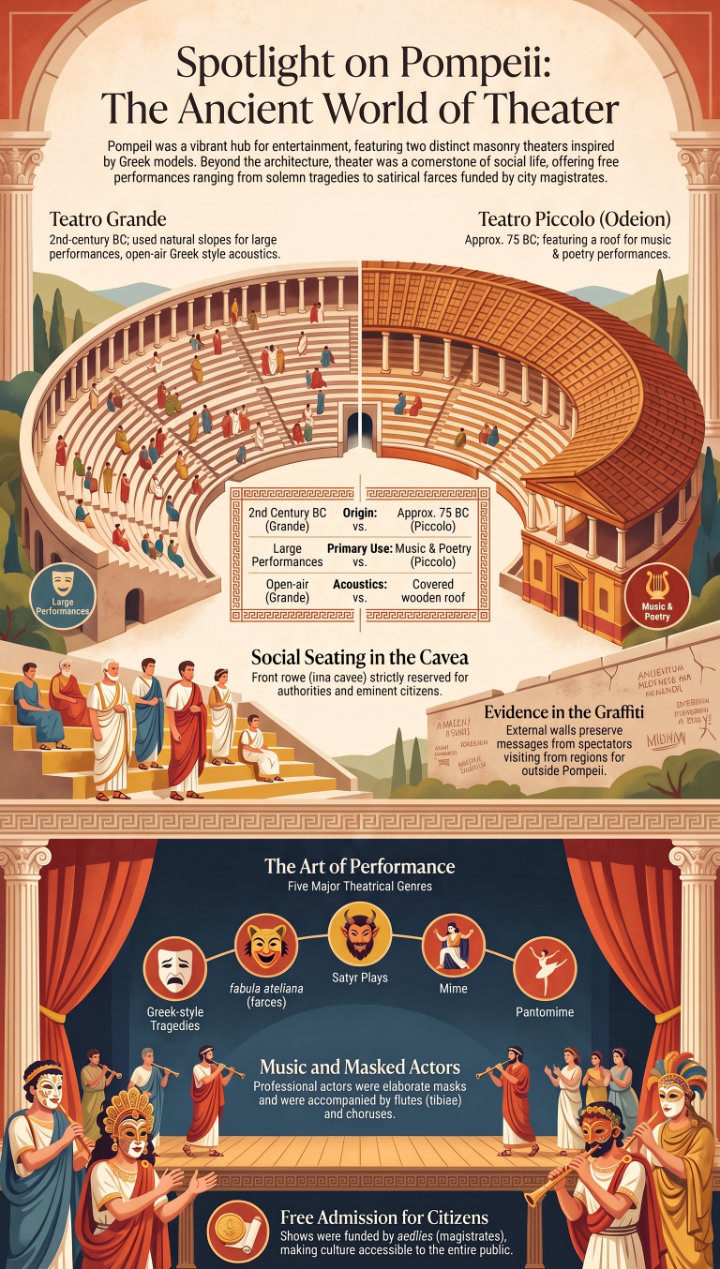
Theater occupied an important place in the public life of ancient Pompeii. Performances combined entertainment, music, literature and civic display, while the buildings themselves formed one of the most important monumental areas of the city. Pompeii preserves two principal theatrical buildings, the Large Theatre and the Small Theatre, or Odeion, situated close to the Triangular Forum, the Temple of Isis and the Samnite Palaestra.
The Large Theatre was built around the middle of the 2nd century BC, taking advantage of the natural slope of the hill to support the cavea, or seating area. Its architecture reflects the strong influence of Greek theatrical traditions on pre-Roman Pompeii, although the building was substantially transformed after the city became a Roman colony.
During the Augustan period the theatre underwent important renovations. An inscription records work associated with the architect Marcus Artorius Primus, including modifications to the stage building and other parts of the complex. The seating was organised into sectors that reflected the hierarchical structure of Roman society, with the position of spectators linked to civic rank and social status.
The Large Theatre was used for performances belonging to the Greek and Roman dramatic traditions, including comedy and tragedy. The stage provided a monumental setting for actors and musicians, while the semicircular cavea accommodated the audience. During the Roman period a velarium, or large fabric awning, could provide protection from the sun.
Behind the stage stood the Quadriporticus of the Theatres, surrounded by Doric columns of grey Nocera tuff. Before the earthquake of AD 62 this large space could serve as a foyer where spectators walked and gathered around performances. After the earthquake part of the complex was adapted for use by gladiators.
The Small Theatre, generally known as the Odeion, was built during the first years of the Roman colony, around 80 BC. An inscription associates its construction with the magistrates Marcus Porcius and Caius Quinctius Valgus, who were also involved in the construction of Pompeii's amphitheatre.
The Romans referred to this building as a theatrum tectum, or covered theatre. Its permanent roof improved the acoustic environment and made it particularly suitable for performances in which sound, voice and music played a major role.
The official archaeological guide associates the Odeion especially with mime, as well as musical and singing performances. Its interior was richly decorated with coloured marbles and sculptural elements, including large male figures in tuff generally known as telamons.
Graffiti preserved in and around the theatre district provide an exceptional source for understanding the people who used these buildings. Names, drawings and texts scratched onto plaster show that ancient theatres were not silent monuments but heavily frequented social spaces.
Recent research has considerably expanded this evidence. The multidisciplinary “Bruits de couloir” project, based on campaigns carried out in 2022 and 2025, has added 79 previously unpublished graffiti to a corpus of around 200 already known inscriptions from the theatre corridor.
The project combines epigraphy, archaeology, philology, photogrammetry and Reflectance Transformation Imaging (RTI) to study the position and relationships of individual inscriptions. Rather than treating graffiti simply as isolated texts, researchers are reconstructing spatial and thematic clusters and interactions between different writers.
This work is revealing the corridor as a true social environment, where inscriptions and drawings accumulated over time and where people responded to existing texts or images. Among the newly documented examples are a fragmentary declaration of love and a representation connected with gladiatorial combat.
The seating arrangements in Pompeian theatres also reflected the strongly hierarchical organisation of Roman society. Spectators did not necessarily sit wherever they wished. The physical division of the cavea made differences of status visible within the audience itself.
Several forms of dramatic entertainment were known in the Roman world. Comedy and tragedy developed from Greek traditions and remained important components of Roman theatrical culture. Roman playwrights adapted Greek models to Latin language and audiences, although the precise repertoire performed at Pompeii cannot always be reconstructed.
A form particularly associated with Campania was the Atellan farce, or fabula Atellana, traditionally connected with the Oscan-speaking town of Atella. It was characterised by comic situations and recurring character types and formed part of the wider development of popular performance in Italy.
Mime became especially popular during the Roman period and could combine spoken dialogue, comic action, music, dance and scenes based on everyday situations. Unlike some other forms of ancient drama, women could participate as performers in mime.
Music was an important component of theatrical performance. Instruments such as the tibiae, together with singing and rhythmic accompaniment, could support both drama and independent musical performances. The covered architecture of the Odeion demonstrates the importance attached to acoustics.
Masks were closely associated with the traditions of Greek and Roman comedy and tragedy. Costume, gesture, movement, music and the highly stylised presentation of characters created a theatrical experience very different from the naturalistic acting expected in many modern theatrical traditions.
Actors could acquire considerable fame, although their legal and social position within Roman society was complex. Professional performers could travel between cities rather than being permanently attached to a single theatre.
Public spectacles were closely connected with politics, civic generosity and prestige. Magistrates and wealthy citizens could finance buildings, festivals and entertainments as part of their public role and as a means of reinforcing their position within the community.
The theatre district was therefore much more than a collection of entertainment buildings. The Large Theatre, Odeion, Quadriporticus and surrounding religious and public spaces formed one of the principal centres of Pompeian urban life, where performance, politics, sociability and religion intersected.
The recent study of its graffiti adds another dimension to this picture. Alongside monumental architecture and official inscriptions, hundreds of informal texts and drawings preserve traces of individual spectators and visitors. Together they allow us to reconstruct not only what Pompeians watched in their theatres but also how people moved through, occupied and interacted within these public spaces before the eruption of AD 79.
Sources and Essential Bibliography
Autin L., Le Guennec M.-A., Letellier-Taillefer É., 2026, “Bruits de couloir”: Shedding New Light on Ancient Graffiti, E-Journal degli Scavi di Pompei, 2026.01.
M. Bieber, The History of Greek and Roman Theater, 1961.
A. Maiuri, Saggi nella cavea del teatro grande, in Notizie degli Scavi di Antichità, 1951, pp. 126 ss.
A. Neppi Modona, Gli edifici teatrali greci e romani. Teatri, odei, anfiteatri, circhi, 1961.
Parco Archeologico di Pompei, A Guide to the Pompeii Excavations.