




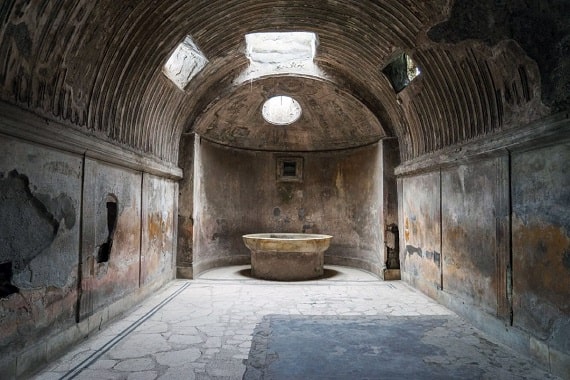
Public baths were an essential part of everyday life in ancient Pompeii. They were not simply places for washing, but important social spaces where people could meet, exercise, relax and conduct business. Pompeii preserves several bath complexes that illustrate the development of Roman bathing culture over several centuries, from the Stabian Baths and Forum Baths to the unfinished Central Baths and the luxurious Suburban Baths.
A typical Roman bath complex included a sequence of rooms maintained at different temperatures. Visitors could pass through the apodyterium, or changing room, before entering the frigidarium for cold bathing, the tepidarium for a warmer environment and the caldarium for hot baths. Furnaces heated air that circulated beneath raised floors and, in more developed installations, through cavities within the walls. This system, usually described as the hypocaust, allowed rooms and pools to be heated efficiently. Bath establishments could also contain palaestrae for exercise, swimming pools, gardens, fountains and service areas.
The Stabian Baths, at the intersection of Via Stabiana and Via dell'Abbondanza, are among the most important complexes for understanding the history of ancient bathing. They developed through several construction phases and, in their final form, occupied an area of approximately 3,300 square metres, making them the largest public bath building still operating in Pompeii after the earthquake of AD 62.
The complex had separate facilities for men and women. The men's section included a large palaestra, a swimming pool or natatio, an apodyterium, frigidarium, tepidarium and caldarium. The women's section was smaller and contained its own apodyterium, tepidarium and caldarium.
Recent archaeological research has significantly changed our understanding of the Stabian Baths. Excavations carried out in 2021 and 2023 revealed two previously unknown circular rooms beneath the courtyard. These have been identified as laconica, or sweat baths comparable to saunas. Both structures had to be reburied after excavation and are therefore not visible to visitors today.
Their discovery is particularly important because it provides new evidence for the development of sweat bathing within the complex. It also shows that apparently well-known monuments such as the Stabian Baths can still produce significant archaeological discoveries more than a century and a half after their first excavation.
The Forum Baths stand immediately north of the Forum, behind the Temple of Jupiter. They were constructed soon after Pompeii became a Roman colony in 80 BC and contained separate sections for men and women.
The better-preserved men's section includes an apodyterium, which also functioned as a tepidarium, together with a frigidarium and caldarium. The interiors were richly decorated. Niches for clothing were framed by terracotta telamons, and the vaulted surfaces carried elaborate stucco decoration. A large bronze brazier contributed to the heating of the room.
The Forum Baths were damaged by the earthquake of AD 62 and subsequently repaired. Work was still taking place in parts of the complex when the eruption of AD 79 buried Pompeii. The discovery of hundreds of lamps near one of the entrances has traditionally been interpreted as evidence that bathing activity could continue after dark.
The Central Baths, occupying an entire block in Regio IX, represent a very different phase in the development of Roman bathing architecture. They were the largest and most ambitious public baths planned in Pompeii but were still unfinished in AD 79.
Their architecture reflects developments characteristic of the Imperial period. Rooms were larger and brighter than in the older establishments, with large windows and monumental spaces. Unlike the Stabian and Forum Baths, the Central Baths were not designed with two clearly separate male and female bathing sections. It has therefore been suggested that different groups may have used the establishment at different times.
Because construction was interrupted by the eruption, the Central Baths provide an exceptional opportunity to study a Roman public building still in the process of completion. Structural elements, service spaces and unfinished surfaces reveal aspects of ancient building practice that are normally concealed in completed monuments.
The Suburban Baths, immediately outside Porta Marina, offer another model. Built against a section of the city walls that had already lost its original defensive function, the establishment was privately owned and particularly luxurious.
Its rooms included heated bathing spaces, richly decorated interiors and a cold-water pool supplied by a decorative cascade. The apodyterium is famous for a series of small erotic paintings positioned above numbered compartments. Their precise interpretation remains debated, and they should not automatically be considered evidence for a single specific use of the building.
The Suburban Baths demonstrate that bathing culture was not limited to municipal public establishments. Baths could also form part of private or semi-private enterprises, villas and wealthy houses.
Recent discoveries in Regio IX, Insula 10 have dramatically reinforced this picture. Excavations published by the E-Journal in 2025 revealed a large private bath complex connected with an imposing banquet hall known as the Black Room. The arrangement suggests a close relationship between bathing, hospitality, banqueting and elite social life.
According to the archaeological study, the dimensions of the bathing facilities and the surviving benches suggest that the complex could accommodate around thirty people. This was therefore not simply a small private bathroom intended for a household's immediate needs, but a substantial installation capable of receiving a much larger social group.
The discovery provides an important reminder that the distinction between “public” and “private” in Roman society was not always equivalent to the modern one. A wealthy Pompeian house could function as a setting for political relationships, patronage, business and entertainment, and a large bath complex could form part of this carefully constructed social environment.
Baths were therefore deeply integrated into Pompeian life. They combined hygiene with exercise, relaxation, conversation, social display and hospitality. The different complexes preserved in the city also document centuries of architectural and technological development.
The Stabian Baths, with their newly discovered laconica, reveal the long evolution of an ancient public establishment; the Forum Baths illustrate Roman civic bathing after the foundation of the colony; the unfinished Central Baths show the increasing monumentality of Imperial bath architecture; the Suburban Baths represent a luxurious privately owned establishment; and the newly excavated complex in Regio IX demonstrates how bathing could become part of the social theatre of an elite residence.
Together these buildings make Pompeii one of the most important archaeological sites for understanding the history of bathing in the Roman world.
Sources and essential bibliography
Giglio M., Müller A., Robinson M., Trümper M., 2024, Public Saunas in the Stabian Baths – A privilege of men, E-Journal degli Scavi di Pompei.
Onesti A., Alesse L., Amoretti V., Esposito D., Iovino G., Marchello A., Russo A., Scarpati G., Sparice D., Spiezia P., Trapani A., Zuchtriegel G., 2025, La casa come palcoscenico. Il complesso termale e conviviale recentemente scoperto nell’insula IX-10 a Pompei, E-Journal degli Scavi di Pompei, 1.
Parco Archeologico di Pompei, A Guide to the Pompeii Excavations.
Parco Archeologico di Pompei, documentation on the Stabian Baths, Forum Baths, Central Baths and Suburban Baths.