



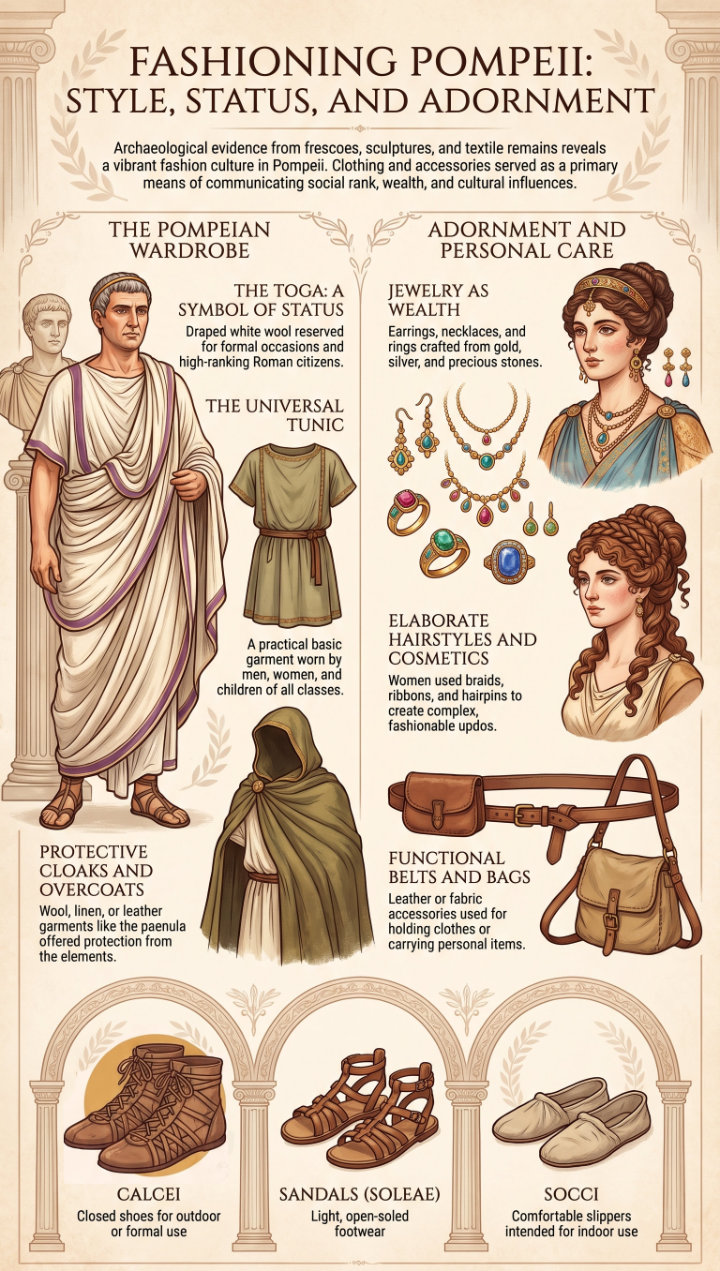
The archaeological evidence from Pompeii offers a remarkable insight into the way people dressed and presented themselves in the 1st century AD. Clothing itself rarely survives, but frescoes, statues, jewellery, personal objects and exceptional textile remains help reconstruct aspects of dress, hairstyles and personal appearance. Fashion was not simply a matter of taste: garments, ornaments and accessories could also communicate citizenship, wealth, age and social position.
The tunic was the basic garment of Roman dress and was worn by men, women and children. Its length, material and decoration varied according to the wearer and the circumstances. Wool was one of the principal textile fibres used in Roman Italy, while linen was also employed. Wealthier inhabitants could afford finer textiles and more elaborate clothing, although the archaeological evidence does not allow every garment represented in Pompeian painting to be identified with certainty.
For Roman male citizens, the toga possessed a particular civic and symbolic importance. It was a large woollen garment worn over the tunic and was especially associated with formal and public life. By the early Imperial period it was cumbersome for ordinary work and was principally connected with ceremonies, public appearances and the exercise of Roman citizenship.
Different types of toga could indicate age or public status. The toga praetexta, distinguished by its purple border, was worn by certain magistrates and priests and also by freeborn boys before adulthood. The transition to the toga virilis represented an important stage in a freeborn boy's entry into adult civic life.
The clavus, on the other hand, should not be confused with the border of the toga. It was a vertical stripe associated particularly with the tunic, and its form could indicate the status or rank of the wearer.
Women's clothing was generally based on long tunics, sometimes worn with an outer mantle or palla. Ancient literary sources also associate the stola with the respectable married Roman woman, although female dress in the early Imperial period was more varied than a rigid catalogue of garments might suggest.
Pompeian frescoes provide invaluable visual evidence for the arrangement of fabrics. Women are represented wearing garments with carefully arranged folds, mantles drawn around the body and clothing of different colours. These images are an important source for understanding ideals of appearance, although painted representations should not automatically be interpreted as exact records of everyday clothing.
Outer garments were also used for travelling and protection against the weather. The paenula, for example, was a practical cloak known throughout the Roman world. Everyday working clothes would naturally have been simpler and more functional than the garments represented in formal portraits or mythological paintings.
There is no evidence, however, for a rigid system in which every Pompeian profession had its own distinctive costume. Craftsmen, merchants, agricultural workers and domestic servants required practical clothing, but occupation cannot normally be identified from dress alone.
Footwear likewise varied according to circumstances and economic means. Roman archaeological evidence documents sandals, closed shoes and other forms of footwear made principally from leather. Quality, decoration and construction could differ considerably.
Jewellery provides much stronger archaeological evidence for personal adornment in Pompeii. Excavations have produced rings, earrings, necklaces, fibulae and bracelets, or armillae, made from materials including gold, silver and bronze. Some incorporated gems, pearls, coral, glass paste and other precious or semi-precious materials.
The Archaeological Park's exhibition Vanity: Stories of Jewels from the Cyclades to Pompeii brought together many of these objects, demonstrating both the variety of Pompeian jewellery and the importance of personal adornment as a means of displaying prosperity and social identity.
Precious ornaments could display wealth and status, but they could also have personal, symbolic or protective meanings. Jewellery was not exclusively decorative. Certain forms could function as amulets or carry religious associations, while other objects commemorated personal relationships or family identity.
Bracelets were especially common. Among the characteristic forms known from the Vesuvian area are snake-shaped armillae, whose serpentine design could combine ornament with symbolic and protective associations.
Some of the most evocative jewellery comes from victims of the eruption. People attempting to escape sometimes carried valuable objects with them, and discoveries made in association with human remains provide unusually direct evidence of possessions considered important during the emergency of AD 79.
These finds must nevertheless be interpreted carefully. Jewellery carried by a victim may reflect wealth, personal attachment or simply the practical decision to take easily portable valuables. It cannot always be used to reconstruct the person's complete social identity.
Personal appearance extended beyond clothing and jewellery. Hairstyles played an important role, particularly among women able to devote time and resources to elaborate grooming. Pompeian portraits show curls, waves, bands and carefully arranged hair reflecting fashions current during the decades before the eruption.
One of the best-known painted portraits from Pompeii depicts the couple conventionally known as Terentius Neo and his wife. The woman's carefully arranged hair, jewellery and clothing form part of a sophisticated representation of social identity, together with the writing tablet and stylus she holds.
Hairstyles changed over time and therefore provide useful chronological evidence. It is important, however, not to project fashions belonging to later Roman emperors onto Pompeii. In particular, the widespread fashion for elaborate male beards associated with some 2nd-century AD emperors belongs to a period after the destruction of the city and should not be used to describe Pompeian fashion in AD 79.
Men's hairstyles in the Julio-Claudian and Flavian periods were generally shorter than many later Imperial styles, although individual appearance naturally varied. Portraiture, sculpture and painting allow broader trends to be identified without implying that every inhabitant followed elite fashion.
Beauty and grooming formed another important aspect of personal presentation. Archaeological finds from Pompeii include mirrors, combs, hairpins, tweezers, small spatulas, containers and other toilet implements.
The systematic study of these objects has become increasingly important. Ria Berg's research on the mundus muliebris, the material world associated with female grooming and personal care in Pompeian houses, demonstrates how mirrors and toilet objects can be studied together with their archaeological contexts rather than simply as isolated luxury items.
The Archaeological Park's exhibition Venustas: Grace and Beauty at Pompeii likewise documented the wide range of objects associated with personal care: cosmetics, perfumed preparations, mirrors, jewellery, clothing ornaments, amulets and objects connected with bathing and grooming.
Perfumed oils and cosmetic preparations were therefore part of a broader culture of body care. Small containers could hold perfumes, ointments or cosmetic substances, although the original contents of individual vessels cannot always be identified unless specific analytical evidence survives.
The distinction between cosmetics, medicine and personal hygiene was also less rigid than it may appear today. Some tools and substances could serve more than one function, which is why archaeological context is essential when interpreting toilet instruments and containers.
Bathing formed part of this culture of personal care. Pompeii's public and private bath complexes provided environments for washing, exercise and social interaction, while oils and grooming instruments were also used in domestic settings.
Amulets deserve particular attention because they show that appearance and protection could overlap. An ornament worn on the body might simultaneously be decorative and intended to protect its wearer from illness, misfortune or the evil eye.
Children could also wear protective objects. Freeborn Roman boys, for example, were traditionally associated with the bulla, which had both protective and social significance and was normally set aside when the boy entered adult civic life.
Fashion and personal adornment must nevertheless be interpreted within Pompeii's broad social diversity. The city included wealthy property owners, merchants, craftsmen, freedmen, enslaved people, agricultural workers and other dependants, whose access to expensive textiles and jewellery differed enormously.
The elegant figures represented in some Pompeian frescoes therefore cannot be treated as typical of the entire population. Fine garments, valuable jewellery and elaborate grooming were particularly visible among those with the resources to display them.
At the same time, archaeological discoveries show that interest in personal appearance was not confined exclusively to the very richest households. Mirrors, ornaments, pins and simple accessories occur in a variety of domestic contexts.
Objects connected with appearance can therefore provide evidence not only for luxury but also for gender, age, social aspiration, personal identity and everyday behaviour.
Pompeii is particularly valuable because paintings, sculptures and archaeological objects can often be studied together. A hairstyle represented on a wall painting can be compared with contemporary portraiture; jewellery shown in an image can be compared with actual ornaments recovered during excavation; and toilet equipment can be examined within the rooms where it was originally used.
This combination of evidence gives us a more nuanced picture than the word “fashion” alone might suggest. Clothing and appearance were part of a wider system through which people expressed their place within Roman society.
A toga could communicate citizenship and public status; jewellery might display wealth or carry protective meaning; hairstyles could respond to contemporary trends; and grooming objects reveal the daily practices through which people cared for and presented their bodies.
Fashion in Pompeii was therefore not simply decorative. It belonged to the complex relationship between identity, status, gender, citizenship and personal expression in a Roman city immediately before the eruption of AD 79.
Sources and Essential Bibliography
Berg R., 2023, Il Mundus Muliebris a Pompei. Specchi e oggetti da toletta in contesti domestici, Studi e Ricerche del Parco Archeologico di Pompei, 48, Roma.
Osanna M., Stefani G. (eds.), 2020, Venustas. Grazia e bellezza a Pompei, exhibition catalogue, Pompeii.
Parco Archeologico di Pompei, 2019, Vanity: Stories of Jewels from the Cyclades to Pompeii, exhibition at the Great Palaestra, Pompeii.
Parco Archeologico di Pompei, 2020, Venustas: Grace and Beauty at Pompeii.
Parco Archeologico di Pompei, E-Journal degli Scavi di Pompei, consulted for recent archaeological research and bibliography relevant to personal objects and domestic contexts.