



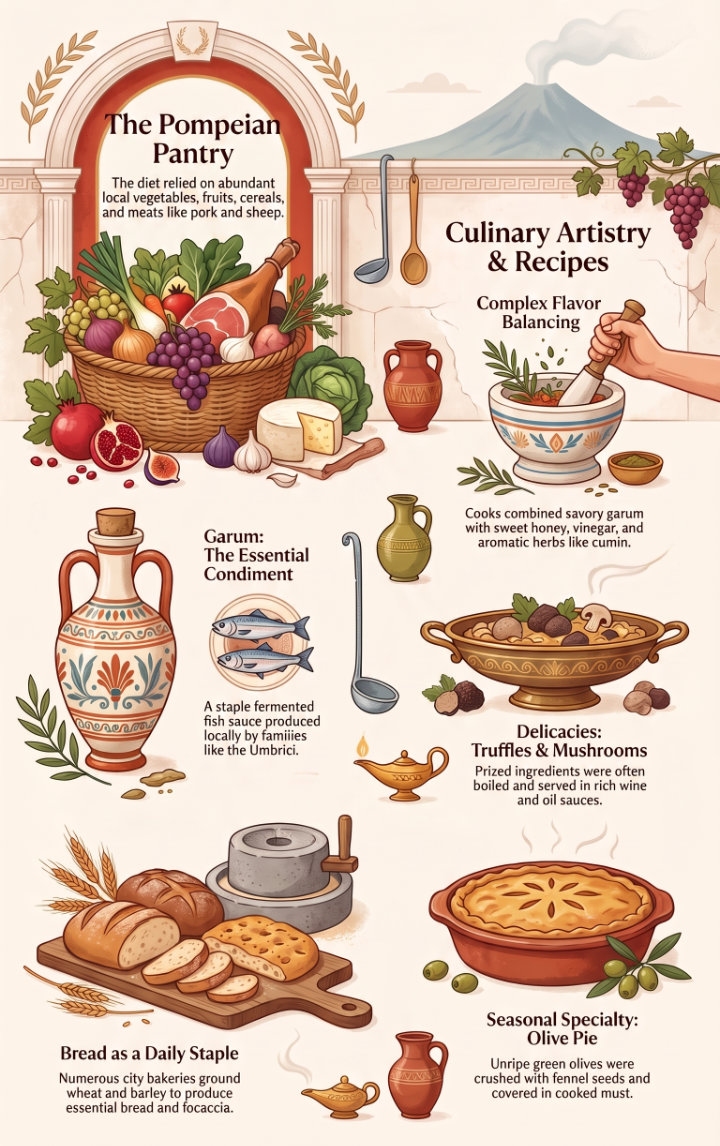
The food of ancient Pompeii can be reconstructed through an exceptional combination of archaeological remains, wall paintings, inscriptions, kitchen installations, food containers and ancient Roman texts.
The eruption of Mount Vesuvius in AD 79 preserved bread, cereals, legumes, fruit, nuts, olives, fish remains, amphorae and cooking equipment, providing unusually direct evidence of what people ate and how food was prepared, stored and sold.
Ancient authors such as Apicius, Columella, Cato and Pliny the Elder provide additional information about Roman ingredients and recipes. Their writings are extremely useful for understanding the culinary culture of the period, but they should not be treated as Pompeian cookbooks: a recipe described by Apicius cannot automatically be considered a dish actually prepared in Pompeii.
What did the people of Pompeii eat?
The diet of Pompeii was varied and depended on wealth, occupation, season, availability and access to markets.
Archaeobotanical studies have identified a wide range of plant foods, including wheat, barley, emmer, millet, legumes, figs, olives, grapes, walnuts, hazelnuts, almonds, pears and other fruits.
Recent research on food remains from Pompeii has shown a long continuity in the consumption of cereals, legumes and fruit over several centuries. Finds from latrines and refuse deposits include different kinds of wheat and barley, millet, lentils, broad beans, figs, olives, grapes and nuts.
The diet also included foods of animal origin. Meat, fish, shellfish, eggs, cheese and other dairy products were available, although their frequency of consumption varied greatly between individuals and social groups.
Recent isotopic research on plant and animal remains from Pompeii confirms a diversified food economy involving cereals, legumes, tree crops, livestock and aquatic resources.
Bread and cereals
Bread was one of the fundamental foods of Roman urban life.
Pompeii preserves numerous bakeries equipped with large stone mills and masonry ovens. Grain was poured into hourglass-shaped millstones made from volcanic stone and ground into flour, often using animal or human labour.
The flour was then used to prepare different forms of bread and other cereal-based foods.
The Bakery of Popidius Priscus, for example, preserves five large lava millstones and a central oven. The official guide to Pompeii explains that milling, bread making and often the sale of bread took place within the same productive complex.
Carbonised loaves found in the Vesuvian area provide a direct image of Roman bread, often divided into segments before baking.
Cereals were also eaten in other forms, including porridges and soups.
Legumes
Legumes were another important part of the diet.
Archaeological remains from Pompeii include lentils, broad beans and other pulses, which could provide an inexpensive and nutritious source of food.
Legumes could be cooked alone or combined with cereals, vegetables, meat or fish.
Their importance is supported both by archaeological discoveries and by Roman culinary literature.
The archaeological evidence is especially valuable because it confirms their actual presence in meals rather than relying only on recipes written by ancient authors.
Fruit and nuts
Pompeii and the surrounding Vesuvian area have preserved an exceptional range of fruit and nuts.
Archaeological finds include figs, grapes, olives, walnuts, hazelnuts, almonds, pears and other fruits.
Some were grown locally, while others could arrive through trade.
The Antiquarium of Boscoreale displays botanical remains that help reconstruct the agricultural and food environment of the Vesuvian region. It also preserves an amphora whose inscription refers to apples from Cumae, showing that fruit could be transported commercially between different areas of Campania.
Fresh fruit was strongly seasonal, while drying and other preservation methods could make certain products available for longer periods.
For more about this aspect of food production, see Food Preservation in Pompeii.
Olives and olive oil
Olives were consumed after processing and were also used to produce oil.
Olive oil was one of the most versatile products in Roman life. It was used in cooking and seasoning but also for lighting and personal care.
The Vesuvian area certainly produced olives and oil, although recent research suggests that local production may not have been sufficient to satisfy the entire demand of the urban population.
This is an important reminder that Pompeii was part of a larger commercial economy and depended on both local production and imported food.
Fish and seafood
Pompeii's proximity to the Bay of Naples provided access to a wide range of marine resources.
Fish, molluscs and shellfish formed part of the local food economy, while archaeological finds demonstrate different methods of fishing and exploitation of aquatic environments.
The Antiquarium of Boscoreale preserves fish remains and objects connected with marine resources, including an amphora fragment containing scales and fish bones associated with garum.
Fish could be eaten fresh, salted or processed into sauces.
The importance of marine products reflects the close relationship between Pompeii, its coastal territory and the commercial networks of the Bay of Naples.
Garum: the famous Roman fish sauce
One of the most characteristic condiments of Roman cuisine was garum, a fermented fish sauce.
Pompeii was an important centre for its production and trade.
The best-known local producer was Aulus Umbricius Scaurus, whose products were sufficiently prestigious that images of garum containers decorated the floor of his own house.
One mosaic represents the characteristic small amphora used for transporting the sauce and includes an inscription referring to high-quality liquamen.
The Archaeological Park identifies Scaurus as a well-known Pompeian producer whose product was appreciated across the Roman world.
Garum was not eaten as a dish on its own. It was used as a seasoning, often in combination with wine, vinegar, oil, herbs and spices.
Its strong flavour made it an important ingredient in many recipes described by Roman culinary writers.
Meat
Meat was part of the Pompeian diet, although it should not be imagined as an everyday food consumed in equal quantities by everyone.
Pork, sheep, goats, cattle and poultry were among the animals used for food in Roman Italy.
Meat could be roasted, boiled, stewed or incorporated into more elaborate preparations.
Animal bones recovered during excavations help reconstruct patterns of consumption more reliably than literary recipes alone.
The spectacular discovery of the Thermopolium of Regio V included animal remains associated with food preparation, demonstrating that meat and other animal products were among the foods handled in Pompeian commercial establishments.
Herbs, spices and flavourings
Roman cooking made extensive use of aromatic herbs and seasonings.
Ancient recipes mention pepper, cumin, coriander, mint, rue and other flavourings.
Pepper was imported over long distances and therefore represents a particularly interesting example of Pompeii's connection with broader commercial networks.
Wine, vinegar, olive oil, honey and garum were frequently combined to create sauces with flavours very different from those associated with modern Italian cooking.
Here again it is important to distinguish the evidence.
Ancient recipe collections help reconstruct the culinary possibilities of Roman society, but they do not prove that every combination was regularly eaten by Pompeians.
Eating outside the home
A striking feature of Pompeii is the large number of establishments traditionally called thermopolia.
At least eighty examples are known in the city.
These establishments had characteristic masonry counters into which large ceramic vessels were inserted. Food and drink could be prepared and sold directly to customers.
The Archaeological Park notes that eating the prandium, a daytime meal, outside the home was common particularly among the middle and lower social groups.
Thermopolia were therefore an important part of everyday urban life, especially for people who did not have access to elaborate kitchens or who spent much of the day working away from home.
The Thermopolium of Regio V
The Thermopolium of Regio V is one of the most remarkable recent discoveries connected with food in Pompeii.
Its beautifully painted counter is decorated with a Nereid riding a sea horse and with images of animals.
Excavation revealed food residues and animal bones inside and around the establishment.
The finds demonstrate that these businesses were not simply places for drinking wine but could also prepare and sell a variety of foods.
The thermopolium provides an unusually vivid picture of a commercial food business that was still in use shortly before the eruption.
The Thermopolium of Vetutius Placidus
Another famous establishment is the Thermopolium of Vetutius Placidus on Via dell'Abbondanza.
Its masonry counter contains large dolia and is decorated with a domestic shrine showing deities connected with protection, commerce and prosperity.
The official material of the Archaeological Park associates establishments of this kind with quickly consumed foods such as cereal or legume preparations, olives, eggs and cheese, as well as wine.
The combination of religious imagery and commercial activity also reminds us that running a food business involved much more than cooking: trade, money and household religion were closely interconnected.
Taverns and food businesses
Thermopolia were only one part of Pompeii's food economy.
The city contained bakeries, taverns, inns, markets and shops where food and drink were produced or sold.
Some establishments changed function during their history. Archaeological investigations along Via dell'Abbondanza, for example, have shown that one shop containing a thermopolium was later transformed, probably into a caupona, or tavern.
Commercial activity often occupied the ground floors of buildings whose upper levels or rear rooms were used for other purposes.
Food production, retail and domestic life were therefore closely integrated within the urban fabric.
Kitchens inside Pompeian houses
Not everyone depended on commercial food outlets.
Many houses contained areas used for cooking and food preparation, although their size and equipment varied considerably.
A kitchen might contain a masonry hearth, storage vessels and utensils, while larger houses could have service areas separated from the prestigious reception rooms.
Cooking spaces were generally much simpler than the richly decorated dining rooms in which food could eventually be served.
The contrast between kitchens and reception areas reflects the organisation of wealthy households, where much of the preparation was carried out by servants and enslaved workers away from the spaces seen by guests.
Dining in wealthy houses
In elite houses, meals could become important occasions for hospitality and social display.
The traditional Roman dining room is known as the triclinium, from the three couches arranged around the dining area.
Guests reclined while eating, although this practice was strongly associated with formal dining and should not be imagined as the normal posture for every meal or every member of society.
Pompeian houses preserve indoor and outdoor triclinia, some richly decorated with wall paintings and mosaics.
In gardens, dining areas could be arranged beside fountains, pools and vegetation, creating elaborate settings for meals during favourable weather.
Food was therefore not simply nourishment. In wealthy households, the manner in which it was served and the setting in which guests ate could communicate status, refinement and social relationships.
Roman recipes and Pompeii
Ancient culinary texts allow us to explore flavours and preparation methods that archaeology alone cannot reconstruct.
The collection traditionally associated with Apicius, known as De re coquinaria, includes recipes using meat, fish, vegetables, legumes, fruit, wine, honey, spices and garum.
Some are highly elaborate.
These recipes are valuable for understanding Roman culinary culture, but there is no surviving Pompeian recipe book.
It is therefore misleading to describe a recipe for mushrooms, truffles or another ingredient from Apicius as a “Pompeian recipe” unless independent archaeological evidence connects it specifically with Pompeii.
A more accurate approach is to use Roman recipes to illustrate the types of preparations that were possible in the culinary world to which Pompeii belonged.
Seasonality and food
The foods available in Pompeii changed throughout the year.
Fruit, grapes, olives, vegetables and other agricultural products were tied to the seasonal farming cycle.
Fresh foods were therefore combined with products that could be stored for longer periods, including cereals, legumes, wine, oil and preserved foods.
Agriculture did not stop at the gates of the city. Archaeologists have identified vineyards, orchards and cultivated spaces both around and within Pompeii.
For a detailed look at the agricultural calendar, see Seasonality in Pompeian Agriculture.
For the wider rural economy, see Pompeian Agriculture.
Local products and imported foods
Pompeii's inhabitants did not eat only what was produced immediately around the city.
The Roman economy moved food over considerable distances.
Some fruits and agricultural products arrived from other areas of Campania, while luxury ingredients could travel much farther.
The presence of imported products demonstrates that the Pompeian diet cannot be reconstructed solely from the crops cultivated around Vesuvius.
At the same time, products from the Vesuvian territory, especially wine and garum, participated in wider commercial networks.
Pompeian food culture was therefore both local and Mediterranean.
What archaeology tells us about diet
Modern research is transforming our understanding of food in Pompeii.
Archaeobotanical analysis of seeds and fruits, study of animal and fish bones and chemical and isotopic analyses can reveal information that was inaccessible to earlier excavators.
A recent study of food remains from a workshop area in Regio VII identified a varied combination of cereals, millets, legumes, figs, olives, grapes and nuts, with evidence extending across several centuries.
Research published in 2025 has also examined isotopic variation in plants and animals from Pompeii to investigate agriculture, animal husbandry and aquatic resources. The results point to a complex food system rather than a simple, uniform “Pompeian diet”.
This evidence is especially important because ancient society was highly unequal. What a wealthy household ate at a formal dinner could be very different from the daily food available to a labourer or customer at a thermopolium.
Food and social life
Food brought together many different aspects of Pompeian society.
Farmers cultivated crops in the surrounding countryside. Bakers transformed grain into bread. Fishermen supplied marine resources. Producers manufactured garum and wine. Merchants transported food, while thermopolia and taverns served customers in the streets.
Within homes, food preparation was closely connected with household labour, much of it carried out by enslaved people and servants.
At formal meals, the same food economy became part of hospitality, politics and social prestige.
Studying food therefore allows us to understand not only what the inhabitants of Pompeii ate but also agriculture, commerce, labour and social differences.
Pompeian food beyond Pompeii
Visitors interested in ancient food can find particularly important evidence at Boscoreale, part of the Archaeological Park of Pompeii.
The Antiquarium preserves plant remains, food containers, agricultural equipment and evidence relating to fishing, garum, wine and other products.
Nearby Villa Regina preserves a Roman farm with a vineyard, wine press and 18 dolia, offering an exceptional view of the agricultural production that supplied the wider Pompeian economy.
Pompeii and Boscoreale therefore complement each other: one shows the urban environment where food was prepared, sold and consumed, while the other helps reconstruct the agricultural landscape in which many products originated.
A taste of everyday Pompeii
There was no single “Pompeian cuisine” shared equally by every inhabitant.
Diet depended on social position, economic resources, season, occupation and access to local and imported foods.
What the archaeological evidence reveals is a remarkably varied food system based on cereals, legumes, fruit, olives, wine, animal products, fish and numerous other ingredients.
Bread emerged from busy urban bakeries, food and drink were sold from street counters, garum became a successful commercial product and wealthy houses turned dining into an expression of status.
Ancient Roman recipes help us imagine how some of these ingredients could be combined, but Pompeii's greatest contribution to the history of food comes from something even more valuable: the physical remains of meals, kitchens, shops, farms and food products themselves.
Preserved by the eruption of AD 79, these traces allow us to move beyond literary descriptions and observe the everyday food culture of a Roman city with extraordinary immediacy.