



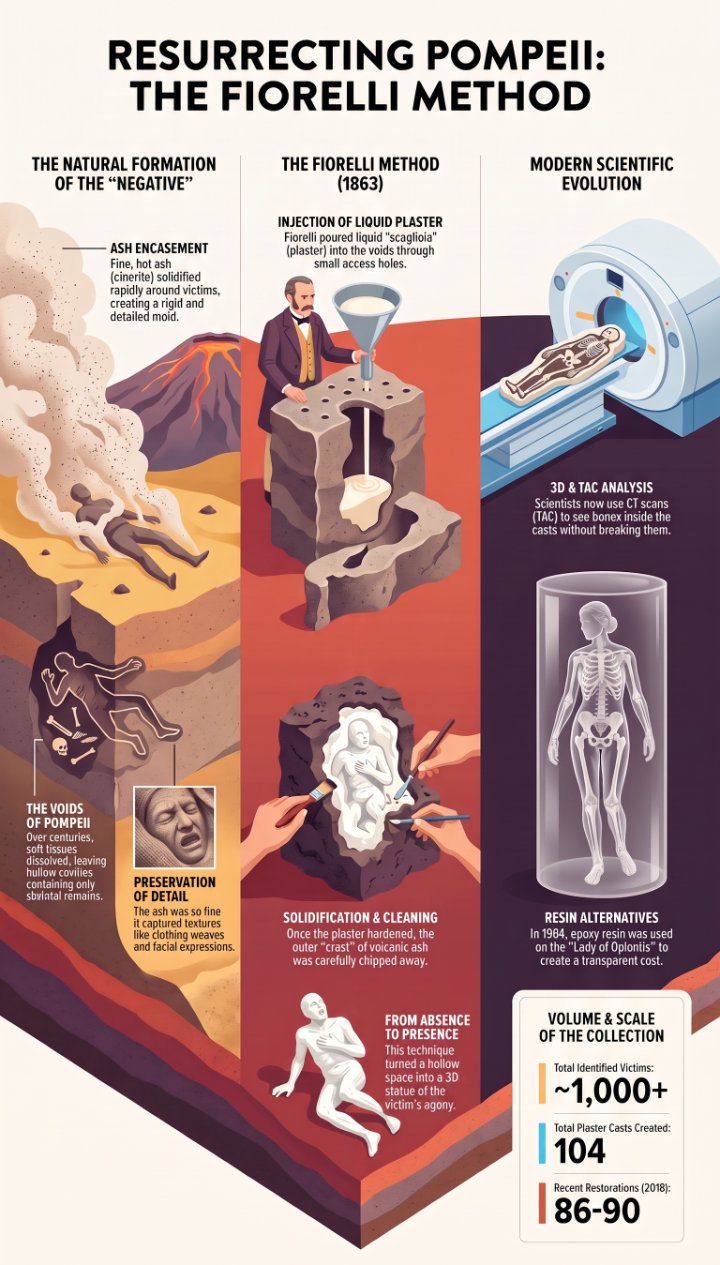
The casts of Pompeii are among the most striking testimonies of the eruption of AD 79. They are sometimes mistaken for petrified bodies, but they are actually casts made from cavities that formed in the hardened volcanic deposits after the decomposition of human bodies, animals and other organic materials. In many cases the casts also contain skeletal remains of the victims, making them both archaeological evidence and human remains that must be treated with particular care and respect.
The method is closely associated with Giuseppe Fiorelli, one of the most important figures in the history of the excavations of Pompeii. Fiorelli directed the excavations from 1860 to 1875 and in 1863 systematically applied a technique that made it possible to preserve the forms left by victims within the volcanic deposits. Earlier excavators had already observed cavities and impressions created by decomposed organic material, but Fiorelli recognised the archaeological importance of filling them before excavation destroyed the evidence they contained.
The first human casts were produced between 2 and 5 February 1863, during excavations in the street later known as the Vicolo degli Scheletri. Four victims were discovered there and plaster was poured into the cavities left by their bodies. The experiment demonstrated that the volcanic deposits could preserve extraordinarily detailed impressions of bodies, clothing and objects.
The process was made possible by the particular sequence of deposits produced during the eruption. Pompeii was first covered by a prolonged fall of pumice and lapilli. Later phases brought hot pyroclastic currents and fine volcanic material that penetrated buildings and accumulated around bodies and objects. Under suitable conditions this material hardened around organic matter. When the organic material subsequently decomposed, an empty cavity remained inside the compact deposit, preserving its external form.
When archaeologists identify such a cavity, it can be carefully examined and filled with liquid plaster. Once the plaster has hardened, the surrounding volcanic material is removed, revealing the form preserved inside. A Pompeian cast is therefore not an ordinary sculpture or a modern reconstruction: it reproduces a negative impression created directly during and after the eruption.
Under favourable conditions casts preserve remarkably fine details, including folds of clothing, footwear, skin impressions and objects carried by the victims. Bones may remain embedded within the cast together with personal belongings. For this reason the casts cannot simply be considered replicas: many incorporate original human remains and archaeological evidence.
The technique was not limited to human victims. It has also been used to reproduce animals, wooden doors, furniture and other objects made from perishable materials. One of the best-known animal casts is the dog discovered in the House of Orpheus, produced in 1874. Casts of organic objects have provided valuable information about materials that would otherwise have disappeared almost completely from the archaeological record.
During the nineteenth and twentieth centuries further casts were made throughout the excavated city. Some were displayed in the first Museo Pompeiano, established under Fiorelli in 1873-1874, while others remained near the places where they had been discovered.
The best-known group is that of the Garden of the Fugitives. Excavations begun under Amedeo Maiuri in 1961 identified fifteen victims in the area. According to the reconstruction of the excavation records, it was possible to produce casts of fourteen individuals, while the skeletal remains of a fifteenth victim could not be cast. Thirteen of the casts were selected for display in the south-eastern corner of the garden, while the first cast produced during the excavation was transferred to the House of the Four Styles and its precise identification among the surviving Pompeian casts is now uncertain.
Recent research has added an extraordinary new detail to the history of this group. During restoration of cast no. 46, archaeologists identified the remains of a small box made from organic material and a fabric purse containing coins. Inside the box was a coticula, a small stone palette commonly associated with the preparation of medical or cosmetic substances, together with small metal instruments embedded in the plaster.
Diagnostic imaging carried out in 2026 revealed previously invisible elements inside the box, including several small metal objects. Their morphology, together with the stone palette, strongly supports the hypothesis that the man associated with the objects may have been connected with medical practice, although the archaeological interpretation must remain cautious. The discovery demonstrates how modern diagnostic technologies can extract new information even from casts made more than sixty years ago.
The history of the casts has also been marked by damage and loss. Several examples were destroyed or seriously damaged during the Allied bombing of Pompeii in 1943. Amedeo Maiuri and his collaborators subsequently carried out restoration work, while modern conservation programmes have allowed surviving casts to be systematically documented and studied.
Since the late twentieth century, new technologies have transformed their study. Laser scanning, photogrammetry, radiography, CT imaging and three-dimensional modelling can document both external surfaces and, in some cases, structures hidden inside the plaster. These techniques allow archaeologists, anthropologists and conservators to investigate the casts without unnecessary physical intervention.
Different casting materials have also been tested. In 1984, a transparent resin cast was produced from one of the victims discovered at the Villa of Lucius Crassius Tertius at Oplontis. The transparency made it possible to observe the skeleton and objects contained inside, demonstrating how Fiorelli's basic principle could be adapted using modern materials.
The casts have immense archaeological value because they preserve evidence that excavation could otherwise destroy. They can document the position of a victim, clothing, objects and the relationship between the individual and the surrounding archaeological context. Casts of animals, furniture and architectural elements likewise preserve information about everyday life and materials that rarely survive.
At the same time, human casts require an approach different from that used for ordinary archaeological objects. They are directly connected with individuals who died during the catastrophe of AD 79, and many contain actual skeletal remains. Their conservation, study and display therefore involve both scientific and ethical considerations.
More than 160 years after Fiorelli's first experiments, the casts continue to produce new archaeological information. They are not merely dramatic images of the destruction of Pompeii: they are complex archaeological documents that preserve the final moments of individuals, traces of vanished materials and evidence of the history of archaeological research itself.
Sources and essential bibliography
Zuchtriegel G., Russo A., Amoretti V., Empireo L., Cirillo F., 2026, Un medico nell’Orto dei Fuggiaschi a Pompei. Esami radiografici e ricostruzione archeologica, E-Journal degli Scavi di Pompei, 2026.04.
Osanna M., Capurso A., Masseroli S.M. (eds.), 2021, I calchi di Pompei da Giuseppe Fiorelli ad oggi, Studi e ricerche del Parco Archeologico di Pompei, 46, Roma.
Capurso A., 2021, I calchi delle vittime trovate tra gli anni Trenta e Sessanta del Novecento, in Osanna, Capurso, Masseroli 2021, pp. 67-98.
D'Ambrosio A., Guzzo P.G., Mastroroberto M. (eds.), 2003, Storie da un’eruzione. Pompei, Ercolano, Oplontis, Milano.
De Carolis E., Patricelli G., Ciarallo A., 1998, Rinvenimenti di corpi umani nell’area urbana di Pompei, Rivista di Studi Pompeiani, IX, pp. 75-122.
Maiuri A., 1962, Pompei nelle ore della tragedia, Le vie d’Italia, 1, pp. 201-211.
Parco Archeologico di Pompei, I Calchi.