



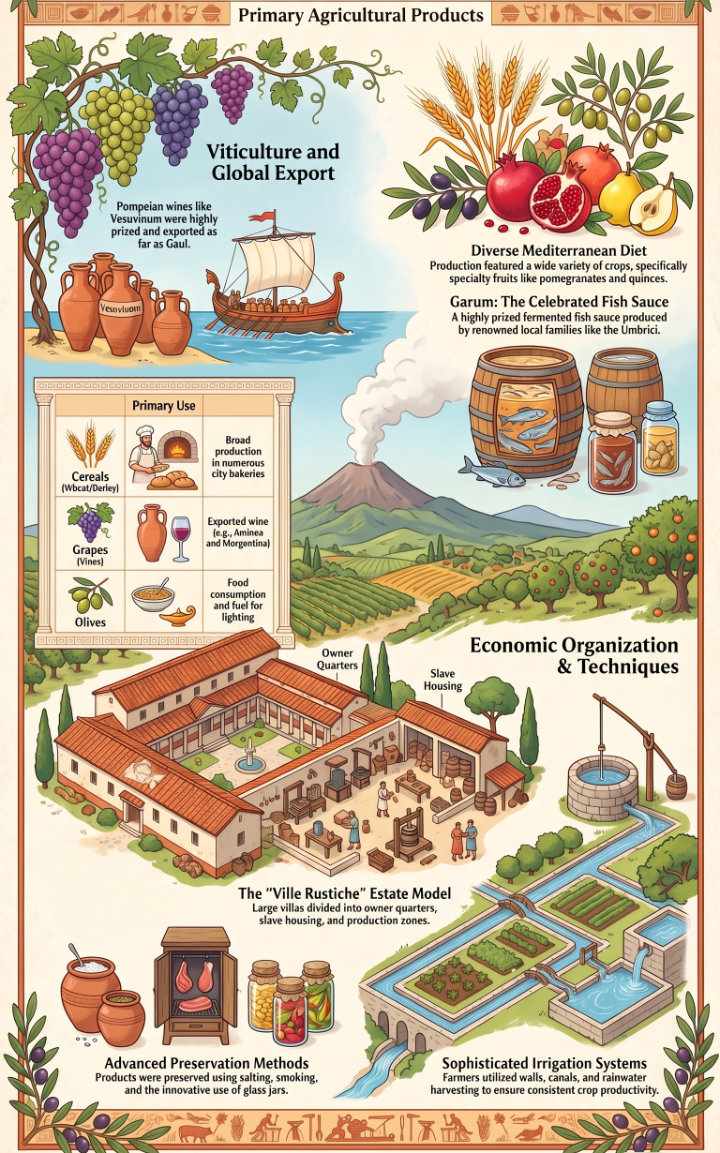
Agriculture was one of the foundations of the economy of Pompeii and the surrounding Vesuvian countryside. The fertile plains of the Sarno valley, the slopes of Mount Vesuvius and the hills around Boscoreale supported a varied agricultural landscape in which vines, olives, cereals, fruit and vegetables were cultivated.
The archaeological evidence from Pompeii and the surrounding villas allows us to reconstruct not only what was grown, but also how agricultural products were processed, stored and transported.
The countryside was closely connected with the city. Farms and villas supplied food and raw materials to the urban population, while wine, oil and other products could also enter wider commercial networks.
The agricultural landscape around Pompeii
The territory surrounding Pompeii contained several different environmental zones, each suited to particular activities.
The plain of the Sarno provided fertile land for cereals, vegetables and other crops, while the slopes of Vesuvius and the nearby hills were particularly suitable for vines and olive trees.
The Archaeological Park's Antiquarium at Boscoreale documents this varied landscape through plant remains, agricultural tools, amphorae and finds from Roman farms and villas.
Roman settlement extended well beyond the walls of Pompeii. The countryside contained numerous farms and villas devoted to agricultural production, particularly in the area of Boscoreale, where archaeology has revealed an important concentration of properties specialising in wine and oil.
These estates were not isolated from the city. They formed part of the economic territory traditionally referred to as the ager Pompeianus, the rural area connected with Pompeii.
Vineyards and wine
The cultivation of the grapevine was one of the most important agricultural activities in the Vesuvian area.
Archaeological evidence shows that vineyards existed both in the countryside and within areas close to or even inside the urban fabric of Pompeii.
One particularly important example is the area once mistakenly identified as the Forum Boarium. Later investigations revealed planting traces belonging to a large vineyard cultivated according to a system described in ancient agricultural sources.
The site also contained a wine press and ten large terracotta dolia, storage vessels sunk into the ground. The estimated production capacity demonstrates that wine making could take place on a substantial scale even within the city.
The ancient planting holes and root cavities have allowed archaeologists to reconstruct the arrangement of the vines. Experimental vineyards have subsequently been planted in some archaeological areas to help visitors understand the appearance of the ancient agricultural landscape.
Wine production was even more clearly organised in the farms and villas surrounding Pompeii.
Villa Regina and wine production
One of the best preserved examples is Villa Regina at Boscoreale, about one kilometre north of ancient Pompeii.
The villa was a working farm rather than simply a luxurious country residence. Its earliest phase dates to the 1st century BC, followed by later modifications in the Augustan and Julio-Claudian periods.
At the centre of the property was a courtyard surrounded by rooms used for agricultural and domestic activities.
The villa contained a torcularium, or pressing room, where the remains of a wooden wine press, the pressing basin and the container used to collect the must have been identified.
Its wine cellar contained 18 dolia, large terracotta storage vessels.
The agricultural soil of AD 79 is still preserved around the villa. Archaeologists were able to make casts of ancient vine roots, providing exceptionally direct evidence of the vineyard that surrounded the farm. Vines have since been replanted beside these traces to recreate the original cultivation pattern.
Villa Regina therefore offers a rare opportunity to see the relationship between a Roman farm, its production facilities and the cultivated land that supplied them.
Rustic villas and agricultural production
The countryside around Pompeii contained numerous properties generally described as villae rusticae, or rural villas.
These complexes combined residential spaces with areas devoted to agricultural work.
A traditional distinction is often made between the pars urbana, used by the owner and his household, and the productive and service areas where agricultural goods were processed and stored.
Some villas could include accommodation for workers, stables, presses, storage rooms, bakeries and large wine cellars.
The Villa della Pisanella at Boscoreale is an important example. Excavation revealed residential rooms, a small bath complex, accommodation for servants, a bakery, a stable, a wine press and equipment for processing olives.
Its large storage capacity suggests that it was connected with an estate of considerable size.
The villa illustrates how agricultural estates could combine productive activity with comfortable living quarters for wealthy owners.
Olive cultivation and oil
The olive tree was another important crop in the Vesuvian countryside.
The hills surrounding Pompeii were particularly suitable for olives, which were grown alongside vines and other crops.
Olives could be eaten directly after processing, but they were also crushed to produce olive oil.
Oil had many uses in Roman life. In addition to being an essential food product, it was used for lighting, personal care and other domestic activities.
Archaeological finds from rural villas include stone olive mills known as trapeta, presses and storage containers associated with oil production.
Evidence from Boscoreale suggests that wine was an especially important export product, while much of the oil produced in the area may have been intended primarily for local consumption.
Cereals
Cereals formed one of the basic components of the Roman diet.
Wheat and other grains were cultivated in the Vesuvian territory and transported to the city, where they were processed in bakeries equipped with large stone mills.
The numerous bakeries discovered in Pompeii demonstrate the importance of grain and bread in everyday urban life, although not all grain consumed in the city necessarily came from the immediate surrounding countryside.
Rural villas could include dedicated areas for the storage of cereals and other dry products.
Villa Regina, for example, contained a room used to store hay, cereals and legumes, while the Villa della Pisanella included facilities connected with grain storage and milling.
This evidence shows the close connection between agricultural production in the countryside and food processing within both farms and the city itself.
Fruit, vegetables and legumes
The inhabitants of the Vesuvian area had access to a wide range of plant foods.
Archaeological excavations have preserved seeds, fruit stones, nuts and other botanical remains, allowing researchers to identify many species that formed part of the ancient diet and agricultural landscape.
The Boscoreale Antiquarium displays remains including olives and peach stones, as well as amphorae used for transporting fruit.
One particularly interesting amphora bears a painted inscription identifying its contents as apples from Cumae, demonstrating that fruit was not only grown and consumed locally but could also be transported commercially.
Gardens and agricultural plots supplied vegetables, legumes, herbs and fruit according to season.
The precise range of crops available at any particular moment depended on the season, the location and commercial exchange, so ancient literary lists should not automatically be treated as exact inventories of what was grown in Pompeii itself.
Agriculture inside the city
Pompeii was not separated sharply from the countryside.
Within the walls, archaeologists have identified gardens, orchards, vineyards and cultivated plots associated with houses and commercial properties.
Some gardens were ornamental, particularly in wealthy domus, while others had productive functions.
Vegetables, fruit trees, vines and herbs could be grown within urban properties, making food production part of the everyday landscape of the city.
The vineyard discovered near the Amphitheatre is one of the clearest examples of substantial agricultural production within Pompeii itself.
Its wine press, storage vessels and planting patterns demonstrate that cultivated land could survive alongside densely built residential districts.
Agricultural work and the seasons
Ancient farming was strongly dependent on the seasonal agricultural cycle.
Different tasks had to be carried out at the appropriate time of year: preparing the soil, sowing, pruning, harvesting grapes, collecting olives and processing agricultural products.
The grape harvest was followed by pressing and the production and storage of wine, while the olive harvest required crushing and pressing before the oil could be stored.
Cereals had their own cycle of sowing, growth, harvesting, threshing and storage.
These activities shaped labour throughout the year and influenced the availability of fresh food.
Preservation techniques therefore played an important role in ensuring that agricultural products could be consumed outside their immediate season.
Read more in Seasonality in Pompeian Agriculture and Food Preserves in Pompeii.
Storage and preservation
Agricultural production required effective systems for storing food and drink.
Large terracotta containers known as dolia were widely used in farms and villas. They could hold wine, oil, cereals and other products and were often partly buried in the floor of storage rooms.
Wine amphorae were used for transport, particularly when products were intended for markets beyond the estate.
Fruit, vegetables, legumes and other foods could be dried, salted, stored in liquids or preserved by other techniques known from Roman agricultural writers.
The archaeological record must nevertheless be distinguished from literary recipes: writers such as Columella describe agricultural practices from different parts of the Roman world, and not every method they mention can automatically be attributed specifically to Pompeii.
For more about Roman methods of storing food, see Food Preserves in Pompeii.
Agriculture and trade
Agriculture supported not only local consumption but also commercial activity.
The discovery of transport amphorae demonstrates the movement of wine, oil, fruit and other products through regional and Mediterranean trade networks.
The Archaeological Park notes that wine from the Vesuvian countryside was produced for export as well as local consumption.
Pompeii's location close to the Sarno and the ancient coastline provided favourable connections between the agricultural hinterland and maritime trade.
Farms therefore formed part of a wider economic system linking rural production, urban markets and long-distance exchange.
Not every product associated with Pompeian food culture, however, was agricultural. Garum, the famous fermented fish sauce produced by entrepreneurs such as Aulus Umbricius Scaurus, belonged primarily to the processing of marine resources rather than farming and is better understood as part of Pompeii's food industry and commerce.
For more about food and eating habits, see A Journey into Pompeian Gastronomy.
Archaeology and the ancient landscape
Much of what we know about Pompeian agriculture comes not from literary texts but from archaeological evidence.
Excavations have preserved agricultural tools, presses, mills, amphorae, storage vessels, seeds, fruit stones and even cavities left by ancient roots.
At Villa Regina, the survival of the agricultural soil buried in AD 79 has made it possible to reconstruct the position of individual vines.
Elsewhere, botanical remains help identify crops and foods, while presses and storage rooms reveal how agricultural products were processed after harvest.
This combination of buildings, objects and environmental evidence makes the Vesuvian area one of the most important places for studying the relationship between ancient agriculture and everyday life.
Boscoreale and the agricultural world of Pompeii
Visitors interested in this aspect of Roman life can gain a much fuller understanding by combining Pompeii with Villa Regina and the Antiquarium of Boscoreale.
The Archaeological Park describes Boscoreale as an area rich in Roman villas and farms devoted particularly to the cultivation of grapes, olives and cereals.
The Antiquarium displays archaeological and botanical evidence illustrating the environment, agriculture and economy of the Vesuvian countryside, while Villa Regina preserves the physical structure of a working Roman farm and its vineyard.
Together, Pompeii and Boscoreale show two sides of the same economic system: the city where agricultural products were consumed, processed and traded, and the countryside where much of that wealth was produced.
Agriculture was therefore essential to the life of ancient Pompeii. Vineyards and olive groves shaped the surrounding landscape, cereals and vegetables supplied everyday food, and rural villas organised the processing and storage of large quantities of produce.
The eruption of AD 79 destroyed this agricultural system, but it also preserved an exceptional record of its fields, farms, tools and products, allowing us to reconstruct in unusual detail the countryside that sustained the ancient city.