



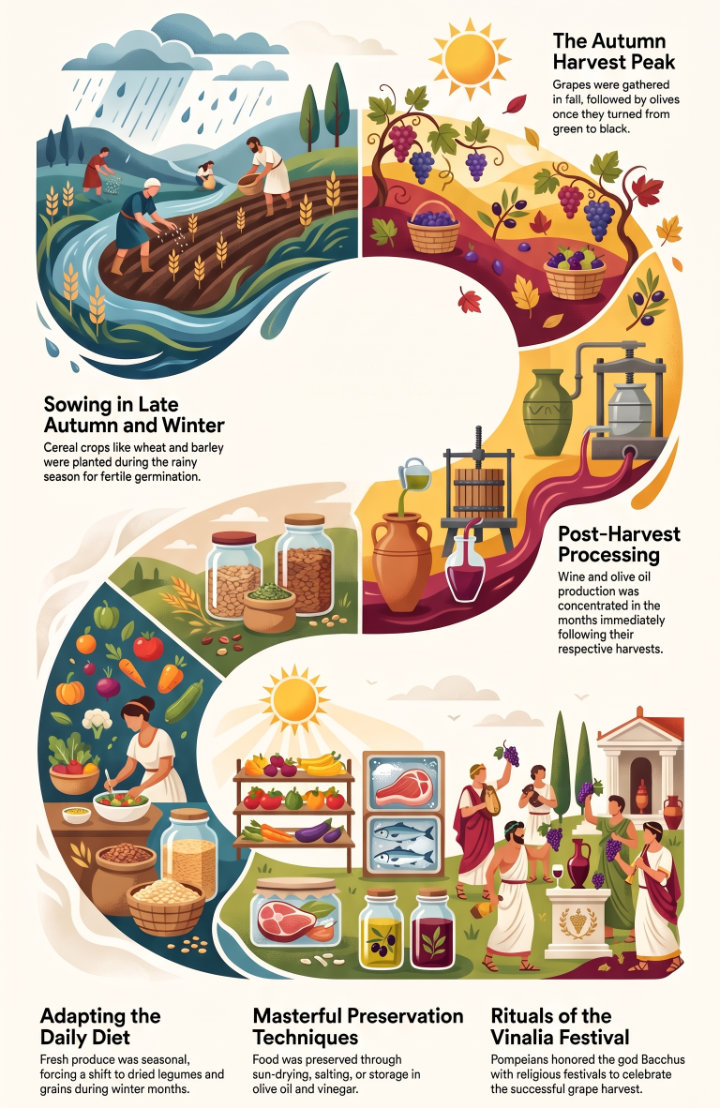
Agriculture in Pompeii and the Vesuvian countryside followed the rhythm of the seasons. Sowing, pruning, harvesting grapes, collecting olives and storing agricultural products had to be carried out at the appropriate time of year, although the exact dates varied according to weather, soil, altitude and the type of crop.
The archaeological evidence from Pompeii and nearby rural settlements such as Boscoreale, combined with Roman agricultural writers including Cato, Varro and Columella, allows us to reconstruct the general rhythm of the farming year.
Ancient literary sources describe agricultural practice across the Roman world and should not be treated as a precise calendar followed identically at Pompeii. The Vesuvian archaeological record, however, confirms the importance of grapes, olives, cereals, legumes, fruit and other crops in the countryside that supported the city.
Winter: preparing the land and caring for the vines
Winter did not bring agricultural activity to a complete stop.
During the colder months, farmers could prepare fields, repair tools and agricultural structures, maintain drainage systems and carry out work in vineyards and orchards.
For many cereal crops, sowing had already begun during the autumn. The Roman agronomist Columella describes a normal sowing period for wheat extending from late October towards the winter solstice in temperate areas, while emphasising that the appropriate moment depended on local soil and climate.
Autumn and early winter rainfall provided the moisture necessary for seeds to germinate and for young plants to begin developing.
The winter period was also important for the vineyard. Pruning and other forms of vine maintenance had to be carried out during the dormant part of the agricultural cycle, although ancient authors give different recommendations according to local environmental conditions.
Farmers also used quieter periods of the year to maintain presses, storage vessels, farm buildings and equipment in preparation for the more demanding seasons ahead.
Spring: growth and vineyard work
With the arrival of spring, agricultural activity intensified.
Cereal crops sown during the colder months entered an important phase of development, while vineyards and fruit trees began producing new shoots.
Roman agricultural writers devote considerable attention to the management of vines during this period. The plants required repeated care: soil had to be worked, supports maintained and unnecessary growth controlled.
New vines could also be planted. Columella notes that planting could take place in either spring or autumn, depending on the climate and characteristics of the soil. Spring was generally preferable in wetter or colder conditions, while autumn could be suitable in warmer and drier areas.
This flexibility is important when reconstructing ancient agriculture. There was no single Roman calendar that applied everywhere in exactly the same way.
Spring was also a critical period because crops were vulnerable to unfavourable weather, disease and damage during growth.
Roman religious festivals reflected these agricultural concerns. Rituals connected with fields, vegetation and the protection of crops formed part of a calendar in which farming, religion and the changing seasons were closely linked.
The Vinalia Priora and the previous year's wine
One of the most important Roman festivals associated with wine was the Vinalia Priora, celebrated on 23 April.
The festival concerned wine produced from the previous year's grape harvest. According to Roman sources, this was traditionally the occasion on which the new wine could be opened and tasted after an offering had been made to Jupiter.
The Vinalia therefore demonstrate that wine production did not end with the grape harvest.
After grapes had been pressed and the must had fermented, the wine required months of storage and maturation before it became part of the following year's consumption and religious cycle.
The festival also illustrates how agriculture was integrated into Roman religious practice. Wine was not simply an economic product: it had social, ritual and symbolic importance.
Early summer: the cereal harvest
For many cereal crops, late spring and early summer brought one of the most demanding periods of the agricultural year.
Grain had to be harvested once it reached the appropriate stage of ripeness. Timing was important: harvesting too early reduced the quality of the crop, while waiting too long increased the risk of losing grain.
After cutting came a sequence of additional tasks, including threshing, separating the grain, drying and storage.
The archaeological evidence from Pompeii demonstrates how important cereals were to the urban food supply. Numerous bakeries contained large stone mills used to grind grain into flour.
The surrounding countryside certainly produced cereals, although recent research suggests that local production should not be imagined as sufficient to supply all the needs of Pompeii. Agricultural production was complemented by goods arriving through regional and wider commercial networks.
At Villa Regina in Boscoreale, a storeroom has been identified for hay, cereals and legumes, providing direct archaeological evidence of the storage of dry agricultural products within a Roman farm. The surrounding Vesuvian countryside was characterised by farms cultivating grapes, olives and cereals.
Summer: protecting and maintaining the vineyard
During summer, the vineyard demanded continual attention.
The grapes were developing towards maturity and had to be protected as far as possible from damage, while vegetation around the vines needed to be managed.
Weather was particularly important.
Excessive heat, drought, storms or heavy rain could affect the crop shortly before harvest. Ancient religious rituals associated with the late summer reflect precisely this anxiety about the final stages of grape maturation.
By this point, facilities for the approaching vendemmia, or grape harvest, also had to be prepared.
Wine presses, collecting basins and storage containers needed to be ready for a period of intense work in which large quantities of grapes would arrive within a relatively short time.
The archaeological remains of the Vesuvian villas show how carefully wine production could be organised.
At Villa Regina, the torcularium, or pressing room, preserves evidence of the wooden press, pressing basin and vessel used to collect the must. Nearby, the wine cellar contained 18 large dolia.
19 August: the Vinalia Rustica
The Vinalia Rustica, celebrated on 19 August, is particularly useful for understanding the relationship between agriculture, religion and seasonality.
It should not simply be described as a “harvest festival dedicated to Bacchus”.
Ancient evidence associates the ritual especially with Jupiter, while the precise religious interpretation of the festival and its relationship with Venus, Liber and other traditions has been debated by scholars.
More importantly, the festival did not necessarily mark the actual beginning of grape harvesting everywhere.
The fixed date of 19 August came while the grapes were approaching maturity. The ritual sought divine protection during this vulnerable period, particularly against dangerous weather.
The actual beginning of the vendemmia depended on conditions that could not be fixed permanently in the calendar: local climate, vineyard location, grape variety, degree of ripeness and the type of wine the producer intended to make.
The Vinalia Rustica therefore provides an excellent reminder that the Roman religious calendar and the practical agricultural calendar were related but not identical.
Late summer and autumn: the grape harvest
The grape harvest was one of the most important moments of the agricultural year in the Vesuvian region.
Its precise timing varied, but it generally took place between late summer and autumn, when the grapes had reached the desired level of ripeness.
Harvesting required a large concentration of labour.
Grapes were collected and transported rapidly to the pressing area, where they were crushed and pressed. The resulting must was transferred to large containers for fermentation and storage.
The ancient vineyards preserved around Pompeii and Boscoreale provide exceptional evidence for this activity.
At Villa Regina, archaeologists found the agricultural soil of AD 79 together with the cavities left by ancient vine roots. Casts of these roots allowed researchers to reconstruct the arrangement of the vineyard, and vines have since been replanted beside the ancient traces to illustrate the original cultivation system.
Wine production was therefore not merely an abstract part of Pompeii's economy. Archaeology preserves the vineyard, press, storage vessels and farm buildings belonging to the same productive system.
For a broader look at viticulture and the rural economy, see Pompeian Agriculture.
Autumn: the olive harvest
The olive harvest represented another important stage in the agricultural cycle.
It is misleading to say that olives were simply harvested when they changed from green to black.
The appropriate moment depended on several factors, including the intended use of the fruit and the type and quality of oil producers wished to obtain.
Olives collected for eating required different treatment from those destined for pressing.
After harvesting, olives intended for oil production had to be processed. Rural estates could contain mills, presses and storage facilities designed for this purpose.
The archaeological evidence from the Vesuvian area confirms the cultivation of olive trees and the presence of equipment connected with oil production.
Oil was important not only as food but also for lighting, personal care and other domestic uses.
Research nevertheless suggests that local production should not automatically be assumed to have satisfied all of Pompeii's demand. As with cereals and other commodities, trade supplemented the agricultural resources of the surrounding territory.
Autumn sowing and the beginning of a new cycle
While grapes and olives were being harvested, preparations for the next agricultural year had already begun.
Fields intended for winter cereals had to be prepared and autumn sowing began.
Roman agriculture therefore did not follow a simple sequence in which one year's work finished before the next began.
Different agricultural cycles overlapped.
While one crop was being harvested, another was being planted. Wine from the grape harvest was beginning fermentation while fields were being prepared for cereals. Olives were being collected while vines approached their winter dormant phase.
For farming communities, the agricultural year was therefore a continuous sequence of overlapping tasks rather than four sharply separated seasons.
Seasonal fruit and vegetables
Fruit and vegetables also followed their own seasonal rhythms.
The Vesuvian archaeological record preserves olives, grapes, figs, peaches, nuts and other plant remains, while written sources describe a much wider range of produce available in Roman Italy.
Some foods could be consumed soon after harvesting, while others could be stored or processed so that they remained available later in the year.
Urban gardens and cultivated plots within Pompeii itself contributed to this seasonal supply.
Archaeologists have identified gardens, orchards and vineyards inside the city walls, showing that food production was not restricted to rural estates.
The ancient urban landscape was therefore greener and more agriculturally productive than the exposed ruins visible today might suggest.
The role of food preservation
Seasonality explains why food preservation and storage were essential.
A harvest could provide a large quantity of food during a relatively short period, but households and farms needed supplies to last for months.
Cereals and legumes could be dried and stored. Wine and oil could remain usable for long periods in appropriate containers. Fruit and olives could be treated through methods known from Roman agricultural practice.
Large dolia played an important role in storing products, particularly wine, while amphorae allowed agricultural goods to be transported over longer distances.
It is important, however, to distinguish between methods documented archaeologically in the Vesuvian area and preservation recipes described more generally by Roman agricultural authors.
For a detailed discussion, see Food Preservation in Pompeii.
Agriculture, climate and uncertainty
Ancient farmers were highly dependent on environmental conditions they could not control.
Too little rain could damage crops, while excessive rainfall, storms or unusually cold weather could also threaten production.
This helps explain the importance of religious rituals associated with agriculture.
Festivals connected with vines, cereals and the protection of crops were part of a broader attempt to place the unpredictable natural world within an ordered religious calendar.
Practical agricultural knowledge and religious practice therefore existed side by side.
Farmers relied on experience to judge when to sow or harvest, while rituals sought the protection of the gods against dangers that human labour alone could not prevent.
What Roman agricultural writers tell us
Authors such as Cato, Varro and Columella provide detailed descriptions of agricultural work throughout the year.
They discuss the appropriate periods for sowing cereals, planting and pruning vines, harvesting crops, managing animals and maintaining agricultural estates.
These texts are essential for reconstructing Roman agriculture, but they were not written specifically about Pompeii.
Their recommendations often acknowledge that agricultural timing had to change according to climate, soil and local conditions.
For this reason, they should be used together with archaeological evidence rather than treated as a precise Pompeian farming calendar.
The preserved fields, root cavities, presses, storage installations, seeds and plant remains of the Vesuvian sites provide the local evidence that allows the literary descriptions to be placed in context.
Villa Regina: an agricultural year frozen in AD 79
Villa Regina at Boscoreale offers one of the clearest archaeological images of farming in the territory surrounding Pompeii.
The villa was a productive rural property closely associated with viticulture.
Its wine-making installations include a pressing room and a cellar containing 18 dolia, while other spaces were used for storing cereals, legumes and hay.
Most remarkably, the agricultural terrain buried by the eruption survives around the villa with traces of the ancient vineyard.
The eruption of Vesuvius therefore preserved not merely the farmhouse but part of the cultivated landscape itself.
The site illustrates how the seasonal tasks described by Roman agricultural writers were connected in practice: vines had to be maintained during the year, grapes harvested and pressed, wine stored, while other products were cultivated and kept in the same agricultural complex.
A year shaped by agriculture
The agricultural year around Pompeii was a continuous cycle of preparation, growth, harvesting, processing and storage.
Winter brought sowing and maintenance; spring demanded renewed care of crops and vines; early summer was important for cereals; late summer and autumn brought grape and olive harvesting, while autumn also marked the beginning of a new sowing season.
These phases were not fixed by modern calendar dates. Ancient farmers responded to the condition of the soil, the development of plants and the weather.
The seasonal rhythm also shaped the food available to the population, the work required from rural communities and the commercial movement of agricultural products towards Pompeii.
The eruption of AD 79 suddenly interrupted this cycle. Yet by preserving vineyards, farms, storage vessels, plant remains and agricultural soil, it also left an exceptional record of the farming landscape that supported the ancient city.
Understanding this seasonal rhythm allows us to see Pompeii not only as an urban archaeological site, but as the centre of a much larger landscape whose economy and everyday life depended on the continuous work of the countryside.