



On Saturday 26 and Sunday 27 September 2026, visitors to Pompeii will have a special opportunity to experience the ancient city in a very different way, with historical re-enactments, gladiatorial displays, processions, workshops and performances inspired by Roman life.
The events are being organised by the Archaeological Park of Pompeii for the European Heritage Days 2026 and will take place not only in Pompeii, but also at Boscoreale, Stabiae and Oplontis. For visitors spending the weekend in the archaeological area, it will therefore be possible to combine a traditional visit to the houses, streets and public buildings of Pompeii with performances that bring some of these ancient spaces back to life.
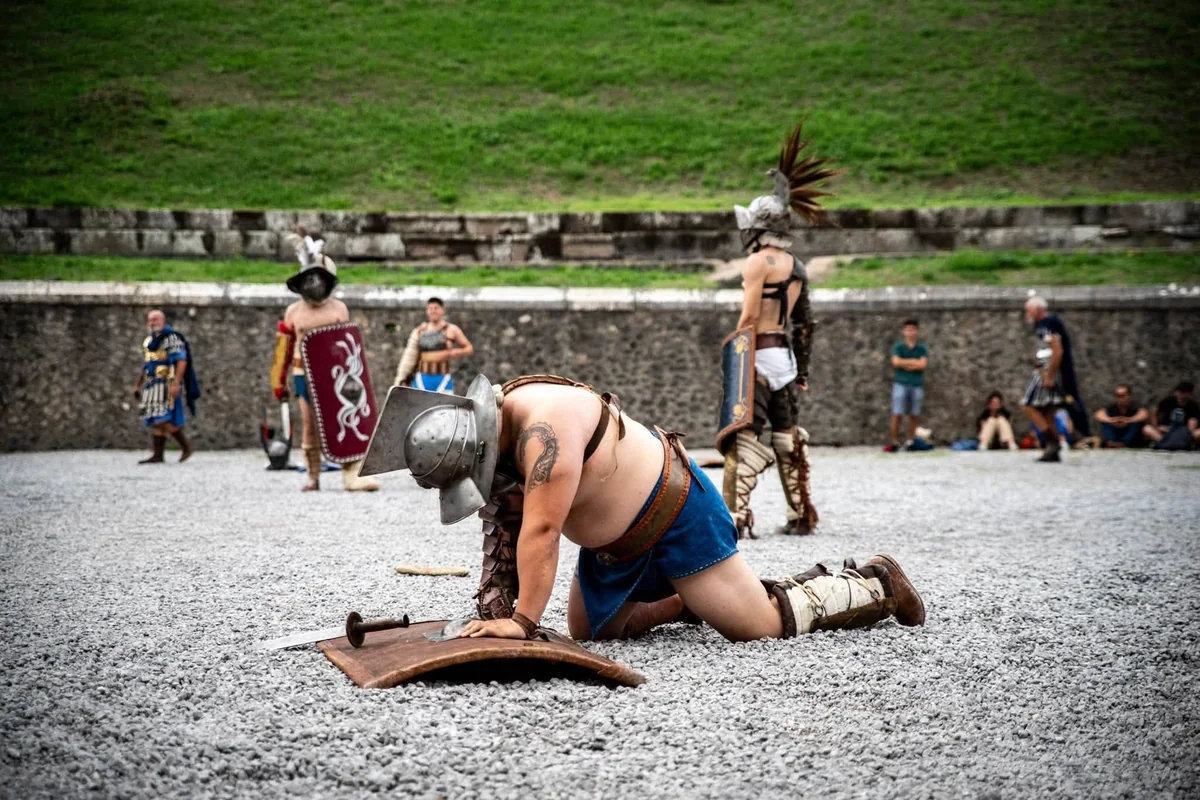
Saturday 26 September will focus particularly on the world of the gladiators with “Dies in Arena”, an itinerary that follows their story from the training ground to the moment they entered the arena. On Sunday 27 September, the programme continues with the third edition of the Ludi Pompeiani, with activities and re-enactments taking place throughout much of the day around the Amphitheatre.
Saturday 26 September: from the gladiators' training ground to the Amphitheatre
Saturday's programme begins at 11.00 am in the Basilica of Pompeii, where the first event, “Popolo e Potere” – People and Power, will introduce visitors to the role of gladiatorial games in Roman society.
Gladiatorial combat was much more than entertainment. Public games were closely connected with political life, social prestige and the relationship between those who sponsored the spectacles and the crowds who attended them. The Basilica, one of the most important public buildings overlooking the Forum, provides an unusual but particularly interesting setting in which to introduce this aspect of Roman life.
Visitors can also locate the Basilica and the other monuments involved in the day's events on the new interactive map of Pompeii's buildings and places.
At 12.30 pm, the focus moves to the Quadriporticus of the Theatres, also known as the Gladiators' Barracks. Here the second part of the programme, “Il Ludus” – The Gladiatorial School, will explore the world in which gladiators lived and prepared for combat, presenting different types of fighters, their armour, the rituals surrounding the games and the organisation of a gladiatorial troupe.
The setting is especially appropriate. The Quadriporticus was originally a large porticoed area associated with the nearby Large Theatre, where spectators could gather and walk during intervals. After the earthquake of AD 62, however, the complex was reorganised and used as accommodation for gladiators. Educational displays devoted to gladiatorial weapons will also be available during the morning.
At 3.15 pm, a historical procession will leave the Quadriporticus and make its way along Via Stabiana and Via dell'Abbondanza towards the Pompeii Amphitheatre. Following the procession offers visitors the chance to cross some of the ancient city's best-known streets before arriving at the place where thousands of Pompeians once gathered to watch public spectacles.
At 3.30 pm, the final part of “Dies in Arena” begins inside the Amphitheatre with “Munera con ingresso imperiale”, featuring an imperial procession, magistrates and four pairs of gladiators.
The reconstructed combats will be accompanied by explanations designed to help the audience understand the different fighters and the rules and customs of the arena. Spectators will also be invited to take part in the final judgement of the contests, recalling the close relationship that existed between performers and audience in Roman spectacles.
The Amphitheatre of Pompeii, built around 70 BC, is the oldest surviving permanent Roman amphitheatre known today. In antiquity it could accommodate a crowd far larger than the population of Pompeii itself, attracting spectators from neighbouring communities as well as from the city. Seeing gladiatorial re-enactments return to this arena offers visitors an unusual opportunity to understand how strongly public entertainment was woven into everyday Roman life.
Take a guided tour of Pompeii and continue with the gladiatorial events
For travellers visiting Pompeii for the first time, the weekend also provides a good opportunity to combine an introduction to the archaeological site with the historical re-enactments.
One option is to begin the day with a guided tour of Pompeii with admission included. The guided part of the visit lasts around two hours and introduces the ancient city through its streets, houses and public spaces, helping visitors to understand what they are seeing before exploring further on their own.
After the guided tour, visitors can continue exploring Pompeii independently, making it possible to plan the rest of the day around the scheduled re-enactments. By choosing a tour time that fits the programme, you can visit the archaeological site with a guide and then make your way to the Basilica, the Gladiators' Barracks and the Amphitheatre for the events taking place later in the day.
The exact itinerary followed by a guided tour may vary according to opening conditions, visitor numbers and the route chosen by the guide, so the monuments involved in the re-enactments are not necessarily included in the guided portion of the visit. The interactive Pompeii map can then be used on a smartphone to find the different locations and plan the route across the archaeological area.
Check availability for a guided tour of Pompeii.
Sunday 27 September: the Ludi Pompeiani
On Sunday 27 September, the historical programme continues around the Amphitheatre with the third edition of the Ludi Pompeiani.
Throughout the day, visitors will be able to see re-enactments inspired by different aspects of Roman society, including gladiators and legionaries, historical dance, public ceremonies and scenes representing important moments in Roman private life.
The programme starts at 9.30 am with the opening of the educational stands. At 10.00 and 10.30 am there will be the opening ceremony and a municipal ovatio in honour of Gaius Cuspius Pansa, while a historical dance performance is also scheduled for 10.30 am.
Gladiatorial and legionary displays will take place at 10.45 and 11.30 am, followed by another historical dance performance at 11.30 am. At noon, visitors will see a reconstruction of a manumissio, the formal act through which an enslaved person could be freed by his or her owner.
At 12.30 pm the programme brings together gladiatorial games, historical dance and legionaries. Educational workshops in the camp will follow at 1.00 and 2.30 pm, while at 3.00 pm a Roman wedding ceremony will be re-enacted.
The afternoon continues with further gladiatorial games at 3.30 pm, historical dance and legionaries at 4.00 pm, and educational activities in the camp from 4.30 pm until the end of the day's programme.
Full programme of the historical re-enactments
POMPEII – Saturday 26 September
“Dies in Arena”
11.00 am – Basilica: “Popolo e Potere” – People and Power, an introduction to gladiatorial combats and their place in Roman society.
12.30 pm – Quadriporticus of the Theatres: “Il Ludus” – The Gladiatorial School, with presentations of different types of gladiators, armour, rituals and the organisation of gladiatorial life. Educational displays devoted to weapons will also be available during the morning.
3.15 pm – Procession from the Quadriporticus of the Theatres: the procession will travel along Via Stabiana and Via dell'Abbondanza before reaching the Amphitheatre.
3.30 pm – Amphitheatre: “Munera con ingresso imperiale”, with an imperial procession, magistrates and four pairs of gladiators taking part in reconstructed combats accompanied by explanations for the audience. Public access will be from the southern side of the Amphitheatre.
POMPEII – Sunday 27 September
“Ludi Pompeiani – 3rd edition”
9.30 am – Opening of the educational stands.
10.00 and 10.30 am – Opening ceremony and municipal ovatio in honour of Gaius Cuspius Pansa.
10.30 am – Historical dance.
10.45 and 11.30 am – Gladiatorial games and legionaries.
11.30 am – Historical dance.
12.00 noon – Manumissio.
12.30 pm – Gladiatorial games, historical dance and legionaries.
1.00 and 2.30 pm – Educational workshops at the camp.
3.00 pm – Roman wedding.
3.30 pm – Gladiatorial games.
4.00 pm – Historical dance and legionaries.
4.30 pm – Educational activities at the camp until the end of the programme.
BOSCOREALE – Saturday 26 and Sunday 27 September
“Scientia et Vita”
From 9.00 am to 6.00 pm, educational stands will explore technology and everyday life among the ancient Italic peoples. Topics will include weaving, cosmetics and perfumes, medicine and surgery, games, coinage, sculpture, crafts and seasonal products.
The numismatic area will also demonstrate how coins were produced in antiquity.
Workshops will accommodate a maximum of eight participants per session. Weaving workshops will take place from 10.00 am to 1.00 pm and from 3.00 to 6.00 pm, with the same schedule for activities devoted to cosmetics and perfumes.
During both days, Villa Regina will also host costumed interpreters presenting crafts, occupations and aspects of everyday life in the ancient world.
STABIAE – VILLA SAN MARCO – Saturday 26 September
“Rectina! The Day the Sky Fell on Pompeii”
10.00 am – Welcome and introduction for visitors.
10.30 am, 12.00 noon, 3.00 and 5.00 pm – Performance of “Rectina! The Day the Sky Fell on Pompeii”.
11.00 am and 3.30 pm – Educational activities for visitors.
OPLONTIS – Saturday 26 September
“Weekend of Culture at Oplontis”
From 10.00 am to 1.00 pm, visitors will be able to join guided itineraries through the Villa of Poppaea and explore educational displays devoted to theatre, music and masks in the ancient world.
From 8.00 to 10.30 pm, the programme continues with guided itineraries and activities focusing on Roman baths and sport.
The evening will also feature the first edition of the “Neronia Oplontini”, including the presentation of awards to two athletes by Emperor Nero and a reconstruction of the Ludi Gladiatorii in the presence of the emperor and his court.
OPLONTIS – Sunday 27 September
From 10.00 am to 1.00 pm, the performance “Poppaea and Cleopatra: Charm and Power” will be accompanied by itineraries through the Villa of Poppaea and activities dedicated to cosmetics and jewellery in the Egyptian and Roman worlds, including references to the famous jewellery discovered at Oplontis.
From 4.00 to 6.30 pm, visits and educational displays will focus on navigation in the ancient world and the wine trade, with reproductions of ancient vessels and readings connected with the theme.
A different way to discover Pompeii
The European Heritage Days on 26 and 27 September offer visitors a chance to see Pompeii from a different perspective. For a few hours, its monuments will be more than archaeological remains: they will once again become settings for the activities, ceremonies and spectacles that formed part of life in the ancient city.
Watching at least one of the re-enactments can add a valuable new dimension to a visit, particularly when the event takes place in the same building where similar activities were held almost two thousand years ago.
Visitors can use the Pompeii Buildings and Places interactive map to locate the Basilica, the Gladiators' Barracks, the Amphitheatre and other monuments during the day, and open the individual pages to learn more about each site.
On Saturday 26 September, Pompeii will also be open in the evening with a special European Heritage Days ticket priced at the symbolic cost of €1. Tickets can be booked through Vivaticket, the official ticketing service of the Archaeological Park of Pompeii.
Source: Archaeological Park of Pompeii – European Heritage Days, 26 and 27 September 2026 and the official programme of the historical re-enactments.