



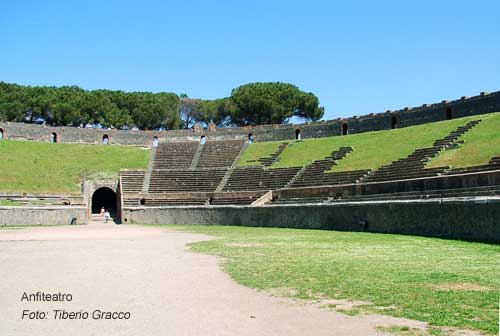
The Amphitheatre of Pompeii is one of the most important surviving monuments of Roman entertainment and the oldest known amphitheatre in the Roman world. Built around 70 BC, shortly after Pompeii became a Roman colony, it could accommodate as many as 20,000 spectators, far more than the population of the city itself. Located in the south-eastern part of Pompeii, close to the city walls and today near the Piazza Anfiteatro entrance, the building hosted gladiatorial combats and other public spectacles that attracted audiences not only from Pompeii but also from neighbouring towns. Its remarkable state of preservation allows visitors to understand how thousands of spectators entered the arena, reached their seats and were organised according to social rank.
The Amphitheatre was built around 70 BC through the initiative of the magistrates Caius Quinctius Valgus and Marcus Porcius. The same two men were also responsible for the construction of Pompeii's Odeion, or Small Theatre, illustrating the scale of public building activity during the first decades of the Roman colony. An inscription connected with the Amphitheatre records that Valgus and Porcius had the building constructed at their own expense and donated it to the colonists. The structure was erected in a peripheral area of the city, immediately beside the fortifications. This location offered important practical advantages: large numbers of spectators arriving from Pompeii and the surrounding territory could reach the arena without having to pass through the most densely occupied streets of the urban centre.
The builders also exploited the terrain and the city's defensive embankment. Parts of the seating were supported by earth rather than by the extensive system of arches and vaults characteristic of many later Roman amphitheatres. This solution made it possible to create an enormous arena with relatively economical construction techniques.
The Amphitheatre of Pompeii is generally regarded as the oldest surviving permanent Roman amphitheatre known today. Its early date makes it exceptionally important for understanding the development of this type of building. The Latin inscription associated with its construction uses the expression spectacula, referring to the seating and spectacle building rather than the later term amphitheatrum. This reflects a period when the architectural form of the amphitheatre was still developing. Unlike the semicircular theatre, an amphitheatre surrounds an elliptical arena with seating on all sides, allowing a large audience to watch spectacles taking place in the centre. Later amphitheatres across the Roman world would become increasingly monumental and technically complex, but Pompeii preserves an unusually early stage in the history of this characteristic form of Roman architecture.
At the centre of the monument is the large elliptical arena where gladiators fought before thousands of spectators. The arena was separated from the seating by a high parapet that protected the audience from the activities taking place below. This barrier was once decorated with paintings connected with gladiatorial combat. The decoration included scenes of fighters and imagery associated with arena spectacles. Some of these paintings were recorded during the excavations but suffered deterioration after exposure. Unlike later monumental amphitheatres such as the Colosseum in Rome, the Pompeian arena does not contain an elaborate underground hypogeum beneath its floor. Gladiators, attendants and equipment entered through passages leading directly into the arena. This relatively simple organisation reflects the early date of the building.
The Amphitheatre could accommodate up to approximately 20,000 people. This enormous capacity shows that spectacles were intended to attract audiences from a much wider area than Pompeii alone. The seating area, or cavea, was divided into sections corresponding broadly to the social hierarchy of Roman society. The lower seats closest to the arena provided the most prestigious positions and were reserved for magistrates and members of the elite. Above them were the media cavea and the higher summa cavea, occupied by broader groups of spectators. The division of the audience allowed thousands of people from different social groups to attend the same spectacle while preserving the distinctions of rank that characterised Roman public life. Inscriptions associated with some of the seating areas recorded the names of magistrates and benefactors who had contributed to the construction or improvement of the building.
Managing the movement of such a large audience required careful planning. The upper seating could be reached through imposing external double staircases, one of the most distinctive architectural features of the Pompeian Amphitheatre. Other passages descended towards the lower areas of the cavea. The system allowed different groups of spectators to reach their seats without everyone having to use the same entrance. The position of the building close to the city walls also helped disperse crowds before and after performances. These practical solutions reveal how Roman architects were already addressing one of the fundamental problems of large entertainment buildings: moving thousands of people efficiently and safely.
Spectators could be protected from the sun by a large fabric awning known as the velarium. The covering was supported by poles and ropes attached around the upper part of the building. Such systems required considerable skill to operate and were probably handled by specialised personnel. The velarium did not create a permanent roof over the arena. Instead, sections of fabric could be extended above the seating to provide shade during spectacles. This was especially important in Pompeii, where public games could last for many hours under the Mediterranean sun. Evidence connected with the support system can still be recognised around the upper parts of the Amphitheatre.
The principal spectacles held in the Amphitheatre were gladiatorial combats. Gladiators were trained fighters who competed individually or in carefully matched pairs using different weapons and fighting styles. Their performances were extremely popular, and surviving inscriptions and graffiti demonstrate that individual gladiators could become local celebrities. Games could be sponsored by magistrates and wealthy citizens as part of public festivals or political celebrations. Paying for an impressive spectacle allowed members of the elite to demonstrate generosity and strengthen their popularity within the community. Advertisements painted on walls around Pompeii announced upcoming games, sometimes providing information about the number of gladiators, the organiser and additional attractions. Graffiti also preserve the names and reputations of individual fighters. For more about these spectacles and the people who fought in them, see Gladiatorial Games in Pompeii.
The popularity of gladiators can also be seen in Pompeian Graffiti, where names and drawings connected with arena spectacles appear among the thousands of messages preserved on the city's walls.
The most famous event in the ancient history of the Amphitheatre took place in AD 59, when a gladiatorial spectacle ended in serious violence between spectators from Pompeii and the neighbouring town of Nuceria. The Roman historian Tacitus describes the episode in his Annals. According to his account, the confrontation began with an exchange of insults. The situation rapidly escalated: spectators began throwing stones and eventually drew weapons. The Pompeians had the advantage because the spectacle was taking place in their city. Many Nucerians were wounded or killed, and news of the violence reached Rome. Emperor Nero referred the matter to the Senate. The punishment was severe: Pompeii was forbidden to hold similar public gatherings for ten years, illegal associations were dissolved and Livineius Regulus, who had organised the spectacle, was exiled together with others considered responsible for provoking the disorder.
The Archaeological Park's guide reports that the restriction was subsequently lifted in AD 62, following the devastating earthquake that struck Pompeii. The incident is one of the earliest documented examples of serious spectator violence associated with a sporting or entertainment event.
The disturbance of AD 59 may also be represented in a remarkable wall painting discovered in Pompeii. The image depicts the Amphitheatre and neighbouring buildings while groups of people fight around the arena. It provides an extraordinary visual impression of the monument and its surroundings during antiquity. Whether every detail should be interpreted as a literal illustration of the event described by Tacitus requires caution, but the painting remains one of the most evocative documents associated with the history of the Amphitheatre. The combination of literary sources, inscriptions, wall paintings and archaeological remains makes the riot unusually well documented for an episode of everyday urban conflict in the Roman world.
Immediately beside the Amphitheatre stands the Large Palaestra, constructed during the early Imperial period. The enormous open courtyard was surrounded by porticoes and was intended principally for the physical and intellectual education of young people. At the centre was a large swimming pool. The proximity of the Palaestra and Amphitheatre created a major recreational area on the eastern edge of the city. The district could accommodate enormous crowds during public spectacles while providing large open spaces separate from the narrow streets of the historic centre.
The powerful earthquake of AD 62 damaged buildings throughout Pompeii. Like other monuments, the Amphitheatre and surrounding district were affected by the period of repair and reconstruction that characterised the final seventeen years of the city's existence. Pompeii was still changing when Vesuvius erupted in AD 79. The city preserved by the eruption should therefore not be imagined as a completely finished urban landscape. Houses, temples and public buildings were being repaired, remodelled or reconstructed after repeated seismic activity. The Amphitheatre nevertheless remained one of the most important symbols of communal entertainment in the city.
The Amphitheatre was among the first large monuments to be identified during the modern excavations of Pompeii. Investigations began in 1748, the year traditionally regarded as the beginning of systematic exploration of the ancient city, while further excavation took place during the early 19th century. Its enormous dimensions helped establish very quickly that the ruins being uncovered belonged to an important Roman settlement. As excavation progressed, the Amphitheatre became one of the most recognisable monuments of Pompeii. Its architectural preservation and dramatic association with gladiatorial games made it particularly important in the modern image of the ancient city.
The Amphitheatre acquired a remarkable second life in modern cultural history in 1971, when Pink Floyd performed inside the ancient arena. The performances were filmed by director Adrian Maben without a conventional audience and became the basis of the celebrated concert film Pink Floyd: Live at Pompeii. Filming took place over several days in October 1971. The extraordinary combination of experimental rock music and an empty Roman amphitheatre created images that became famous around the world and established a lasting connection between Pompeii and the history of modern music. The event was unusual precisely because there was no public audience inside the Amphitheatre. In 2016, guitarist David Gilmour returned to the Amphitheatre for two concerts on 7 and 8 July. These performances marked the first rock concerts in the arena with an audience present.
The Amphitheatre has subsequently continued to host selected musical and cultural events, giving the ancient building a new role while preserving its extraordinary archaeological character.
The Amphitheatre is located in Regio II, close to the Piazza Anfiteatro entrance to the Archaeological Park. Visitors entering from Piazza Anfiteatro encounter it very early in their route, making it an excellent starting point for exploring the eastern area of the ancient city. The neighbouring Large Palaestra, Via dell'Abbondanza and several important houses can easily be included in the same itinerary. Access arrangements can occasionally change because of conservation work, temporary exhibitions or cultural events. Before visiting, check the official information from the Archaeological Park of Pompeii. The Amphitheatre remains one of the most important monuments in Pompeii. Its architecture records the earliest history of the Roman amphitheatre, its walls preserve evidence of gladiatorial culture and mass entertainment, and the riot of AD 59 provides an extraordinary glimpse of the passions generated by ancient spectacles.
Almost two thousand years later, the performances of Pink Floyd added another chapter to the history of a building that has repeatedly brought together architecture, spectacle and collective memory.
At the time of this check, the Park’s opening information states that the Amphitheatre is visible only from the southern entrance. This is a temporary access arrangement, not a change to the monument’s usual role in the visitor route. Check current official access information before visiting.

View this location on the Pompeii Buildings and Places map