



The Stabian Baths, at the intersection of Via Stabiana and Via dell’Abbondanza, are one of Pompeii’s most important bath complexes and among the earliest buildings of their kind known in the Roman world.
Their history began in the 2nd century BC, long before Pompeii became a Roman colony. Over the centuries, the complex was repeatedly enlarged and modernised, adapting to changing bathing practices and, above all, technological innovations in heating and water distribution.
The Stabian Baths were not simply a place to wash. They were a true centre of civic social life, where people could exercise, meet friends and acquaintances, relax and spend part of the day.
One of the earliest Roman bath complexes
Archaeological research has shown that the Stabian Baths were laid out in the 2nd century BC.
The building subsequently passed through at least four major phases of transformation, but the first complex already had broadly the same overall organisation that would be maintained in later centuries.
A laconicum, a room used for heat baths and sweating, was added in a second phase.
The frigidaria used for cold bathing were introduced later, as was the all-important connection to the aqueduct. This revolutionised the baths’ operation by providing a far greater supply of water than earlier systems based on wells, cisterns and rainwater collection.
In the last major phase, the western section was enlarged with the construction of the natatio, an open-air swimming pool, and monumental structures decorated with water features.
The building used by Pompeii’s inhabitants in AD 79 was therefore the result of a history extending over several centuries.
The palaestra
The main entrance from Via dell’Abbondanza led into a large open area used as a palaestra.
Before entering the baths, men could exercise here. Physical training was closely associated with bathing: after exercise, users would normally move to the changing rooms and then through the different bathing chambers.
Porticoes and service rooms surrounded the open space.
The large open-air pool occupied the western side, while other areas were gradually embellished with fountains and nymphaea.
The complex therefore combined exercise, bathing, relaxation and social interaction within a single building.
The men’s section
The men’s section of the Stabian Baths was the larger and more richly decorated of the two.
The circuit began in the apodyterium, or changing room. Niches and other spaces along the walls allowed bathers to leave their clothes before beginning their visit.
From the apodyterium they could reach the frigidarium, used for cold bathing.
The route then continued into the tepidarium, a moderately heated room that allowed the body to adjust gradually to the heat.
From there, bathers finally entered the caldarium, the hottest room in the complex.
This sequence of chambers at different temperatures was one of the fundamental features of Roman bathing.
The frigidarium
The men’s frigidarium is one of the Stabian Baths’ most distinctive rooms.
The circular chamber contained a pool for immersion in cold water. After spending time in the heated rooms, bathers could end their circuit by plunging into the cool water.
The room’s intimate form and rich wall decoration created a setting very different from the large open spaces of the palaestra.
The cold bath was not simply a matter of hygiene: it formed part of a carefully organised circuit in which hot and cold alternated according to well-established practice.
Tepidarium and caldarium
The tepidarium, kept at an intermediate temperature, was reached from the changing area.
It prepared the body for the intense heat of the caldarium or eased the gradual return to cooler temperatures.
The caldarium, by contrast, was the heart of the hot bath.
Temperature and humidity were high here. A large pool held hot water, while a basin with cooler water for bathers could stand at the opposite end.
Water, steam and heated surfaces made these rooms technically sophisticated environments.
How the baths were heated
One of the most remarkable features of Roman bath buildings was their heating system.
In the Stabian Baths, hot air produced in the furnaces circulated beneath raised floors. The floors of the heated rooms did not rest directly on the ground, but were supported by small pillars that created an empty space through which the hot air passed.
This system is known as the hypocaust.
Heat could also rise through cavities and pipes in the walls, warming the entire room.
Portable braziers were also used during some phases.
Beneath the apparent simplicity of the bathing rooms lay a complex infrastructure of furnaces, pipes and suspended floors requiring continuous labour and large quantities of fuel.
Water and the aqueduct
The baths naturally depended on the availability of large quantities of water.
During the earliest phases, local collection and storage systems provided the supply. This changed radically when Pompeii was connected to the aqueduct.
The Stabian Baths were then adapted to the city’s new water network.
Water could be distributed more easily to pools, fountains and the complex’s other installations, making possible a more elaborate bathing system than in the earlier phases.
The development of the Stabian Baths therefore also traces part of the history of Pompeii’s water supply.
The women’s section
Women had a separate section adjoining the men’s baths but smaller in size.
It was entered independently near Via del Lupanare. The word Mulier, “woman”, above the doorway indicated the entrance’s destination.
The women’s section also contained an apodyterium, tepidarium and caldarium, but did not possess the same richness and monumentality as the men’s baths.
The apodyterium retained niches for clothing and decorated floors, while the tepidarium and caldarium had the systems needed for heating and bathing.
Separating men and women was common in bath buildings throughout the Roman world, although arrangements could vary from one city and period to another.
The open-air swimming pool
The natatio, a large open-air swimming pool, stood on the western side of the palaestra.
This area belongs to one of the complex’s later phases of enlargement.
The pool allowed users to swim and cool down after exercise, extending the facilities well beyond the basic circuit of hot and cold rooms.
Nymphaea and fountains were also constructed in the same area, turning the western side of the baths into a monumental space where water and decoration played an important role.
The Stabian Baths were therefore also a place where architecture and water displays contributed to pleasure and public display.
A place for everyday social life
Visiting the baths formed part of daily life for the inhabitants of Roman cities.
Bathing was naturally important for personal care, but the baths served a much broader purpose.
People met friends, clients and acquaintances, discussed business and politics, exercised and spent their leisure time here.
The Stabian Baths should therefore be imagined not as a silent place, but as a crowded and noisy building, constantly filled with bathers, athletes, enslaved attendants and the staff who operated the installations.
The furnaces had to be fed, water heated and distributed, rooms cleaned and customers’ belongings watched.
A complex system of organisation lay behind the pleasure of bathing.
Changes before the eruption
The Stabian Baths continued to be altered during the 1st century AD.
New archaeological investigations have reconstructed these changes more precisely and shown that the complex was continually adapted to the city’s evolving needs.
The earthquake of AD 62 also affected the building.
Like many other Pompeian monuments, the baths underwent repairs and renovation in the years before the eruption.
Some rooms preserve decoration belonging to the city’s final phases, including work carried out in the years immediately before AD 79.
Recent archaeological research
The Stabian Baths continue to provide new information about Pompeii’s history.
Modern excavations have challenged several traditional reconstructions. It was once thought, for example, that traces of the city’s earliest fortifications might lie beneath the baths; new archaeological investigations have not confirmed this hypothesis.
Archaeologists have instead reconstructed the four principal phases in the bath complex’s development more accurately, showing how water distribution, heating systems and the spaces used by bathers changed over time.
In a western area, remains have also emerged of a large house that preceded or was connected with the site’s transformation, including refined mosaic floors. These discoveries demonstrate the complexity of the insula’s urban history.
Nineteenth-century excavations
The complex was systematically brought to light chiefly between 1853 and 1857, with further investigations in 1865.
The discovery of the rooms, heating systems and pools greatly advanced knowledge of Roman baths.
Pompeii gave scholars an exceptional opportunity to examine not only great monumental buildings, but also the technical installations that allowed them to function.
The Stabian Baths thus became a fundamental reference point for the study of ancient bath architecture.
A key setting of Pompeian life
The Stabian Baths reveal an aspect of the city less apparent in its great domus and temples: daily life shared in public spaces.
Citizens could move from exercise to a hot bath, cool off in the pool, meet friends and discuss business without leaving the complex.
At the same time, the building traces centuries of development in Roman technology, from water management and heating systems to the organisation and increasing monumentalisation of the rooms.
For their age, architectural complexity and exceptional state of preservation, the Stabian Baths are among the most important monuments for understanding not only Pompeii, but the entire history of bathing in the Roman world.
Further information
Video
Map
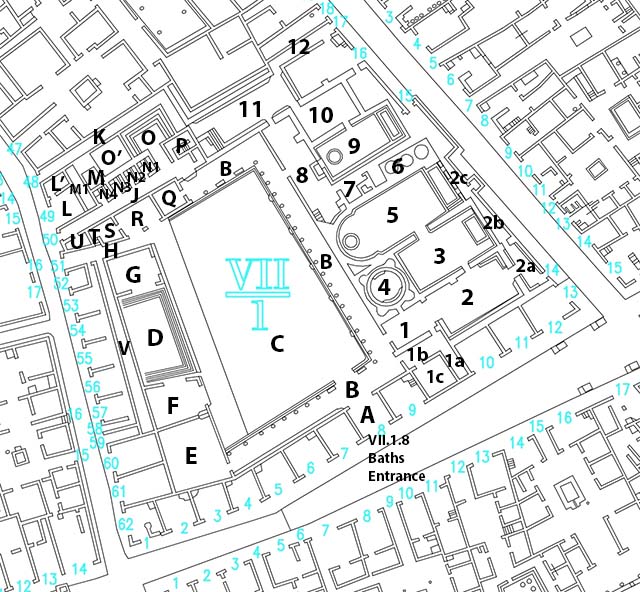
A: Baths entrance and vestibule at VII.1.8
B: South, east and north porticos
[The west side may have formed a bowling court as stone balls were found]
C: Palestra
D: Pool
E: Destrictarium - Room for preparing before, and cleaning after, gymnastic exercise
F: Nymphaeum
G: Nymphaeum
H: Corridor from VII.1.51 entrance. See also VII.1.51
J: Corridor from VII.1.50 entrance. See also VII.1.50
K: Corridor from VII.1.48 entrance leading to women's' baths.
L: Workshop at VII.1.49. See also VII.1.49
L': Rear room of workshop at VII.1.49. See also VII.1.49
M: Rectangular well
M1: Treadmill to lift water
N1: Unheated private bath not in use in 79AD
N2: Unheated private bath not in use in 79AD
N3: Unheated private bath not in use in 79AD
N4: Unheated private bath not in use in 79AD
O: Latrine
O': Windowless room with no door, west of latrine O,
Originally part of latrine O but divided in two in Claudian era
It has a small lunette in the east wall into the latrine O
It was filled with rubble and waste in antiquity
P: Cella and stairs to upper floor
Q: Office of bath superintendent
R: Bowling players room
S: Room on south side of corridor J
T: Rear room in room S with entrance to underground corridor
U: Small room on south side of corridor J, just inside entrance VII.1.50
V: Underground corridor and storeroom
An irregular shaped room carved into the stone below the pool.
Originally this was probably a tomb dating back to 6 or 7th century BC
1: Antechamber to the men's apodyterium
1a: Corridor previously an entrance which was later closed
1b: Corridor to servants waiting room
1c: Servants waiting room
2: Men's apodyterium
2a: Benches outside men's apodyterium
2b: Service corridor at rear of men's baths
2c: Service corridor at rear of men's baths
3: Men's tepidarium
4: Men's frigidarium
5: Men's calidarium
6: Water tanks
7: Praefurnium or furnace room
8: Women's baths anteroom - entrance to praefurnium
8: Women's baths anteroom - entrance to women's baths
9: Women's calidarium
10: Women's tepidarium
11: Women's apodyterium
12: Corridor from entrance VII.1.17
