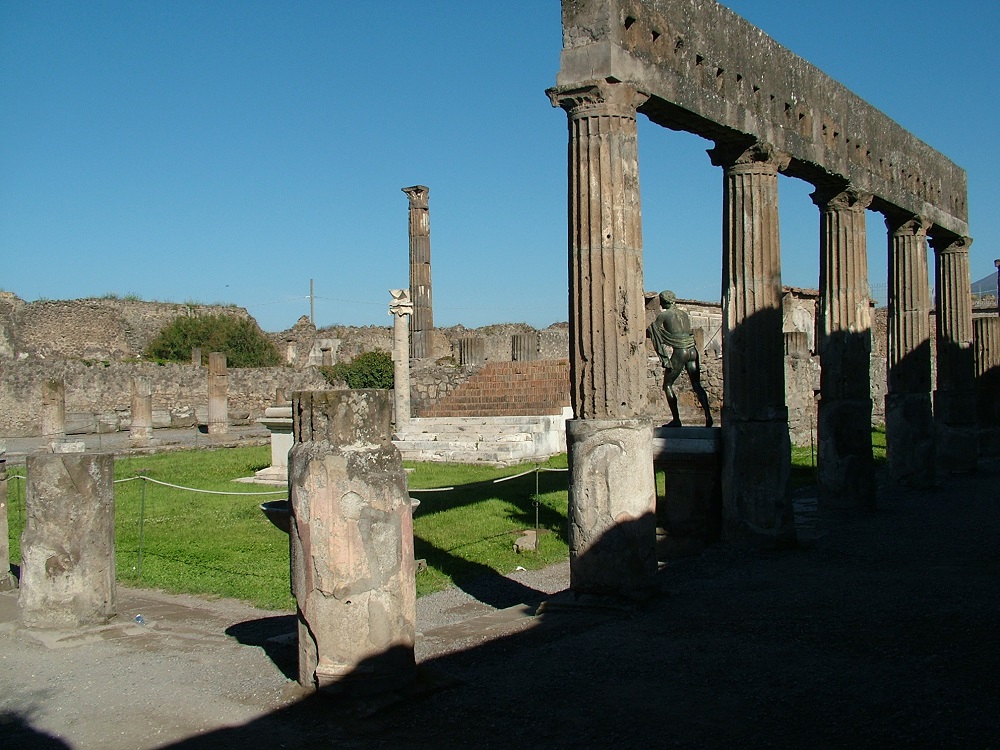
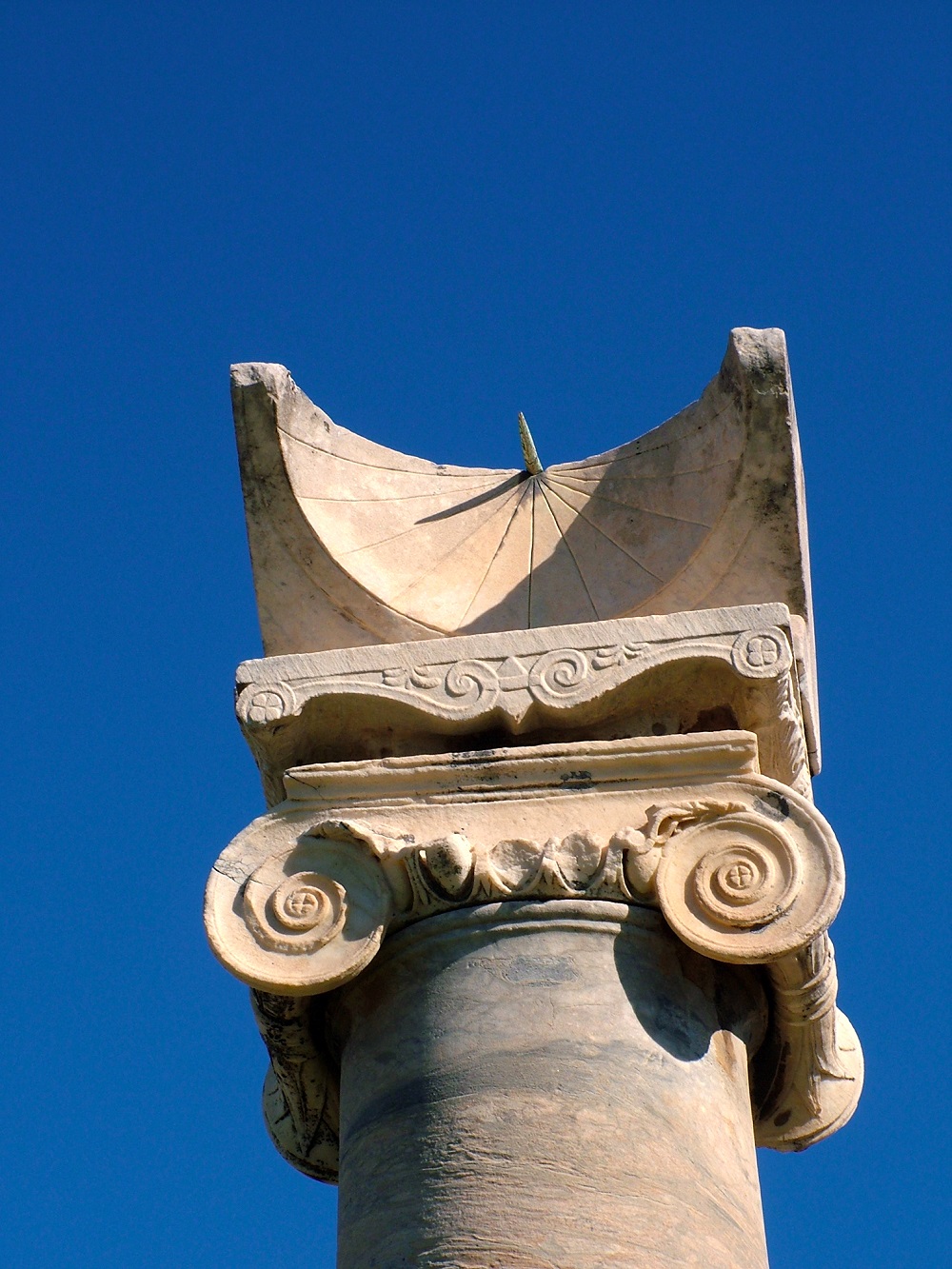
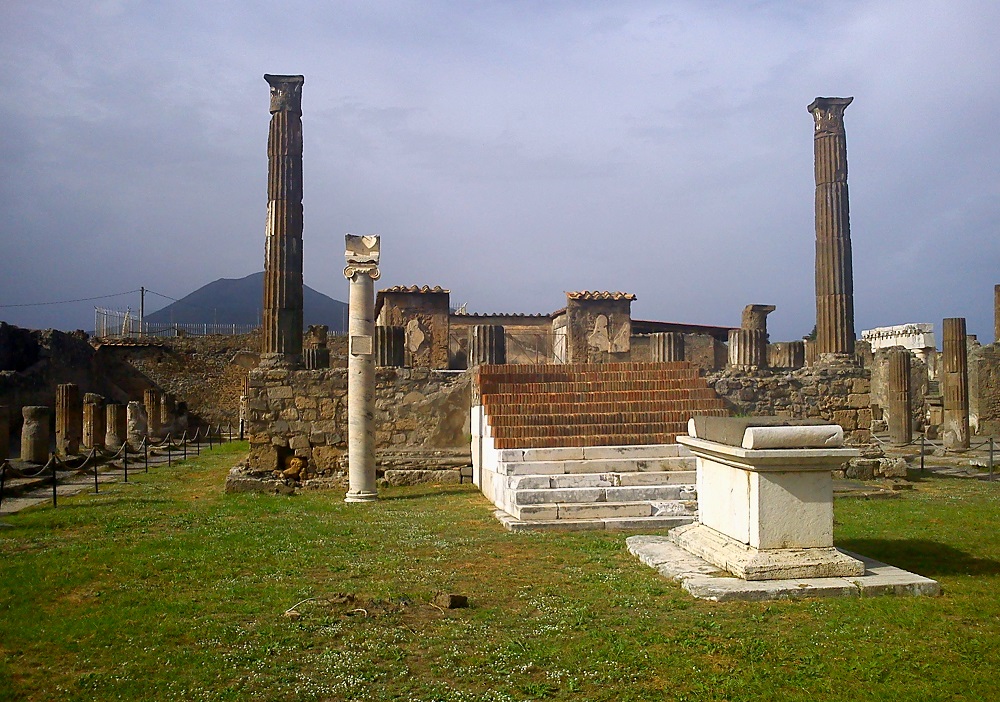
The Temple of Apollo, or more accurately the Sanctuary of Apollo, is one of Pompeii’s oldest and most important places of worship. It stands on the western side of the Civil Forum, in a strategic position along the route leading from Porta Marina to the city’s public centre.
The sanctuary’s history extends far beyond the Roman Pompeii visible today. Archaeological investigations have documented a place of worship here as early as the 6th century BC, when the city was deeply embedded in the Greek and Etruscan cultural world of Campania.
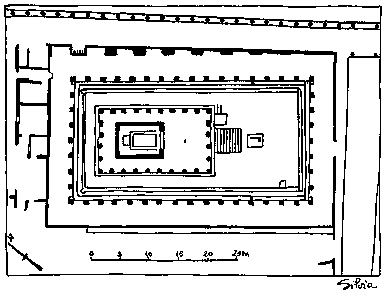
Between the 3rd and 2nd centuries BC, the earlier sanctuary was radically transformed and replaced by a new monumental complex. The layout still recognisable today largely dates to this Hellenistic phase: a temple raised on a podium, surrounded by a great portico and preceded by an altar, within a sacred precinct directly connected with the Forum.
One of Pompeii’s oldest cults
Apollo was one of the most important deities of the Greek world. The god of music, prophecy, light, medicine and order, his cult also spread very early to the cities of Campania.
At Pompeii, the worship of Apollo dates to the earliest phases of urban life.
The existence of a sanctuary dedicated to the god in the Archaic period attests to the city’s deep connections with the Greek and Etruscan communities of the region, particularly those around the Bay of Naples.
The sanctuary therefore belongs to a Pompeii long predating the Roman conquest and provides some of the most important evidence for understanding the city’s cultural origins.
The Archaic sanctuary
Deep excavation has revealed a history far more complex than could be understood from the visible structures alone.
Finds include votive objects, pottery and fragments of terracotta architectural decoration belonging to an Archaic temple of the 6th century BC.
Recent research has also identified an earlier road beneath the western portico, gradually covered by successive transformations of the sanctuary.
Still earlier material has been recovered, including an Iron Age fibula, indicating activity in the area from the earliest phases of Pompeii’s history.
The sanctuary visible today therefore conceals centuries of urban transformation beneath it.
The great Hellenistic transformation
Between the 3rd and 2nd centuries BC, the area was extensively reorganised.
The earlier sacred building was replaced by a new monumental temple erected on a high podium within a spacious court.
The new complex reflected Pompeii’s growing prosperity during the Samnite period and the civic elite’s desire to equip the city with public buildings comparable to those of the great centres of the Hellenistic Mediterranean.
The sanctuary was gradually incorporated into the monumental development of the Forum, while retaining a slightly different orientation from the square. That difference remains a reminder that the cult of Apollo predated the monumental layout of the Roman Forum.
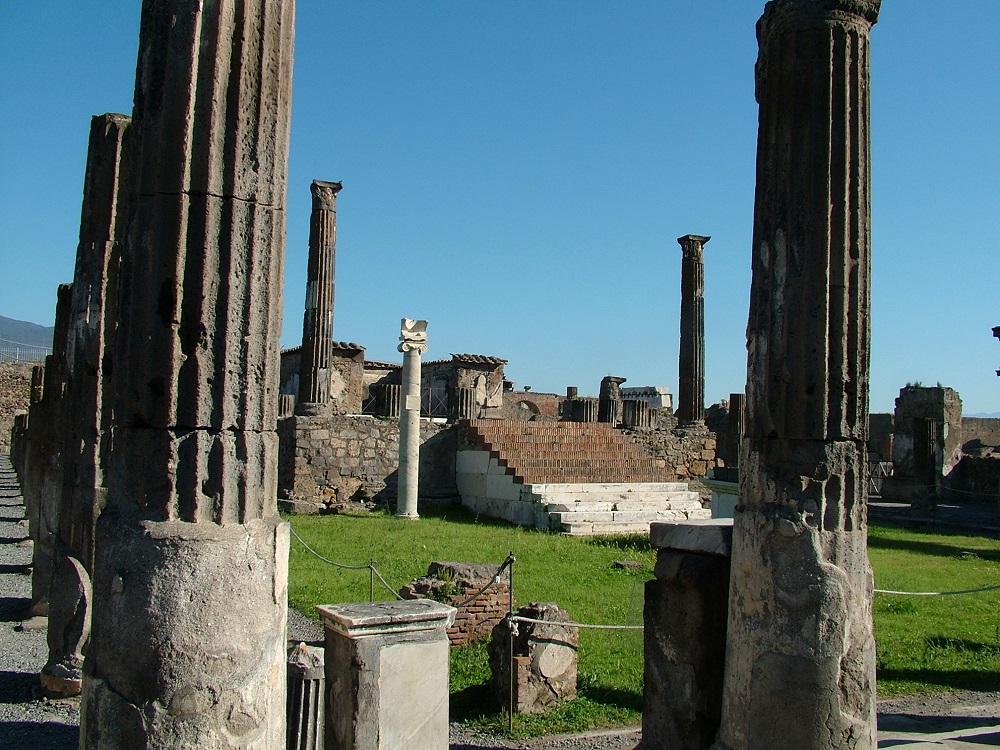
The temple on the podium
The sacred building itself occupied the western part of the court.
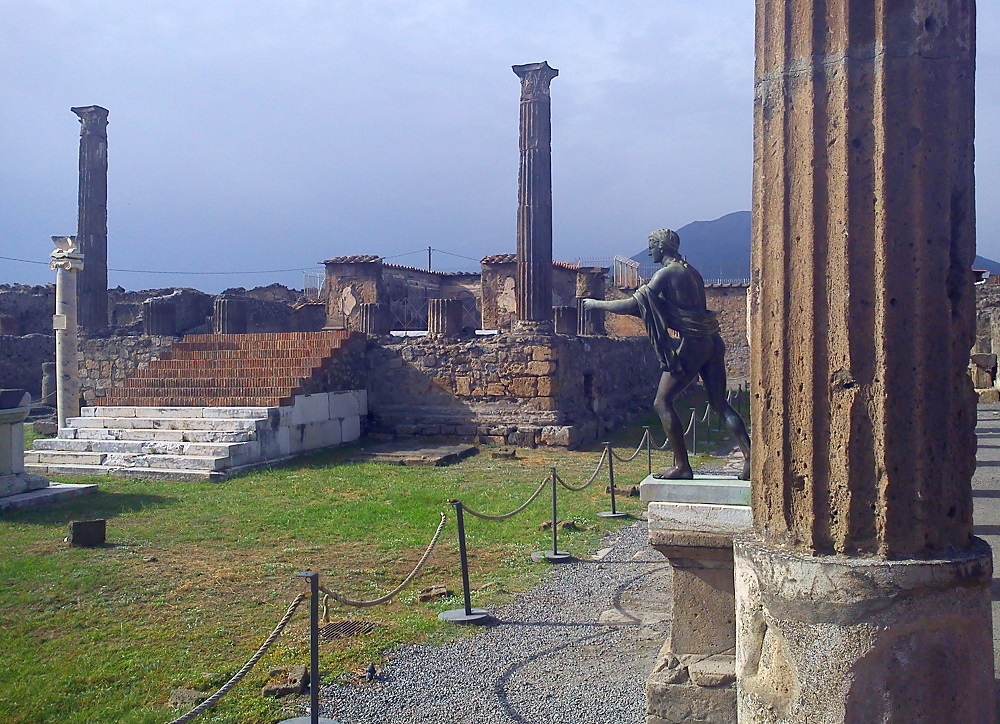
It stood on a high podium reached by a frontal staircase. The elevated position symbolically separated the space reserved for the deity from the area used by worshippers.
Inside was the cella, the temple’s most sacred room, where the divine image was kept.
During the 2nd century BC, the cella was embellished with a refined pavement combining tessellated mosaic and opus sectile, with elements arranged to create a perspectival cube pattern.
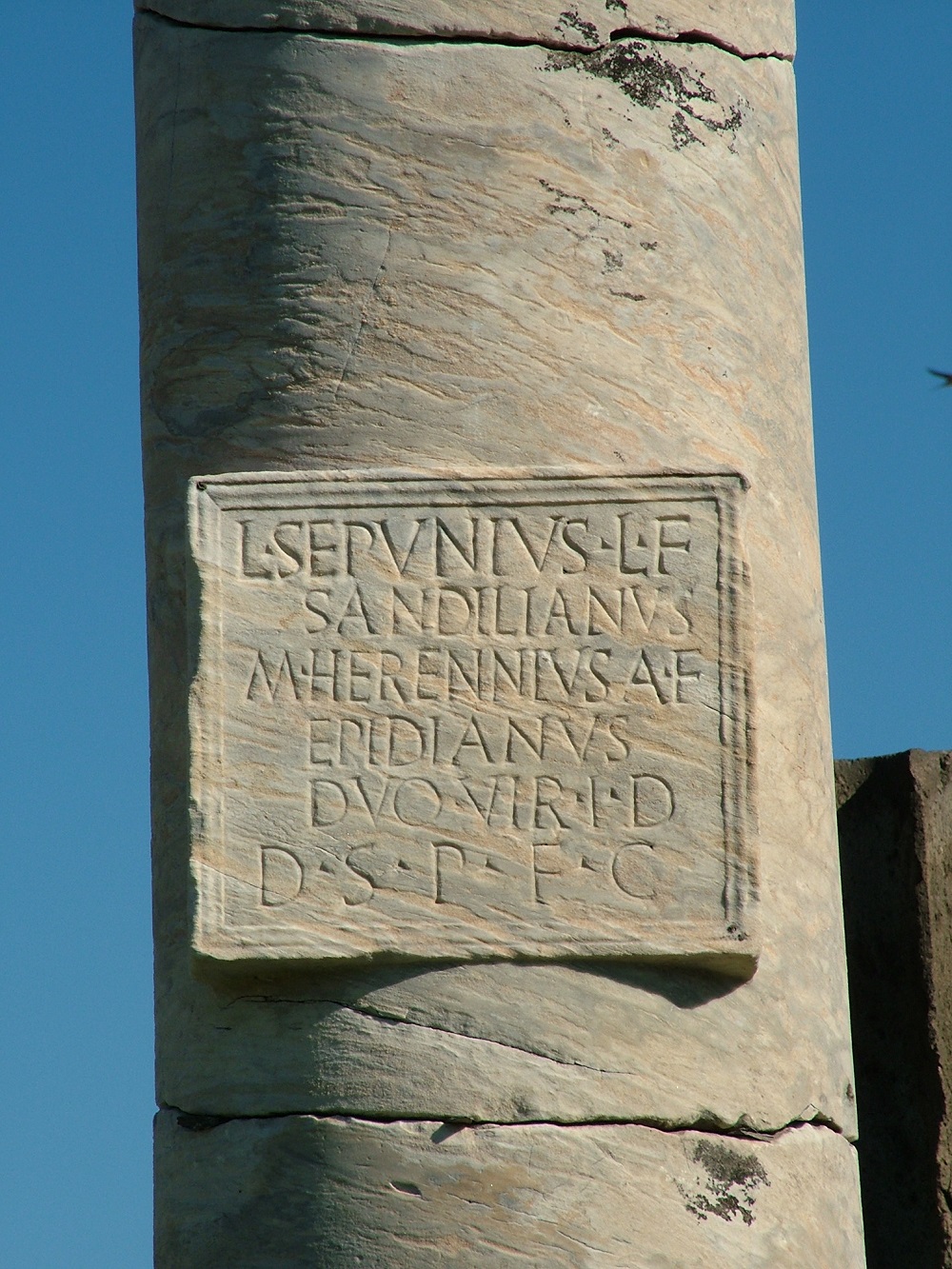
The floor also preserves an inscription in Oscan naming the magistrate responsible for one of the sanctuary’s renovations.
This detail is particularly important because it documents the role of civic institutions in maintaining and embellishing the sacred place.
The great porticoed court
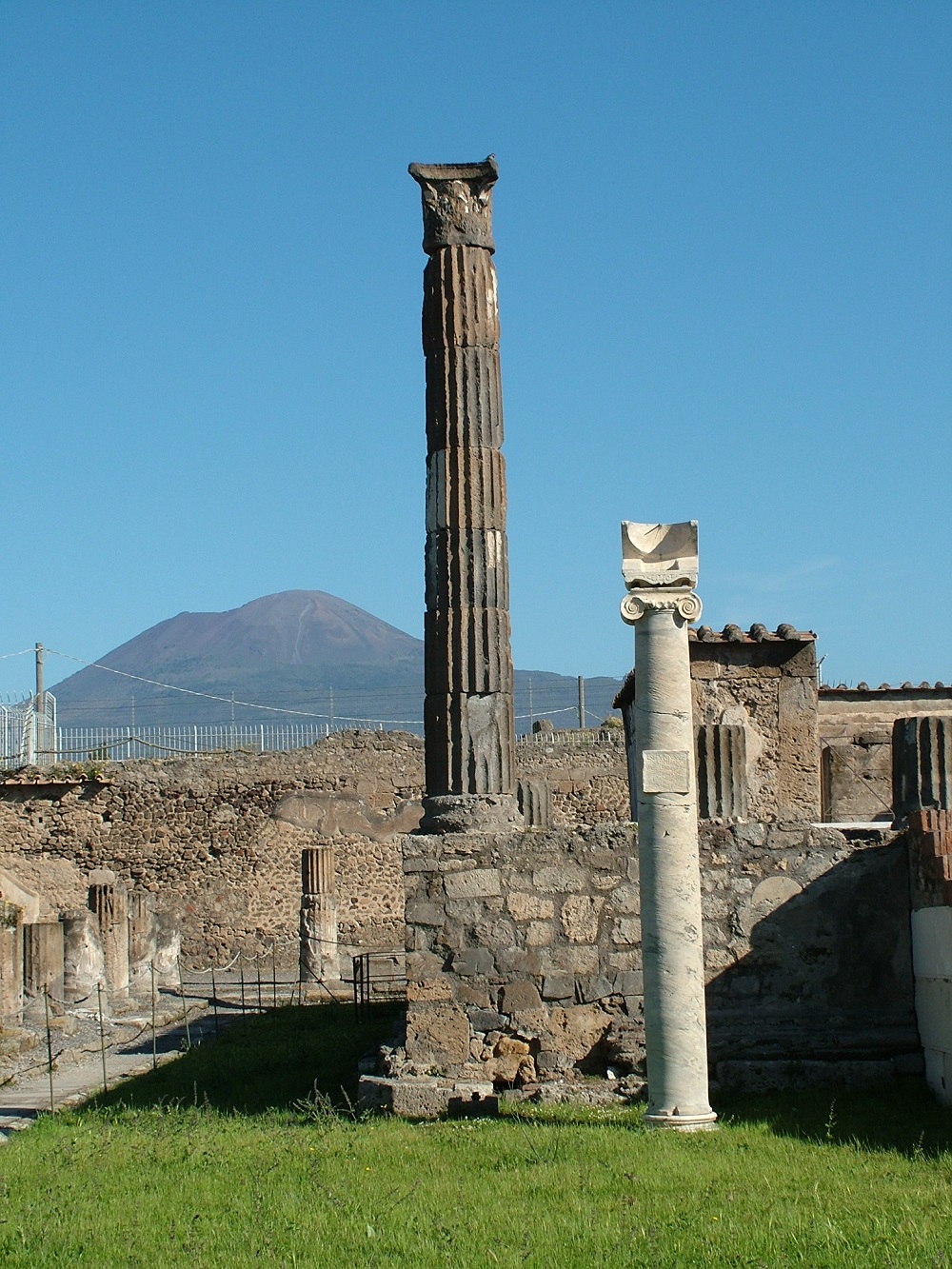
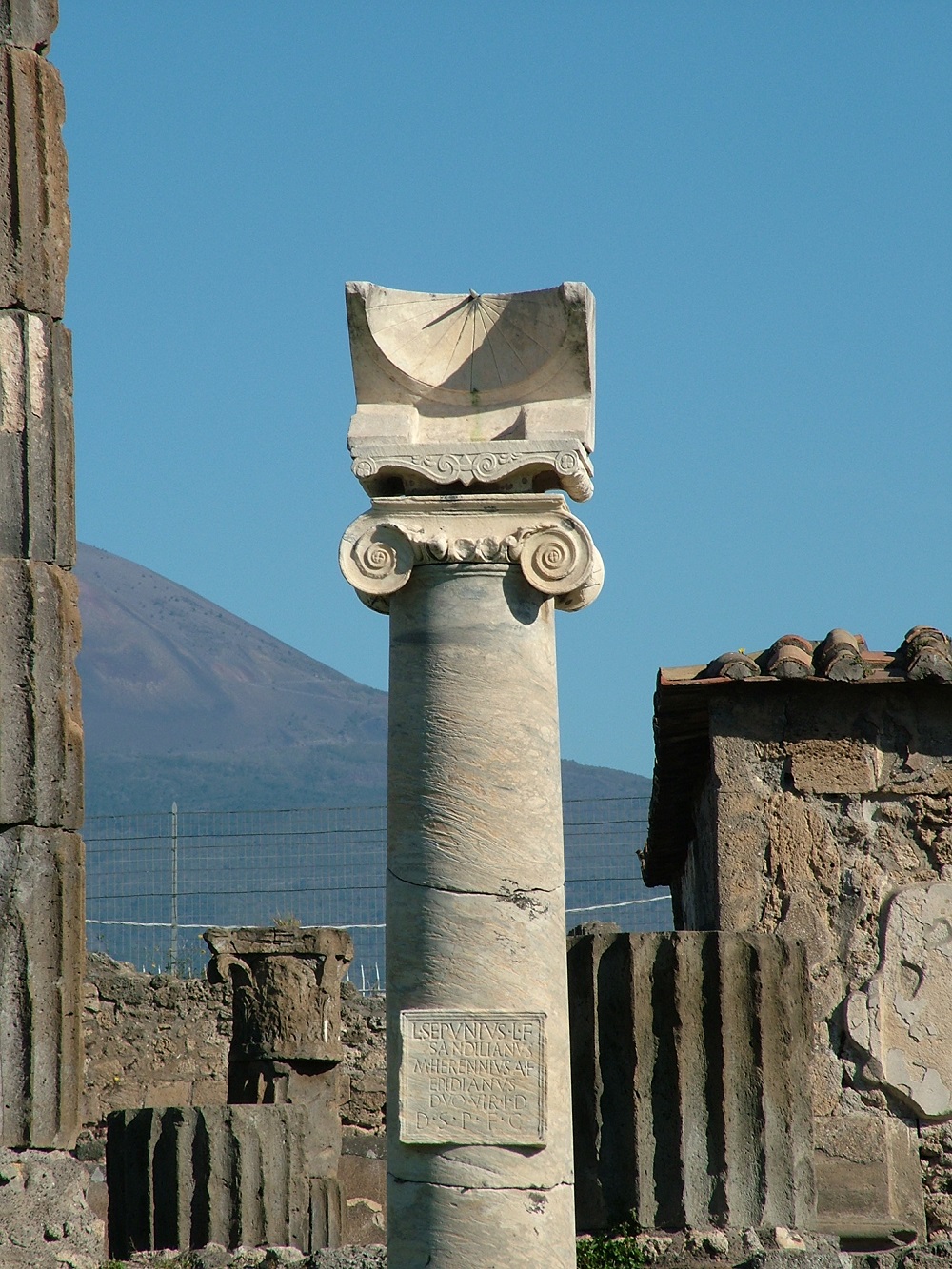
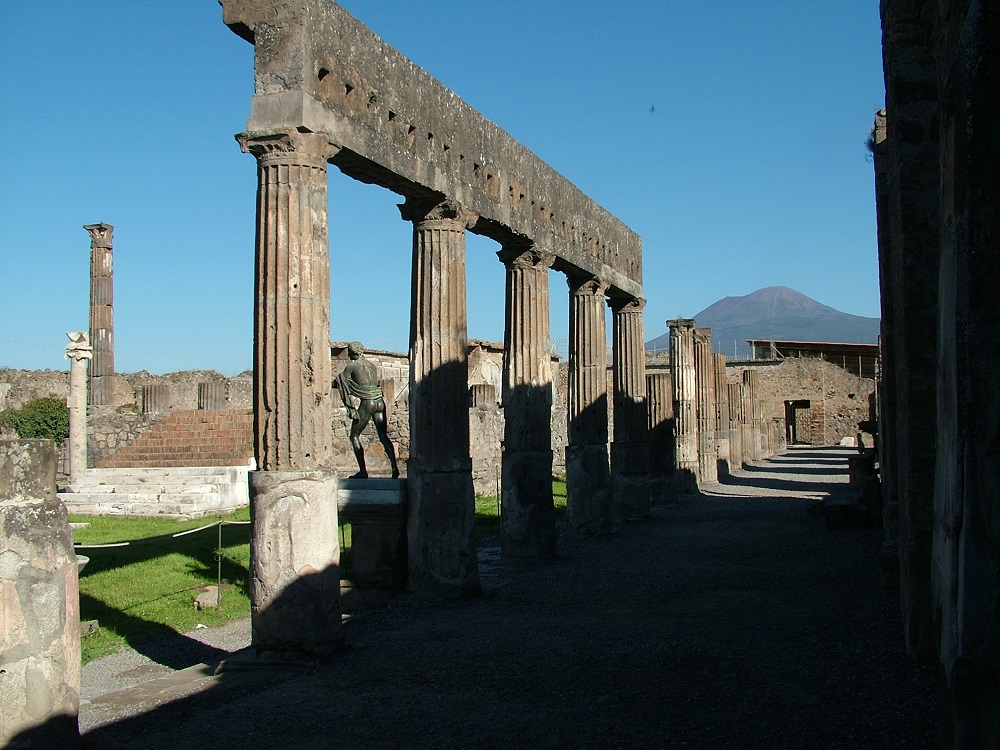
The temple was surrounded by a large court enclosed by a colonnaded portico.
This space separated the sanctuary from the rest of the city while providing worshippers with an area in which to move during ceremonies and religious festivals.
The portico also created a monumental setting: on entering the sanctuary, visitors found themselves surrounded by columns, while the elevated temple dominated the court.
A series of openings on the eastern side connected the complex directly with the Civil Forum.
Religion and public life were therefore not separate. The Sanctuary of Apollo formed an integral part of Pompeii’s political and monumental heart.
The altar
The great altar used for sacrifices stands before the temple at the centre of the court.
In ancient religion, many ceremonies took place not inside the cella but in the open space before the temple.
Animals, incense, wine and other gifts were offered to the deity here.
The temple housed the divine image, while the altar was where the ritual relationship between the community and the god was enacted.
The altar’s central position therefore shows how actively the court was used during celebrations.
Apollo and Diana
The sanctuary’s most famous works include the bronze statues of Apollo and Diana, his twin sister.
Apollo is shown as an archer, his body tense as he draws his bow. Diana stood on the opposite side of the court and was likewise associated with archery and hunting.
The original sculptures, masterpieces in the Hellenistic tradition, are now held in the National Archaeological Museum of Naples.
Copies displayed in the Pompeian sanctuary indicate the statues’ positions within the ancient complex.
The joint presence of Apollo and Diana recalls the close cultic relationship between the divine twins.
Festivals in honour of Apollo
The sanctuary was not merely a place for individual prayer.
Apollo was celebrated in public festivals, the Ludi Apollinares, which could include ceremonies, theatrical performances and other spectacles.
Documentation from the Archaeological Park also associates the god’s celebrations with rites of passage and initiation for the community’s young men and women, who recognised Apollo and Diana as protective deities.
On these occasions, the sanctuary became one of the great centres of Pompeian communal life.
Religion, performance and civic identity all formed part of the same system of public celebration.
The sanctuary and the Forum
One of the Temple of Apollo’s most interesting aspects is its relationship with the Civil Forum.
The sanctuary existed before the square acquired its monumental form and was gradually incorporated into the new civic centre.
During the transformations of the 3rd and 2nd centuries BC, tabernae facing the Forum were also built, their rear wall helping separate the square’s commercial space from the sacred precinct.
The sanctuary and Forum were later connected more monumentally through the portico and the openings on the eastern side.
The area’s evolution thus provides tangible evidence for Pompeii’s transformation from an Archaic and Samnite city into a major Romanised urban centre.
The earthquake of AD 62
Like many Pompeian monuments, the Sanctuary of Apollo was damaged by the great earthquake of AD 62.
Repairs and renovation began over the following years.
Some parts of the building were restored and decorated in the Neronian taste, but the work was probably still incomplete when Vesuvius erupted in AD 79.
The sanctuary buried by the eruption therefore preserved both very ancient structures and interventions made during the city’s final years.
Few Pompeian buildings display an equally clear continuity of worship over so many centuries.
The rediscovery
The Temple of Apollo was one of the first major monuments around the Forum to be brought to light.
The principal excavation campaigns took place in 1816–1817, followed by further investigations during the 20th century and important modern archaeological research.
Excavations in the 20th and 21st centuries have profoundly changed our understanding of the sanctuary.
Investigations beneath the visible structures have identified the earlier phases, reconstructed the Archaic sanctuary and clarified the relationship between the place of worship and the formation of the Forum.
The Temple of Apollo is therefore not simply a monument to be viewed at surface level: it is a true archaeological sequence through the earliest history of Pompeii.
A key place for understanding Pompeii’s origins
The Sanctuary of Apollo is profoundly different from the great monuments built after the Roman conquest.
Its origins lie in a period when Pompeii still formed part of the complex network of relationships among the Italic peoples, Greeks and Etruscans of Campania.
For centuries, the sanctuary continued to be transformed without losing its religious function.
The square, public buildings, language of inscriptions and political system all changed around the temple, but the cult of Apollo continued to occupy the same part of the city centre.
For this reason, the Sanctuary of Apollo VII.7.32 is far more than one of the Forum’s monuments: it is one of the places where almost the entire history of Pompeii can be read, from its Archaic origins to the eruption of AD 79.