




The Villa of the Mysteries is one of Pompeii’s most celebrated monuments and one of the best-preserved residential complexes in the Roman world. It stands outside the city walls, beyond the Herculaneum Gate in the north-western part of Pompeii’s suburbs, in a position that in antiquity offered broad views across the plain towards the Bay of Naples.
The villa takes its modern name from the extraordinary Hall of the Mysteries, decorated with a great Dionysiac frieze in which almost life-size figures participate in a complex sequence of ritual actions. Scholars still debate the precise meaning of the scenes, but the paintings are unquestionably among the greatest masterpieces of the Pompeian Second Style and of ancient Roman painting as a whole.
The Villa of the Mysteries is, however, much more than its famous room. The complex contained luxurious residential quarters, porticoes, panoramic terraces, banqueting rooms, service quarters and an important production area devoted chiefly to processing grapes and making wine. An aristocratic residence and a working farm thus occupied the same property.
A villa outside Pompeii’s walls
To reach the villa from the city, visitors passed through the Herculaneum Gate and followed the suburban road lined with funerary monuments and large estates. This was not an ordinary domus within an urban insula, but a residence able to take advantage of greater space and, above all, its relationship with the landscape.
In antiquity, the coastline was much closer than it is today, and the villa’s panoramic rooms offered views across the plain towards the sea. The setting was integral to the design: porticoes, windows and reception rooms brought the view into the architecture, making the landscape part of the residence’s luxury.
An aristocratic residence and a working farm
Roman villas could serve primarily as places for otium—a retreat for rest, reading, banquets and social life—or as agricultural estates organised for production. The Villa of the Mysteries combined both functions.
Elegantly decorated rooms, panoramic spaces and reception areas stood alongside a working sector equipped for processing grapes and producing wine. This combination is essential to understanding the economy of the Roman elite, whose wealth often came from landownership and the sale of agricultural products.
The villa’s origins and transformations
The earliest phases of the complex date to the 2nd century BC, but the villa was enlarged and transformed repeatedly. One of its principal monumental arrangements dates to the late 2nd and early 1st centuries BC, while some of the most important work took place in 80–70 BC, probably including the great painting cycle in the Hall of the Mysteries.
During the 1st century AD, further rooms changed function and new decoration was added. The earthquake of AD 62 also prompted repairs and alterations, so the villa buried by the eruption of AD 79 reflected almost two centuries of occupation, expansion and change.
The residential rooms
The aristocratic quarters included an atrium, tablinum, cubicula, banqueting rooms, porticoes and living spaces. As in Pompeii’s large domus, the atrium served both as a circulation space and a setting for reception, while the tablinum was closely associated with the owner and could be used to receive visitors and conduct business.
The tablinum also preserved refined decoration with small Egyptian-inspired motifs, reflecting the fascination that Egypt and the eastern Mediterranean held for the Italic and Roman elites. Pompeii was fully integrated into a world in which images, goods and artistic models circulated throughout the Mediterranean.
The Pompeian Second Style
The Villa of the Mysteries preserves some of the most spectacular examples of the Second Style, a form of decoration particularly widespread in the 1st century BC. These paintings transformed walls through painted perspectives, columns, doorways, buildings and landscapes, creating the illusion that rooms extended beyond their physical boundaries.
Imaginary columns and architecture seemed to open rooms onto spaces that did not exist, while real light interacted with painted light. The effect must have been even more spectacular when the villa was furnished, inhabited and lit. Painting was therefore more than decoration applied to walls: it actively shaped the experience of space.
The Hall of the Mysteries
The villa’s most famous room is the so-called Hall of the Mysteries, which gives the entire complex its modern name. A continuous composition runs around the walls against a vivid red background, with figures depicted at almost life size.
The effect is very different from the usual mythological panels set at the centre of walls in Pompeian houses. Here, the figures seem to share the viewer’s space: they sit, advance, dance, turn and interact, transforming the whole room into something resembling a theatrical setting.
This type of decoration is known as megalography, meaning painting with large-scale figures. The Hall of the Mysteries is one of the best-preserved examples from the ancient world.
What “mysteries” means
The term “mysteries” does not mean something mysterious in the modern sense. In the Greek and Roman world, mystery cults were religious traditions characterised by initiation rites reserved for those admitted to a community of initiates, who were forbidden to reveal the details of the ceremonies to outsiders.
The villa’s frieze contains numerous elements associated with Dionysus, god of wine, theatre, transformation and religious ecstasy. Since its discovery, the great composition has therefore been interpreted as depicting some form of Dionysiac initiation. The precise reading of the sequence, however, remains a subject of debate.
Dionysus and Ariadne
At the centre of the composition is Dionysus, accompanied by a female figure generally identified as Ariadne. According to myth, Ariadne helped Theseus escape the labyrinth on Crete after he killed the Minotaur, but was later abandoned on the island of Naxos, where Dionysus met her and made her his wife.
The divine couple’s presence is especially significant because themes of Dionysus, initiation and changes in women’s status seem to intertwine throughout the frieze. The central position of Dionysus and Ariadne nevertheless confirms that the Dionysiac world provides the cycle’s principal religious frame of reference.
The opening scenes of the frieze
At the beginning of the sequence is an elegantly dressed woman, followed by figures reading a text or performing actions that appear ritual in character. Other women carry objects or make gestures that can be interpreted as preparation and purification.
In one traditional reading, these scenes mark the beginning of an initiation. Other scholars see a young woman’s preparation for marriage. No inscriptions or ancient texts explain the images directly, so caution is appropriate: what is visible should be distinguished from modern interpretation.
Silenus, satyrs and masks
The frieze also includes Silenus, an elderly member of Dionysus’ retinue, traditionally regarded as the god’s companion and teacher. Beside him are young satyrs engaged in enigmatic actions: one appears to look into a vessel or reflective surface, while another holds up a mask.
The scene’s precise meaning remains debated. It may allude to ritual revelation, theatre, a transformation of identity, or several ideas at once. The mask is particularly significant, however, because Dionysus was also closely associated with the origins and traditions of Greek theatre.
Fear, ordeal and transformation
Elsewhere in the frieze, a young woman seems to respond fearfully to events. Nearby, a large winged female figure raises a whip, while a young woman bends over the lap of a seated woman.
Traditionally interpreted as ritual flagellation, this scene has been decisive in readings of the cycle as an initiation. We do not know, however, whether it depicts an actual ceremony or a symbolic ordeal within a mythological and religious narrative.
The tension of this episode is followed by a very different scene: a woman dances with vigorous movements recalling those of the maenads, the female followers of Dionysus. The progression from fear through ordeal to dance has reinforced the idea of a journey of personal transformation.
The final scenes
Towards the end of the frieze, a young woman receives assistance as she prepares and adorns herself. Eros also appears, directly evoking love and marriage, while the sequence ends with a large, seated, elegantly dressed female figure.
This final figure has been interpreted in different ways: she may be the mistress of the villa, a woman who is now married, or an idealised figure representing the completion of the journey. There is insufficient evidence to choose conclusively between these interpretations.
The contrast between the final figure’s calm and the strong tension of the preceding scenes nevertheless suggests a transition from an initial condition to a new state of stability.
Dionysiac initiation or marriage?
The best-known reading regards the frieze as a depiction of initiation into the mysteries of Dionysus. This interpretation accounts well for the god, Silenus, the satyrs, dancing, ritual actions and imagery of transformation.
Another major interpretation emphasises marriage. Some scenes do appear to show a young woman’s preparation, while the central presence of the divine couple, Dionysus and Ariadne, may support this reading.
The two interpretations are not necessarily incompatible. In the ancient world, marriage was a true rite of passage and could be expressed through religious imagery. The frieze may therefore combine Dionysiac worship, initiation, marriage and a transformation in a woman’s social status.
An unresolved enigma
Modern interpretations should not be treated as absolute certainties. Scholars continue to debate the frieze’s overall meaning, and no ancient description allows every figure and gesture to be identified securely.
The power of the Hall of the Mysteries also lies in this ambiguity. Its emotions—fear, anticipation, tension, dancing and calm—are readily understandable, while its ritual meaning remains partly elusive. The composition may have been deliberately designed to offer several levels of interpretation.
The new discovery at the House of the Thiasus
In 2025, excavations in Regio IX uncovered another exceptional Second Style megalography devoted to the world of Dionysus in the so-called House of the Thiasus.
The discovery is particularly significant because, for more than a century, the Hall of the Mysteries seemed almost unique in its scale and subject. The new cycle shows that other large Dionysiac compositions adorned elite residences in 1st-century BC Pompeii.
Comparing the two complexes may help scholars better understand the visual language and social significance of these paintings, without automatically making the new discovery a definitive solution to the enigma of the Villa of the Mysteries.
Dionysus, wine and banqueting
Dionysus was especially suited to a great aristocratic residence. The god was associated with wine, music, theatre, pleasure and transformation, all closely connected with the culture of banqueting.
The connection becomes even more evocative when we consider that the same villa contained an important wine-production sector. We cannot, of course, conclude that the frieze was painted because the villa produced wine, but within the estate the same substance held economic, convivial and religious value.
The production quarters and the wine press
Alongside the luxurious rooms was a part of the villa devoted to work, with facilities for agricultural production and particularly for processing grapes.
A large wooden wine press used to crush grapes has also been reconstructed in the production area. The original timber naturally did not survive intact, but archaeological traces made it possible to reconstruct how it worked.
The Vesuvian region was famous for viticulture, and Pompeian wine was traded beyond Campania. The villa thus participated directly in one of the region’s most important economic activities.
The labour behind the luxury
The villa’s splendour depended on the daily labour of a large community of enslaved people, servants and agricultural workers. People had to cultivate the land, make wine, cook, clean the rooms, maintain the open spaces and serve the owners and their guests.
Part of the villa was devoted specifically to service quarters. Some of these areas were not fully explored during the 20th-century excavations because modern buildings prevented further investigation.
New research is therefore gradually extending its focus to the people who kept this large estate running, as well as the spaces used by its owners.
The monumental entrance and the Via Superior
Recent excavations have also improved our understanding of the villa’s original entrance, which opened onto the so-called Via Superior. The doorway formed part of a monumental entrance surmounted by an arch, with features on either side intended to protect the passage from carts.
A stretch of the road paved with lava stone has also been uncovered, allowing a more precise reconstruction of the villa’s relationship with the suburban road network. Owners, visitors and workers travelled along it, as did the agricultural products bound for the city and its markets.
The bench outside the villa
A masonry bench has also been identified in front of the entrance, a seemingly modest detail that offers valuable insight into the estate’s social life.
Similar benches are known outside some large Pompeian houses and may have been used by people waiting to be received by the owner. In Roman society, an elite man maintained a network of relationships with his clientes, who might attend the traditional morning salutatio.
Traces of graffiti have also been identified near the bench, small marks probably left by people waiting outside the entrance. This detail contrasts sharply with the aristocratic interiors: while owners lived among grand paintings and panoramic rooms, others might remain outside waiting to be received.
The villa as a setting for social hierarchies
The architecture of the Villa of the Mysteries thus also reflected the deep divisions within Roman society. Owners, distinguished guests, clientes, enslaved people and workers did not use the same rooms or move through the complex in the same way.
The grand frescoed rooms belonged to the world of the aristocratic family and its guests, while the production and service sectors were for those who worked on the estate. The newly discovered entrance and bench reveal even more clearly how outdoor spaces also helped to organise this hierarchy.
The earthquake of AD 62
The great earthquake of AD 62 damaged Pompeii and the surrounding area, beginning a long period of repairs. The Villa of the Mysteries also underwent alterations and other work, and some rooms probably changed function during the final seventeen years before the eruption.
The production sector remained very important, and by AD 79 the villa differed from the splendid residence decorated in the 1st century BC. Like almost all major Pompeian buildings, it should therefore be understood as a continually evolving complex.
The eruption of AD 79
In AD 79, the eruption of Vesuvius brought life on the estate to a permanent end. Pumice, ash and subsequent volcanic deposits buried the complex along with the city and surrounding countryside.
The destruction was, of course, a tragedy for the people living in these areas, but it also created the exceptional conditions that preserved the paintings. The Hall of the Mysteries survives precisely because it remained sealed beneath volcanic material for centuries.
Its discovery in the 20th century
The Villa of the Mysteries was discovered relatively late compared with many Pompeian monuments. The first explorations took place in 1909–1910, under a private excavation concession associated with Aurelio Item, which is why the complex was initially also known as Villa Item.
That name therefore has no connection with an ancient Roman owner. Only later, as the great painting cycle became increasingly famous, did the name Villa of the Mysteries become firmly established.
Amedeo Maiuri’s excavations
Between 1929 and 1930, Amedeo Maiuri launched a major systematic campaign to uncover and protect the entire complex then accessible. The problem was not purely archaeological: paintings already discovered were threatened by damp, water infiltration and structural fragility.
Maiuri recognised that proper conservation of the frescoes required the whole building to be studied and protected. He also secured funding from the Banco di Napoli to support the work, an interesting episode in the history of archaeological conservation.
In 1931, he published a comprehensive study of the villa that became a fundamental reference for subsequent research.
Excavations continue today
Research into the Villa of the Mysteries did not end with Maiuri’s excavations. Some sectors remained inaccessible for decades because modern buildings stood above or beside the archaeological area.
Once some of these structures had been demolished, investigations could resume, uncovering further stretches of the Via Superior, the monumental entrance, the outdoor bench and rooms in the estate’s less familiar areas.
Traces of illicit excavation tunnels have also been identified, demonstrating the continuing risks to buried archaeological heritage. Illegal digging causes more than the loss of objects: above all, it destroys the context that enables archaeologists to interpret finds correctly.
New structures across the road
Structures belonging to another archaeological complex, including walls and a cryptoporticus, have also been identified on the opposite side of the Via Superior. The exact nature of these buildings remains to be clarified.
The new discoveries show that the landscape around the Villa of the Mysteries was much more complex than it appeared after the 20th-century excavations, and that Pompeii’s suburbs still preserve much information awaiting recovery.
Conserving the paintings
Since its discovery, conserving the Hall of the Mysteries has become one of the Archaeological Park’s principal challenges. A fresco protected for almost two thousand years suddenly enters a different environment when uncovered, facing humidity, temperature changes, dust, light and microorganisms.
Protecting the paintings therefore means monitoring not only pigments and plaster, but also roofs, drainage, walls and ventilation. Numerous restoration and consolidation projects have taken place during the 20th and 21st centuries, making progressive use of increasingly sophisticated analytical techniques.
Technology and conservation
Recent solutions also seek to reconcile conservation with sustainability. Some roofs have been fitted with photovoltaic systems designed to minimise their visual impact on the monument and supply part of the energy needed to operate and illuminate the complex.
This is a telling example of how archaeological conservation involves more than keeping ancient buildings unchanged: it requires a continual balance between research, restoration and the use of contemporary technologies.
A villa between town and country
The location of the Villa of the Mysteries perfectly expresses its character. It stood outside the walls, yet close enough to maintain daily contact with Pompeii; it was an aristocratic residence and a working farm; it faced the sea but depended on the surrounding countryside.
The complex thus brought together city, countryside, agriculture, trade and aristocratic life. This combination makes it a fundamental source for understanding Roman society.
Wine as a product, pleasure and symbol
Wine had several distinct but closely connected meanings at the Villa of the Mysteries. It was an agricultural product intended to generate income, an essential drink at banquets and, at the same time, a substance symbolically associated with Dionysus.
The same substance made in the agricultural quarters could therefore be sold, consumed in the aristocratic rooms and evoked through the religious imagery of the Hall of the Mysteries. Economy, social life and religious culture met within a single estate.
Women and the Dionysiac world
The strong female presence in the frieze has contributed to the long debate about women’s relationship with the worship of Dionysus. Women could play an important role in certain forms of Dionysiac devotion in antiquity, but we cannot claim that the Hall of the Mysteries literally depicts a ceremony actually held in the villa.
The paintings may combine ritual elements, myth, marriage and idealised representation. Overly simple reconstructions should therefore be avoided: the room is not a photographic record of a rite, but a complex work of art intended for an educated audience.
A masterpiece still in its original setting
One of the frieze’s most extraordinary qualities is that it can still be viewed in the room for which it was created. Many Pompeian paintings discovered in the 18th and 19th centuries were detached and moved to museums, losing their original relationship with the architecture.
In the Hall of the Mysteries, we can experience directly the scale of the figures, the position of the doorways and the way the cycle surrounds the viewer. This experience cannot be recreated by looking at a single fresco displayed in isolation on a museum wall.
One of Pompeii’s essential monuments
The Villa of the Mysteries – Suburban Area should be seen as far more than a house containing a famous painting cycle. It offers insights into Roman elite life, the relationship between villas and landscape, agricultural production, the wine trade, enslaved labour, Second Style painting, the world of Dionysus, rites of passage, relationships between patrons and clientes, and the development of archaeological research itself.
The Hall of the Mysteries inevitably remains the heart of the complex, but its meaning becomes far richer when viewed within this history. Behind the images of Dionysus, Ariadne, satyrs, women and winged figures was a real, inhabited and productive estate, frequented by owners, guests, clientes, servants and workers.
New investigations also demonstrate that, despite more than a century of research, the villa has not yet revealed everything it preserves. This combination of extraordinary beauty, historical complexity and continuing capacity to raise new questions makes the Villa of the Mysteries one of the most important sites not only in Pompeii, but in Roman archaeology as a whole.
Visiting Pompeii and the Villa of the Mysteries with a guide
The Villa of the Mysteries lies outside Pompeii’s main urban core, so visiting it requires a wider itinerary than one confined to the central buildings of the ancient city.
For visitors wishing to understand both Pompeii’s main monuments and the villa’s frescoes and rooms, a guided tour of Pompeii and the Villa of the Mysteries with an archaeologist is available.
The itinerary lasts approximately three hours and includes some of the ancient city’s principal sites before continuing to the Villa of the Mysteries.
Visitors who prefer to explore independently should check which ticket is required for the suburban villas and confirm the latest opening hours before their visit.
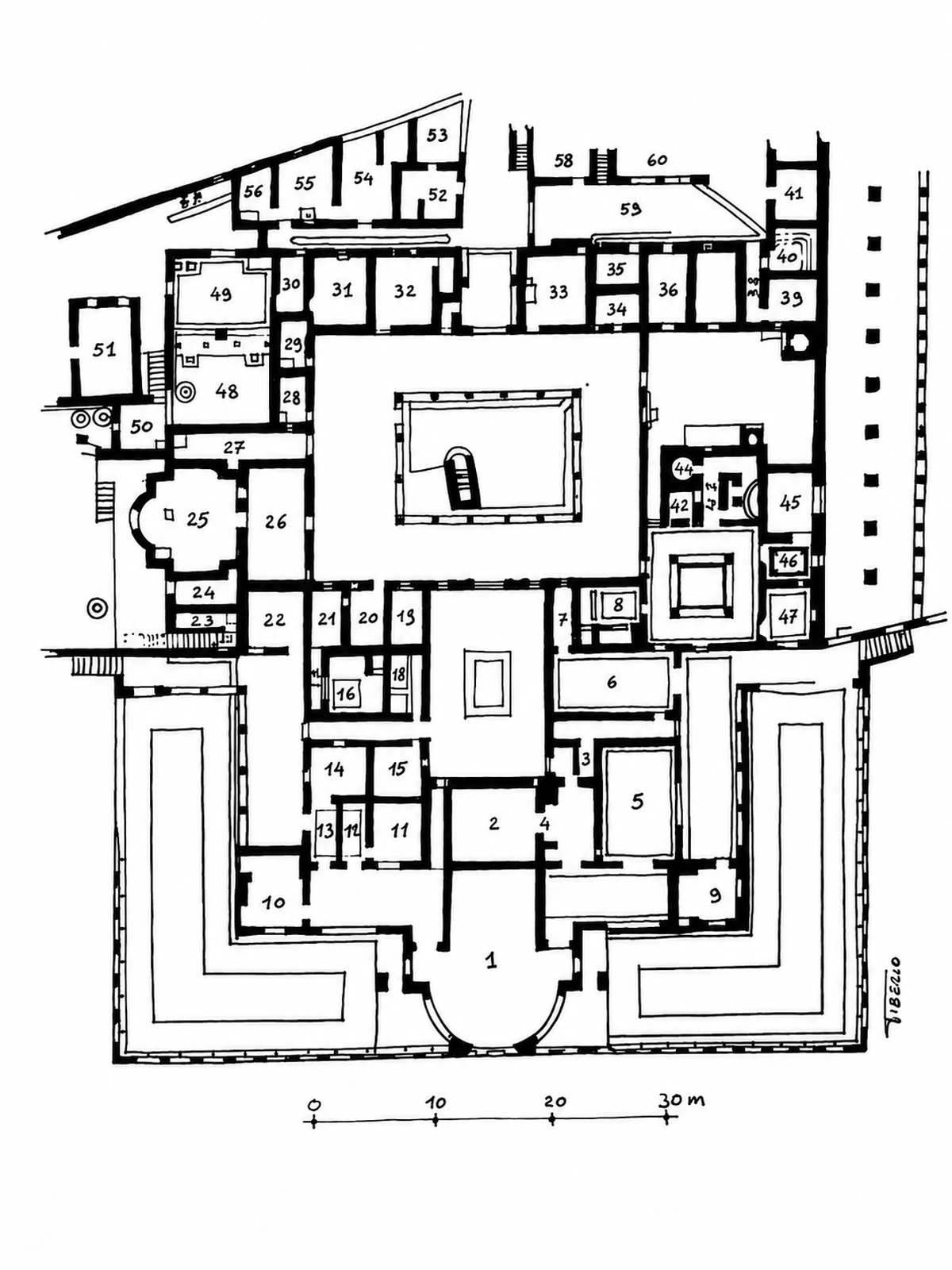
Floor plan of the Villa of the Mysteries
The floor plan helps explain the building’s complexity and the relationship between its residential rooms, courtyards, service quarters and production areas.


View this location on the Pompeii Buildings and Places map