View all buildings and places on the map
The Temple of Asclepius, in Regio VIII at the junction of Via Stabiana and Via del Tempio d’Iside, is the smallest known monumental place of worship in Pompeii.
Despite its modest size, the sanctuary is especially important because it reveals the long development of a sacred area established in the Samnite period and transformed over the centuries until the eruption of AD 79.
For many years the building was also known as the Temple of Jupiter Meilichios. More recent archaeological research has led scholars to abandon this identification. The most convincing attribution today is to Asclepius, known to the Romans as Aesculapius, the god of medicine and healing, who was probably worshipped here together with his daughter Hygieia, goddess of health.
Asclepius, god of medicine
In Greek tradition, Asclepius was the god associated with medicine and healing.
According to myth, he was the son of Apollo and learned the medical arts from the centaur Chiron.
His cult spread throughout the Mediterranean, and many sanctuaries dedicated to him became places of healing where religion and medicine were closely connected.
The best-known symbol of Asclepius is the snake coiled around a staff, still used today as an emblem of medicine.
The god was often worshipped alongside his daughter Hygieia, the personification of health and the prevention of disease. The modern word “hygiene” derives from her name.
Why the temple is attributed to Asclepius
The identity of the sanctuary has been debated for more than two centuries.
During the 18th-century excavations, two terracotta cult statues and a bust were found inside the cella. They are now in the National Archaeological Museum of Naples.
The figures have been interpreted as Asclepius and Hygieia, accompanied by a bearded male head.
Another particularly significant piece of evidence is the reported discovery during the early excavations of a case containing medical instruments.
The combination of divine images and objects connected with medicine makes the attribution to Asclepius the most convincing explanation currently available.
Archaeologists nevertheless remain cautious, since the records of the 18th-century excavations lack the precision of modern fieldwork.
The former name: Temple of Jupiter Meilichios
For a long time, the sanctuary was identified with the cult of Jupiter Meilichios.
The hypothesis was based chiefly on an Oscan inscription found near Porta Stabia in the 19th century.
Jupiter Meilichios was a deity of Greek origin, related to Zeus Meilichios and characterised by chthonic aspects associated with the earth, the dead and the underworld.
The name Meilichios can be translated approximately as “benevolent” or “gentle”.
There was, however, an evident problem: sanctuaries dedicated to this deity were normally situated outside inhabited centres, whereas the small Pompeian temple stood within the city, in one of its most important public districts.
New discoveries in the sacred area of Fondo Iozzino, outside Pompeii’s walls, have enabled archaeologists to associate the evidence for Jupiter Meilichios with that location.
For this reason, the identification of the temple at VIII.7.25 with this deity is now considered outdated.
A very ancient sanctuary
Archaeological research shows that religious activity in this area began long before the construction of the monumental temple visible today.
An initial phase can be dated between the late 3rd and early 2nd centuries BC.
At that time, a temple building probably did not yet exist.
The sacred area seems to have consisted principally of an open space with an altar and a male cult statue.
Around the middle of the 2nd century BC, walls defined the area more precisely.
Only later did the sanctuary acquire the monumental form that can still be recognised today.
Monumentalisation in the Sullan period
A decisive transformation took place during the Sullan period, between the late 2nd and early 1st centuries BC.
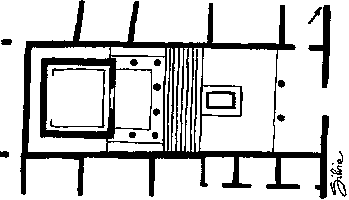
The temple proper was constructed at this stage, together with the pronaos, cella and probably the entrance vestibule.
The sanctuary thus assumed the typical form of an Italic temple, built on a high podium and strongly oriented towards a dominant façade.
Visitors entered from the street, passed through a vestibule and reached a small courtyard.
Ahead of them rose the altar, the broad flight of steps and the temple.
Despite the sanctuary’s modest dimensions, the sequence of spaces was carefully designed to create a powerful monumental effect.
The courtyard
Beyond the entrance lay an open courtyard.
The large tuff altar still stands at its centre.
The courtyard was relatively narrow, and the high walls on either side accentuated the temple’s presence at the far end.
Unlike major sanctuaries such as those of Apollo or Isis, the complex had no extensive porticoes designed to accommodate large crowds.
Its intimate character may have been particularly appropriate for a cult in which a personal relationship with the deity and the request for healing were of great importance.
The tuff altar
The large tuff altar at the centre of the courtyard is one of the sanctuary’s best-preserved features.
It has refined architectural decoration with Ionic volutes and a Doric frieze.
Recent studies indicate that it was probably placed in its present position during the Sullan period, when the entire complex was monumentalised.
Sacrifices and offerings to the deity were performed here.
As in other sanctuaries of the ancient world, ritual activity took place chiefly outside the cella, before the image of the god.
The steps
Behind the altar, a steep flight of steps led up to the temple proper.
The marked difference in height between the courtyard and the cella emphasised the sacred character of the building.
Those who climbed towards the temple gradually left the space used by worshippers and approached the area reserved for the deity.
The arrangement reflects a typical feature of Italic religious architecture: the temple was not intended to be viewed equally from every side, but had a strongly dominant principal façade.
The pronaos
The steps led to a small pronaos, the colonnaded space in front of the cella.
The temple was tetrastyle, with four columns across the façade and further columns along the sides.
The Corinthian capitals were decorated with especially interesting bearded male heads.
Much of the upper structure has been lost, but the surviving remains still make the building’s overall organisation clear.
The pronaos formed the transitional zone between the public courtyard and the sacred cella.
The cella
The cella was the religious heart of the sanctuary.
According to the accounts of the 18th-century excavations, it contained a platform supporting the terracotta cult statues.
The two principal figures are traditionally identified as Asclepius and Hygieia.
The original statues are no longer in the temple and are now held by the National Archaeological Museum of Naples.
The cella also contained a small stuccoed altar, now lost.
The room must therefore be imagined as far richer than the bare masonry visible today.
The cult statues
The statues found in 1766 are among the most important pieces of evidence for interpreting the sanctuary.
They were made of terracotta, a material widely used for sacred images in Italic culture.
A bearded male figure has been associated with Asclepius, while the female figure may represent Hygieia.
The style of the images is consistent with the Hellenistic religious world in which the cult of Asclepius became widespread.
Their presence offers further evidence of the deep cultural connections between Pompeii and the Greek world.
Religion and medicine
The Temple of Asclepius illuminates an aspect of ancient society very different from the modern separation between medicine and religion.
For Greeks and Romans, healing could depend simultaneously on the skill of physicians, the remedies they used and divine intervention.
A person suffering from illness could appeal to Asclepius for protection or recovery.
At major sanctuaries dedicated to the god, ritual practices sometimes involved patients spending the night in the sanctuary while awaiting divine guidance through dreams.
We do not know whether similar practices took place in the small Pompeian sanctuary.
The cult nevertheless shows how closely health and religion were connected in ancient daily life.
The case of medical instruments
Particularly intriguing is the report in the records of the earliest excavations that a case containing medical instruments was discovered.
The find is one of the arguments used to connect the sanctuary with Asclepius.
Numerous surgical and medical instruments have been recovered from other buildings in Pompeii, demonstrating the high level attained by Roman medicine.
At the temple, however, the presence of these objects alongside images attributed to the god of medicine has special significance.
Although caution is required when interpreting a discovery recorded in the 18th century, the association considerably strengthens the attribution of the sanctuary.
The theatre district
The Temple of Asclepius stands in one of the most important parts of Regio VIII.
Very close by are the Temple of Isis, Large Theatre, Odeion, Triangular Forum and Samnite Palaestra.
This concentration of religious, cultural and entertainment buildings makes the district especially significant.
The Sanctuary of Asclepius existed alongside very different cults.
Isis, a deity originating in Egypt, was worshipped only a few metres away, while one of the city’s earliest sanctuaries survived in the Triangular Forum and was probably dedicated to Athena and Hercules.
The district therefore provides exceptional evidence for the religious plurality of Pompeii.
The earthquake of AD 62
The Temple of Asclepius also underwent work after the major earthquake of AD 62.
Archaeological research distinguishes a final phase marked chiefly by repairs to damaged structures.
The earthquake does not appear to have resulted in a complete rebuilding of the complex.
The general layout remained essentially that created during the Sullan monumentalisation.
By the time Vesuvius erupted in AD 79, the small sanctuary therefore had a religious history stretching back almost three centuries.
Discovery in the 18th century
The temple was one of the first monuments in the district to be explored.
In 1766, excavators reached the cella and found the cult statues and terracotta bust.
In 1798, the courtyard, large altar, flight of steps and other rooms were uncovered.
Further investigations took place in 1940.
The methods used in the 18th-century excavations explain why much information about the stratigraphy and the original context of the finds has been lost.
Modern archaeologists often have to reconstruct the building’s history by combining early journals and drawings with the surviving structures and new stratigraphic trenches.
New archaeological research
Since 2018, the sanctuary has once again been the focus of a major research project.
Investigations by the Federico II University of Naples in collaboration with the Archaeological Park of Pompeii have examined the pronaos, courtyard, service rooms and surrounding spaces.
The 2023 campaign provided new evidence for the chronology and successive phases of occupation in the area.
This research is testing hypotheses formulated many decades ago and reconstructing the sanctuary’s history with greater precision.
One of its most important conclusions is the definitive rejection of the former identification as the Temple of Jupiter Meilichios.
A sanctuary still to be understood
Despite more than two centuries of study, many questions about the Temple of Asclepius remain open.
Archaeologists are working to establish more precise dates for its building phases, the transformations of the surrounding rooms and the exact nature of the cult.
The attribution to Asclepius is currently the most convincing, but archaeological research avoids conclusions more certain than the evidence allows.
This is precisely what makes the small sanctuary so compelling.
It represents not only what is known about religion in Pompeii, but also the way in which new discoveries can overturn interpretations accepted for almost two centuries.
With its long history, its connection with the cult of healing and the important research still under way, the Temple of Asclepius at VIII.7.25 is one of the most significant places in the religious and cultural district of Regio VIII.