




View all buildings and places on the map
The Large Theatre of Pompeii, in Regio VIII at the foot of the Triangular Forum, is one of the city’s earliest and most important public buildings. Constructed to exploit the natural slope of the hill, it still preserves the relationship between architecture, landscape and performance that characterised the great theatres of the ancient world.
Its origins date to the mid-2nd century BC, when Pompeii was still strongly influenced by Hellenistic culture. The theatre was enlarged and altered several times over the following centuries, especially after the city entered the Roman sphere and during the Augustan period.
By AD 79, the Large Theatre was therefore the product of a long architectural history: a building created according to Greek models and gradually adapted to the requirements of Roman entertainment and society.
The theatre and the Triangular Forum
The location of the Large Theatre was not accidental. It stands on the slope of the hill occupied by the Triangular Forum, one of Pompeii’s oldest monumental areas and the site of the Archaic sanctuary dedicated to Athena and Hercules.
The theatre used the natural gradient to support much of the cavea, the seating area for spectators. This solution, typical of the Greek theatrical tradition, integrated the building into the landscape without requiring all the massive supporting structures needed for theatres constructed on level ground.
The district formed a true complex devoted to entertainment and public life: beside the Large Theatre stood the Odeion, or Small Theatre, and the great Quadriporticus of the Theatres, which was later also used as gladiators’ barracks.
The cavea and the audience
The great semicircular seating area was divided into sections for different groups within Pompeian society.
The section closest to the orchestra, the ima cavea, contained the most prestigious seats and was reserved for officials and the highest-ranking citizens. Above it was the media cavea, used by most of the audience, while the upper section, the summa cavea, accommodated the remaining spectators.
Seating was therefore not assigned at random: even during a performance, the theatre made the city’s social hierarchy immediately visible.
Separate routes and entrances also allowed the most important figures to reach their seats without passing through areas occupied by the crowd.
Major work on the seating took place during the Augustan period, when the seats were numbered to improve the organisation of admission.
The Holconii and civic prestige
The transformation of the Large Theatre is also associated with one of Pompeii’s leading families, the Holconii.
An inscription records Marcus Holconius Rufus and Marcus Holconius Celer, who paid for work that included the seating, the tribunalia and the theatre’s covered passage.
Marcus Holconius Rufus was one of the most prominent political figures in Augustan Pompeii. His association with the theatre demonstrates how financing public buildings allowed elite families to display their wealth and strengthen their standing within the community.
The theatre also contained a seat of honour connected with the memory of Holconius Rufus.
The stage and stage building
The orchestra, stage and great stage building stood opposite the cavea.
The stage building was more than a simple backdrop. It must have appeared as a monumental architectural composition on several levels, with doors, niches, columns, statues and decoration forming the permanent setting for performances.
Actors performed on the raised stage, reached by small flights of steps. Behind it were rooms used to operate the performances and prepare the actors.
Two broad side passages, the parodoi, gave access to the orchestra and linked the theatre with both Via Stabiana and the Triangular Forum area.
The stage was altered several times during the building’s long history. After the earthquake of AD 62, which caused serious damage throughout Pompeii, this part of the theatre also underwent restoration and rebuilding.
Marcus Artorius Primus and the Augustan transformation
One of the Large Theatre’s most interesting inscriptions concerns work carried out during the Augustan period.
It records Marcus Artorius Primus, described by the term architectus. This evidence is particularly important because the names of architects very rarely appear in inscriptions on ancient public buildings.
The work profoundly transformed the theatre according to Roman taste and affected the stage building, stage and arrangement of the audience.
Provision was also made for the velarium, a large awning that could be extended over part of the cavea to protect the audience from the sun.
Performances in Pompeii
The Large Theatre chiefly hosted comedies and tragedies from the Greek and Roman traditions, but ancient performances also included music, dance and other forms of entertainment.
For Pompeii’s inhabitants, going to the theatre meant more than watching a play. It was also an important social occasion: the audience gathered, observed the city’s officials and leading families, and attended events often funded by magistrates and benefactors.
Performances could be offered to the population during religious festivals or as part of the initiatives through which members of the elite sought support and popularity.
The theatre was therefore simultaneously a place of culture, entertainment, political display and social encounter.
The velarium and audience comfort
Although it was an open-air building, several measures made the audience’s stay more comfortable.
The velarium protected at least some spectators from the intense sunlight. The upper part of the structure contained the fittings needed to support the poles and ropes used to operate the great awning.
Systems for organising entrances, numbering seats and sheltering the audience show how complex the management of a major spectacle was in a Roman city.
Excavation of the Large Theatre
The Large Theatre also holds an important place in the modern history of Pompeii.
It was one of the first major public buildings in the city to be completely cleared of the material deposited by the eruption. Excavation began in the 18th century and continued in numerous campaigns from 1764 into the 20th century.
The building’s discovery contributed decisively to Pompeii’s international fame. Travellers, scholars, artists and architects could directly examine one of antiquity’s great Roman theatres, influencing modern European culture and architecture in turn.
A theatre still alive
The Large Theatre is more than an archaeological monument.
It is still occasionally used for theatrical performances, concerts and cultural events, returning the building—subject to all necessary conservation measures—to a function closely resembling that for which it was built more than two thousand years ago.
Entering the Large Theatre therefore reveals one of the most vibrant aspects of ancient Pompeii. The seating, orchestra, stage and passages were not simply architectural elements: they were spaces where thousands of people met, watched performances and saw the social and political structure of their city enacted before them.
For this reason, the Large Theatre is one of Pompeii’s essential monuments, simultaneously illustrating the long influence of Greek culture, the Roman transformation of the city, the role of local elites and the ancient Pompeians’ enthusiasm for entertainment.
Further information
Video
Map
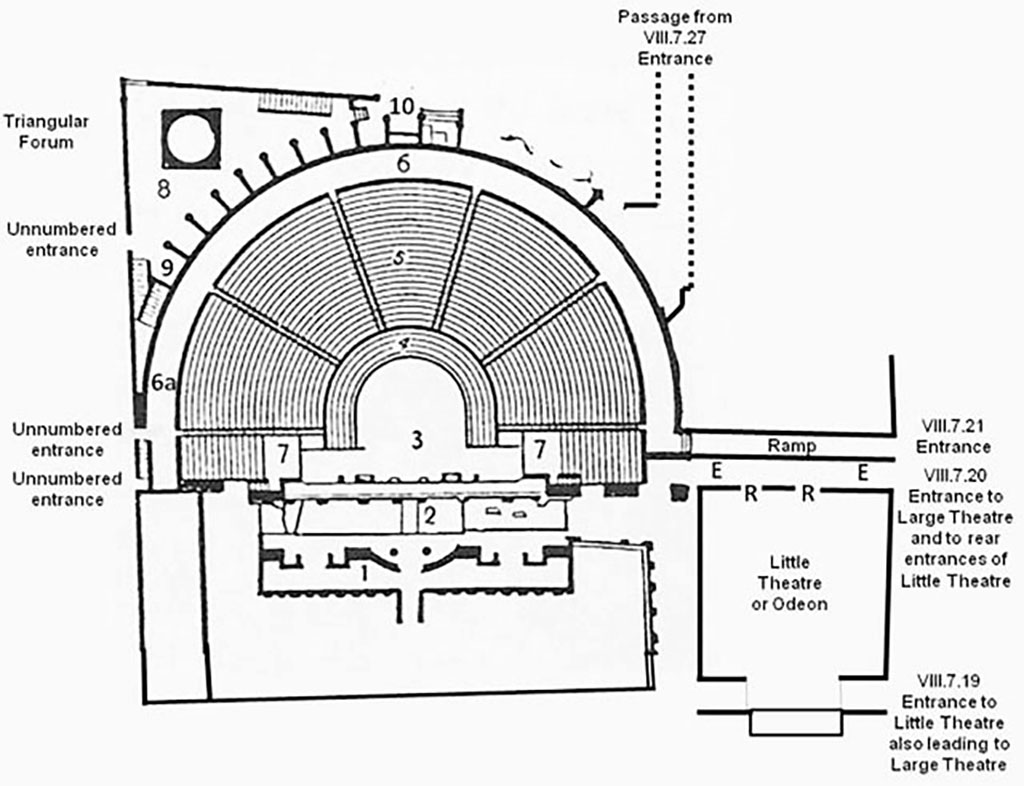
Included in the Pompeii in Pictures page for VIII.7.20:
E = Entrance passage, also known as the Graffito Passage
1 = Dressing room
2 = Stage
3 = Orchestra
4 = Ima cavea
5 = Media cavea
6 = Site of the summa cavea, with remains of the crypta that supported it
6a = Summa cavea with crypta/vaulting and rear wall for the wooden masts that supported the awning
7 = Tribunal
R = Rear entrances to the Small Theatre, with stairs
Included in the Pompeii in Pictures page for VIII.7.21:
6 = Views across the theatre from the summa cavea
8 = Tank for perfumed (saffron) water
9 = Theatre latrine
Unnumbered entrances from the Triangular Forum
Included in the Pompeii in Pictures page for VIII.7.28:
10 = Sacred room, or Hall of Initiation, in the Temple of Isis