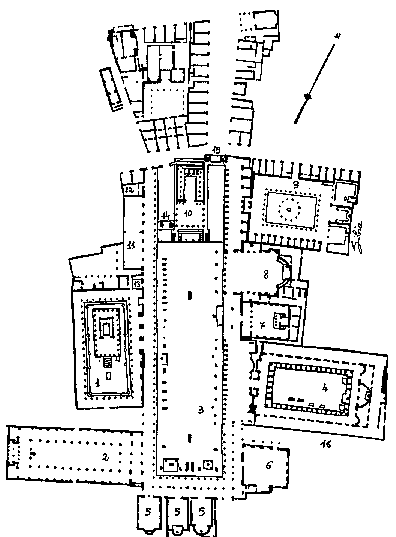
The Civil Forum of Pompeii was the city’s political, religious, administrative and economic heart. The buildings around the great square were where justice was administered, public business conducted, trade carried on and civic cults celebrated. They also represented the power of the leading families and, in the imperial period, of Rome itself.
More than a single monument, the Forum was therefore the centre of Pompeian public life. Citizens, magistrates, merchants and visitors met here every day, and the square contained some of the city’s most important buildings: the Temple of Jupiter, Sanctuary of Apollo, Basilica, Macellum, administrative buildings and numerous monuments associated with religious and political life.
What we see today is the result of a long transformation extending over several centuries.
From the earliest square to the monumental Forum
The Forum was probably originally an open space of less regular form than the great monumental square of the Roman period.
The ancient Sanctuary of Apollo already stood on the western side, while shops and other buildings occupied the eastern sector.
Between the 3rd and 2nd centuries BC, during one of the most prosperous phases of Samnite Pompeii, the entire area was extensively transformed.
The square was regularised and monumentalised, surrounded by porticoes and paved with tuff slabs. At the same time, several of the great buildings that still characterise the area, including the Basilica and Temple of Jupiter, were constructed or renewed.
This work transformed an ancient urban space into the city’s true monumental centre.
The Temple of Jupiter and Vesuvius
The northern side of the square is dominated by the Temple of Jupiter, built on a high podium.
After the Roman colony was founded, the sanctuary became associated with the Capitoline Triad—Jupiter, Juno and Minerva—and was one of the principal symbols of the city’s new Roman identity.
The building occupies an exceptionally dramatic position: seen from the south, the temple closes the vista across the Forum, with Mount Vesuvius rising behind it.
This relationship between architecture and landscape remains one of Pompeii’s most celebrated views.
A pedestrian square
The Forum was a monumental space from which wheeled traffic was excluded.
Stone barriers at the entrances prevented vehicles from entering the square, leaving the central area to pedestrians and public activities.
This separated the city’s monumental heart from the traffic moving along the surrounding streets.
The porticoes also provided shelter from sun and rain and allowed people to walk around the sides of the square to reach the public buildings opening onto it.
The Basilica: business and justice
At the south-western end of the Forum stands the Basilica, one of the city’s largest and earliest public buildings.
Constructed between the late 2nd and early 1st centuries BC, it was used for the administration of justice and for economic and commercial activity.
Magistrates, merchants and citizens could meet inside, discuss business and settle disputes.
The Basilica’s position beside the square shows how closely political life, economic activity and the administration of justice were linked in the Roman world.
The Sanctuary of Apollo
The Sanctuary of Apollo, one of Pompeii’s oldest places of worship, stands on the western side of the Forum.
Its origins predate the city’s Roman transformation by many centuries and attest to Pompeii’s deep cultural connections with the Greek and Etruscan worlds.
When the Forum was monumentalised, the sanctuary was incorporated into the new layout of the square.
Its presence is a reminder that the centre of the Roman city did not draw a sharp distinction between politics and religion: public cult was an integral part of civic life.
The market and economic activity
The Macellum, the city’s great food market, stands on the eastern side.
Meat and fish were the principal goods sold here, although other foodstuffs were probably available as well.
The market’s presence directly on the Forum shows that the square was also an important economic centre.
Goods, money and people arrived here not only from Pompeii, but also from the countryside and neighbouring settlements.
The Forum was therefore very different from a purely monumental modern square: it was crossed every day by economic, administrative and religious activity.
Politics and civic administration
Buildings connected with municipal administration stood on the southern side.
The magistrates and bodies that governed the city worked here.
The so-called Comitium also occupies the square’s south-eastern corner. It has traditionally been interpreted as a space associated with municipal elections, but more recent archaeological research calls for caution: functions connected with the administration of justice or market activity have also been proposed.
New investigations have shown that before this building was erected, the area contained shops and at least part of a house, all demolished during the monumental reorganisation of the Forum.
The Forum in the Augustan period
At the beginning of the imperial period, the Forum changed again.
The old paving was replaced with large travertine slabs, and new buildings, statues and commemorative monuments were gradually added to the square.
Some slabs still preserve the cuttings that held bronze letters belonging to a great inscription.
Buildings associated with the imperial cult and the city’s political representation were also erected or extensively altered around the square.
Pompeii was now fully assuming the appearance of a city of the Roman Empire.
Statues and honorary monuments
The Forum must have appeared far richer and more crowded than the ruins suggest today.
Numerous statues of emperors, members of the imperial family and distinguished citizens stood around the square.
What chiefly survives today are the large bases on which they were displayed.
The images of these prominent figures turned the Forum into a kind of monumental memory of the community: as citizens crossed the square, they were surrounded by figures representing Rome, imperial power and Pompeii’s most influential families.
The earthquake of AD 62
The great earthquake that struck Pompeii in AD 62 also damaged the buildings around the Forum.
Numerous programmes of restoration and reconstruction began over the following seventeen years, but several were still unfinished when Vesuvius erupted in AD 79.
The Forum buried by the eruption was therefore a vast building site where restored ancient monuments stood alongside buildings still being reconstructed.
This situation helps explain some of the anomalies visible in the monumental area today.
After the eruption
The history of the Forum did not end immediately in AD 79.
Archaeological research has shown that people returned to the buried area after the eruption to recover valuable objects and building materials.
Marble, architectural elements and decoration were removed from numerous buildings.
When modern excavations reached the Forum, it was clear that a substantial part of its ornament had already been taken away in antiquity.
The flooring of some buildings, including the so-called Comitium, was also dismantled to recover the marble slabs.
The rediscovery of the Forum
Systematic excavation of the square began in the early 19th century and gradually extended to the buildings around it.
The discovery of the Forum was fundamental in showing that Pompeii was not simply a collection of exceptionally preserved houses, but a true Roman city with institutions, law courts, markets, temples and administrative spaces.
The square thus made a decisive contribution to reconstructing the political and social life of the ancient city.
The heart of Pompeii
To visit the Forum is to stand where almost all Pompeii’s principal public activities converged.
Within a few steps of one another stood the Roman city’s great sanctuary, one of its most ancient cult places, the law court, market, municipal offices and buildings used to represent power.
Understanding Pompeii therefore requires more than looking at the individual ruins surrounding the square. The Forum must be imagined as a space filled with citizens, magistrates, priests, merchants, vendors, clients and visitors, surrounded by columns, statues, inscriptions and monumental façades.
This was where the city publicly displayed its identity.
For this reason, the Civil Forum may be regarded as the true heart of Pompeii: the place where politics, religion, the economy and social life met every day.