



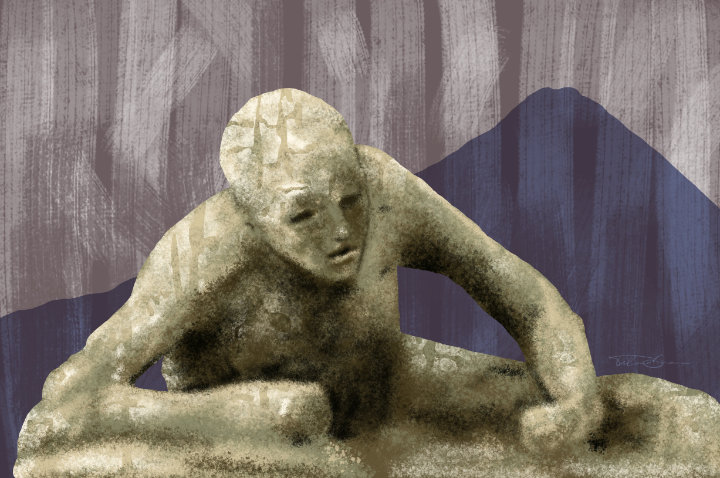
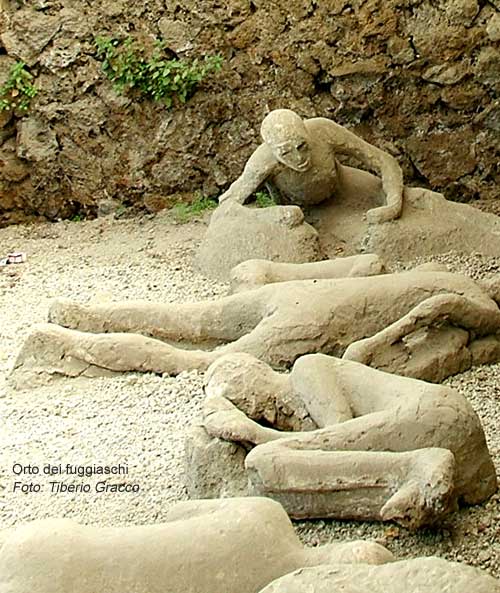
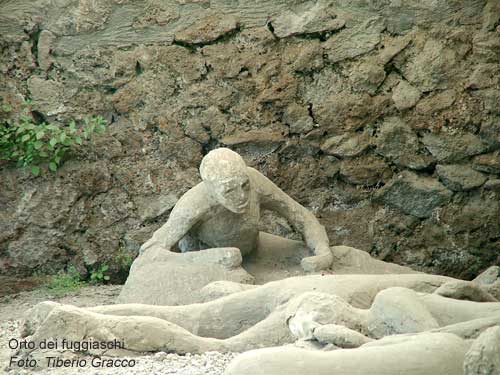
Cast of a man in the Garden of the Fugitives at Pompeii, by Tiberio Gracco
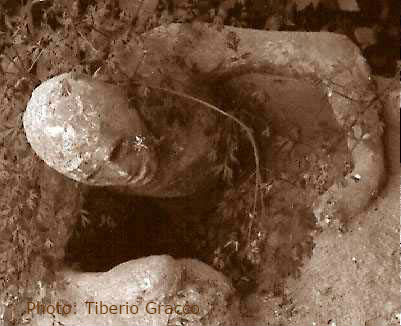
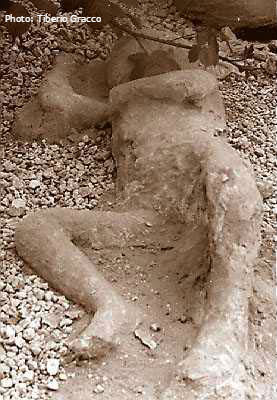
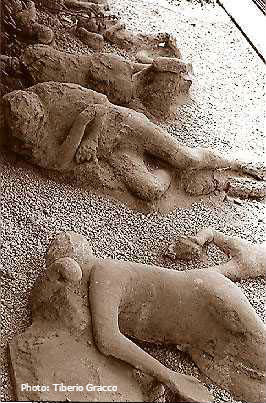
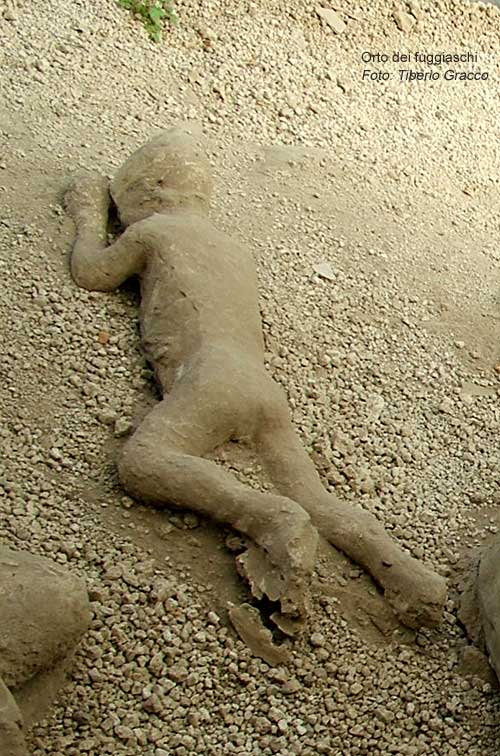
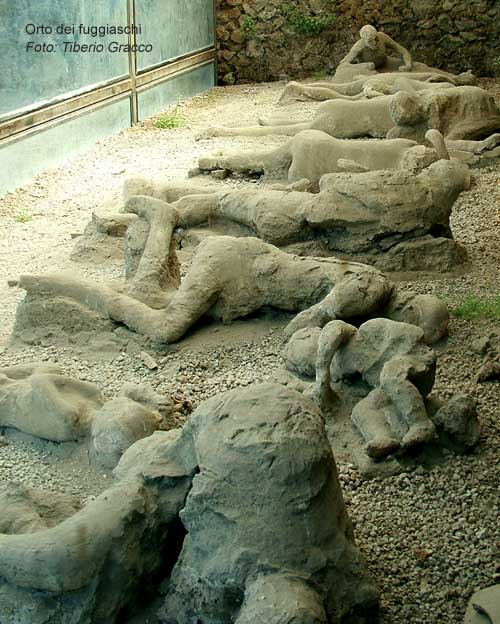
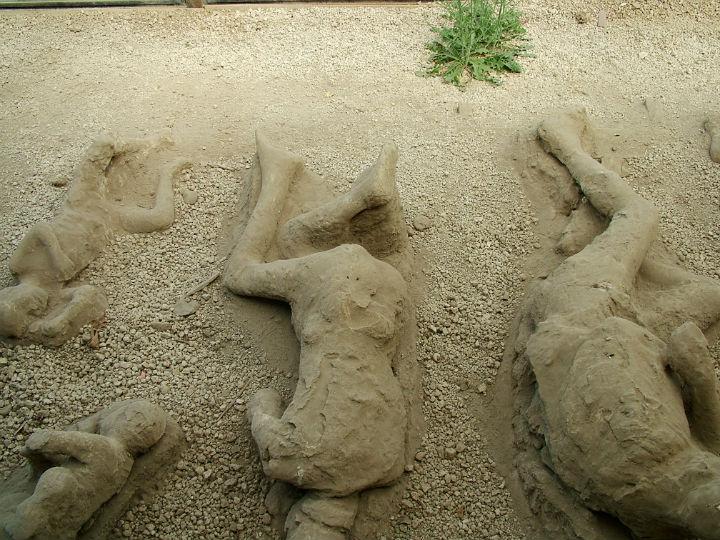
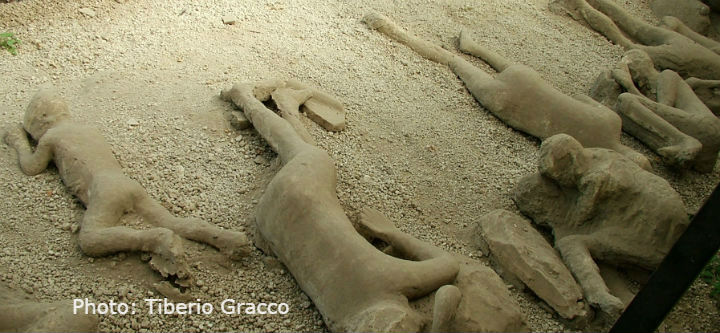
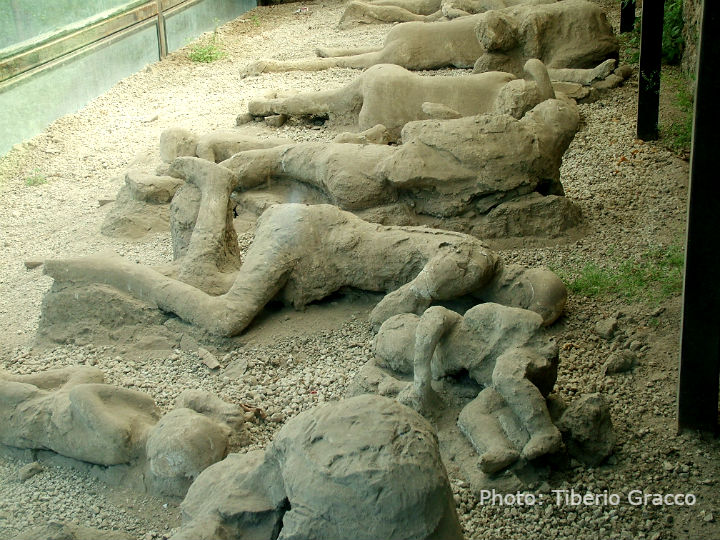
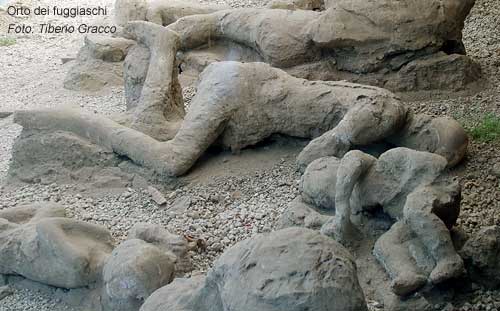
The Garden of the Fugitives in Regio I is one of the most moving places in the entire archaeological site. During excavation in 1961, the remains of men, women and children who had attempted to flee the city during the final and most violent phases of Vesuvius's eruption in AD 79 were found here.
The celebrated casts preserve not only the positions of their bodies, but also details of clothing and gestures made during their final moments. The tragedy of Pompeii is consequently experienced with particular immediacy in the Garden of the Fugitives.
Before the eruption, however, this was neither a burial place nor an abandoned plot. It was a vineyard within the urban fabric, with cultivation facilities and a summer triclinium where people could dine outdoors beneath a pergola.
A vineyard within the city
During Pompeii's final years, the area was used chiefly as an agricultural space.
Archaeological research has identified traces of viticulture and a triclinium intended for outdoor banquets.
The vineyard recalls an important aspect of the ancient city: the area within the walls was occupied by more than houses, shops, temples and public buildings.
Gardens, vegetable plots, vineyards and small cultivated parcels occupied many urban spaces and contributed to the production of fruit, vegetables and wine.
In AD 79, this tranquil green space instead became the place where a group of people desperately sought a route to safety.
Fleeing towards Nocera Gate
During the first phases of the eruption, an enormous quantity of pumice gradually fell onto the city.
Streets and open spaces were covered by an ever-deepening layer of volcanic material, making movement extremely difficult.
The people found in the Garden of the Fugitives were probably trying to reach Nocera Gate, one of the city's exits, a short distance to the south-east.
By the time they crossed this area, the pumice blanket was already several metres deep.
They therefore had to walk across unstable ground that was being continually transformed by falling volcanic debris.
The final phases of the eruption
The situation changed radically when pyroclastic currents—extremely hot clouds of gas, ash and volcanic material—began to reach Pompeii.
The eruption's final phase left virtually no prospect of survival for anyone still in the city.
The group in the Garden of the Fugitives was overtaken while attempting to escape.
The positions of the bodies show people who had fallen or crouched down, some very close to one another.
What we see today is therefore not an imagined reconstruction of the tragedy, but material evidence of the precise place where these individuals died almost two thousand years ago.
How many victims were there?
The Garden of the Fugitives is traditionally known as the site of 13 casts.
Research published by the Archaeological Park in 2026 has enabled the events of the 1961 excavation to be reconstructed more precisely.
The archaeologists actually identified 15 victims.
It was not possible to make a cast of one of the first victims found.
Fourteen plaster casts were made from the others, but only thirteen were arranged in the south-eastern corner of the Garden.
Soon after it was made, the fourteenth cast was transferred to the House of the Four Styles. Its precise identification among the casts now preserved at Pompeii is not completely certain.
The thirteen casts visible in the Garden are therefore part of a larger group of victims than traditional descriptions suggest.
The discovery in 1961
Excavation began on 2 March 1961 under the direction of Amedeo Maiuri, one of the most important archaeologists in the modern history of Pompeii.
The victims were not all found at the same time.
The first cast was made on 10 April. Further groups were identified over the following days and weeks.
Between 17 and 22 April, casts were made of five victims close to one another.
Three more people were identified on 27 April, and another group of five emerged on 31 May.
Their distribution therefore shows that this was not necessarily a single compact group travelling together, but several people or smaller groups caught in the same area while fleeing.
How the casts are formed
The Pompeii casts result from a particular process caused by the eruption.
As the victims were covered by volcanic deposits, ash gradually compacted around their bodies.
Over time, organic tissues decomposed, leaving a void in the ground that retained the body's outer form.
In the nineteenth century, the excavation director Giuseppe Fiorelli realised that these cavities could be filled with liquid plaster.
Once the plaster had set and the surrounding volcanic material was removed, the form of the person who had died in the eruption was revealed.
The technique was first tested in 1863.
The casts in the Garden of the Fugitives do not belong to that initial experiment, however. They were made almost a century later, in 1961, during Maiuri's excavation.
Not simply “statues”
The casts should not be regarded as statues made by archaeologists.
Plaster fills a space once occupied by a real person's body.
It can therefore preserve extraordinary details: folds in clothing, footwear, facial features, the position of the hands and other particulars.
Bones and objects belonging to the victim may also survive within a cast.
Modern diagnostic technologies now allow these elements to be studied without destroying the cast.
Radiography, computed tomography and three-dimensional scanning are providing new information about age, sex, physical condition and the objects people carried while fleeing.
Men, women and children
The victims in the Garden of the Fugitives included adults and children.
This is one of the aspects that makes the place especially affecting.
The eruption did not strike a single category of the population. Families, individuals, enslaved people, free citizens, rich and poor all had to decide quickly whether to remain in their homes or attempt to escape.
We do not know with certainty how all the people found in the Garden were related.
The proximity of some bodies nevertheless suggests that at least some of the victims may have been travelling together.
Objects found with them sometimes allow small fragments of those final hours to be reconstructed.
What they carried
Anyone trying to leave Pompeii had to decide quickly what to take.
Archaeological research on the eruption's victims has documented coins, jewellery, keys, lamps, containers of water and small personal possessions.
Objects associated with the fleeing people were also found in the Garden of the Fugitives.
These include coins and glass-paste necklace beads.
They may appear modest, but they bring home what it meant to leave one's house suddenly without knowing whether a return would ever be possible.
A new discovery: perhaps a doctor among the fugitives
In 2026, the Archaeological Park of Pompeii published important new research on one victim from the Garden of the Fugitives.
During restoration of the cast numbered 46, a small case made of organic material was identified within the plaster.
A bag containing silver and bronze coins also lay beside the victim.
Modern radiographic and tomographic analysis allowed the contents of the case to be examined without destroying it.
A coticula and small instruments
The case contained a coticula, a small stone palette used for grinding or preparing substances.
Objects of this kind could be used to prepare medicines or cosmetics.
Scanning also revealed several small metal instruments, some potentially compatible with tools used in medical practice.
Comparison with other medical cases found in the Vesuvian area makes it possible to suggest that the victim was a doctor or someone involved in preparing remedies.
This cannot be regarded as conclusively proven, but the discovery gives an extraordinary personal dimension to one of the Garden's victims.
We no longer see only an anonymous figure fixed in plaster. We begin to glimpse a person who chose, while fleeing, to carry tools probably connected with his occupation.
Modern investigative techniques
The 2026 research shows that the casts remain an active source of archaeological evidence.
Computed tomography can pass virtually through the plaster and reveal bones and objects without damaging the artefact.
In the case of the small box from the Garden of the Fugitives, scanning also showed the interior structure of the case, its lock and several metal elements wholly invisible from outside.
Techniques unavailable to Maiuri in 1961 are thus extracting new information from the same victims discovered more than sixty years ago.
The casting method and the memory of the victims
The technique devised by Fiorelli radically changed the way Pompeii was perceived.
Before the casts, the eruption was told chiefly through collapsed buildings, abandoned objects and skeletons.
The casts instead revealed people at the moment of death.
They have therefore always had an enormous emotional impact on visitors.
Their importance extends beyond understanding the eruption.
They remind us that the houses, streets, baths and temples visited today were once inhabited and used by real people.
A place to approach with respect
The Garden of the Fugitives has inevitably become one of Pompeii's defining images.
It is important, however, not to treat the casts merely as a dramatic curiosity.
What we see is the place where people who lived almost two thousand years ago actually died.
The Park's modern research increasingly emphasises the need to study these remains as individual people and personal histories, not simply as evidence of the eruption.
Every detail—a coin, a piece of jewellery, a working tool or the position of one body beside another—may help to recover something of the victims' lost identities.
The vineyard before the tragedy
It is equally important to remember what the Garden represented before the eruption.
Visitors' attention is inevitably drawn to the casts, but the site was originally a productive space used in everyday life.
Vines grew here, people worked in the garden and meals could be eaten outdoors beneath a pergola.
The contrast between this original purpose and the events of the eruption makes the place still more significant.
Within a few hours, a space used for cultivation, work and banqueting became one of the most dramatic records of the city's destruction.
One of Pompeii's defining places
The Garden of the Fugitives I.21.2 offers a profoundly human perspective on the eruption.
Pompeii's buildings show how the inhabitants lived; the casts instead reveal what happened to some of them during the city's final hours.
Archaeological research, from the 1961 excavation to modern analysis in 2026, is gradually transforming these figures from anonymous images of catastrophe into people whose lives, possessions, occupations and final decisions can be partially reconstructed.
The Garden of the Fugitives is therefore one of the most important and sensitive places in Pompeii: not only evidence of Vesuvius's destructive power, but above all a memorial to the people who tried to survive the eruption of AD 79.


View this location on the Pompeii Buildings and Places map