



A small cloth bag containing a collection of amulets, a handful of coins kept in a woven basket and several personal care items have emerged from the excavations at Pompeii, offering a glimpse into the everyday life of someone who lived almost two thousand years ago. The discovery was made in Regio IX, inside a house overlooking Via dell’Abbondanza, where archaeologists uncovered the remains of a large wooden cupboard, destroyed during the eruption of Mount Vesuvius in AD 79 but still remarkably easy to reconstruct thanks to the impressions preserved in the volcanic deposits.
The cupboard contained a remarkable variety of objects, including household vessels, cosmetic tools, weights that may have been used for commercial activities and a small reserve of money. Perhaps the most touching discovery, however, is a collection of twenty-four tiny amulets, probably belonging to someone who had received them as a child and continued to treasure them later in life, perhaps because of the personal memories they carried.
Announced by the Archaeological Park of Pompeii on 29 October 2026, the discovery is described in the latest issue of the E-Journal of the Excavations of Pompeii. The detailed archaeological study explores not only the contents of the cupboard but also the history of the house, the changes made to its rooms and the circumstances that allowed these fragile objects to survive. Together, the findings offer a fascinating picture of Pompeian society, revealing how domestic routines, work and personal memories could all find a place within the same household.
The Discovery in the House of Cornelius Maximus
The cupboard was discovered in the building identified as IX 11, 7, traditionally known as the House of Cornelius Maximus. This name comes from inscriptions recorded during the excavation of the façade in 1912, although archaeologists point out that the identification remains uncertain, particularly because the inscriptions on which it was based are no longer visible.
The recent investigations were carried out as part of a conservation and restoration project in the area adjoining the Insula of the Chaste Lovers, a large archaeological complex in Regio IX that has been the focus of important excavation and improvement work in recent years. The need to stabilise the excavation boundary and improve safety provided an opportunity to investigate several rooms behind the façade, which had previously remained largely unexplored.
The archaeologists were able to identify a series of spaces belonging to a building that had undergone several changes in layout and use over time. Some rooms appear to have been intended for domestic and service activities, while others preserve more elaborate decoration, suggesting a residential function. Our understanding of the house is still incomplete, however, since the excavations have covered only part of the building and do not yet allow its original arrangement to be fully reconstructed.
It was in one of these rooms, possibly used as a triclinium or Roman dining room, that the large cupboard was discovered.
A Wooden Cupboard Reconstructed from Its Impressions
The cupboard has not survived as an intact piece of wooden furniture, but its original structure can still be reconstructed from the impressions left in the volcanic material and the traces identified during excavation. It was a substantial piece of furniture, positioned in the south-eastern corner of the room and arranged in two adjoining sections, each approximately two metres long but with different depths.
Careful archaeological examination revealed evidence of the wooden boards forming its outer sides, the planks of its base and the internal shelves on which vessels and other possessions had been stored. Iron fittings helped support and stabilise the structure, while the distribution of the recovered objects provided further clues about how the storage space had originally been organised.
During the eruption of AD 79, the collapse of the roof struck the upper part of the cupboard, causing some of its shelves to give way and sending their contents falling into the space below. The subsequent arrival of a pyroclastic flow filled the room and entered the damaged furniture, covering the objects and preserving traces of their original arrangement. These deposits have allowed archaeologists to reconstruct at least part of the sequence of events that led to the cupboard’s destruction.
The investigation was made more complicated by the presence of tunnels dug into the volcanic deposits during later explorations, which disturbed some of the archaeological layers and displaced several objects. Researchers therefore had to distinguish between items that had remained in their original positions, those that had fallen during the destruction of the house and others that had been moved by subsequent digging.
The discovery provides an excellent example of how archaeological research can recover information about objects that have almost entirely disappeared, making it possible to reconstruct not only the appearance of a piece of furniture but also the way its contents were arranged nearly two thousand years ago.
Everyday Possessions: Perfumes, Cosmetics and Household Vessels
The contents of the cupboard provide an unusually detailed picture of the activities that took place inside the house, showing how the same piece of furniture could be used to store personal belongings, household equipment and other everyday possessions.
Among the objects associated with personal care, archaeologists identified a pair of bronze tweezers, a small glass perfume or ointment bottle and a slate tablet known as a coticula, which could be used to prepare or mix pigments and other substances. The finds also include bone spatulas, one of which has an end decorated in the shape of a finger. Such tools could be used for cosmetics, although some also had possible medical applications.
These objects suggest a connection with the mundus muliebris, the collection of accessories traditionally associated with female personal care in the Roman world. Their presence does not, however, prove that the cupboard belonged to a woman, since household spaces could be shared by several people and individual objects might serve more than one purpose.
Alongside the cosmetic implements were an incense burner, a bronze oil lamp and numerous vessels made of pottery, glass and metal, used for preparing, serving or storing food and other substances. One particularly attractive find is a small drinking vessel decorated with a pinecone-scale pattern, a more refined object than ordinary household pottery which, like some of the other possessions kept in the cupboard, may also have held personal significance.
The collection suggests a household where practical utensils were stored alongside more carefully made objects, although it is impossible to establish whether they all belonged to the same person. This variety is one of the most interesting aspects of the discovery, as it allows us to explore different sides of daily life in Pompeii through objects that rarely feature in accounts of the city’s great monuments.
Crepundia: Twenty-Four Tiny Amulets from Childhood
Perhaps the most remarkable discovery is a collection of twenty-four miniature objects made from different materials, including faience, bone, glass paste and rock crystal. All have holes through which they could be suspended, suggesting that they once formed part of a necklace or another ornament made up of individual pendants, each with its own shape and possible symbolic meaning.
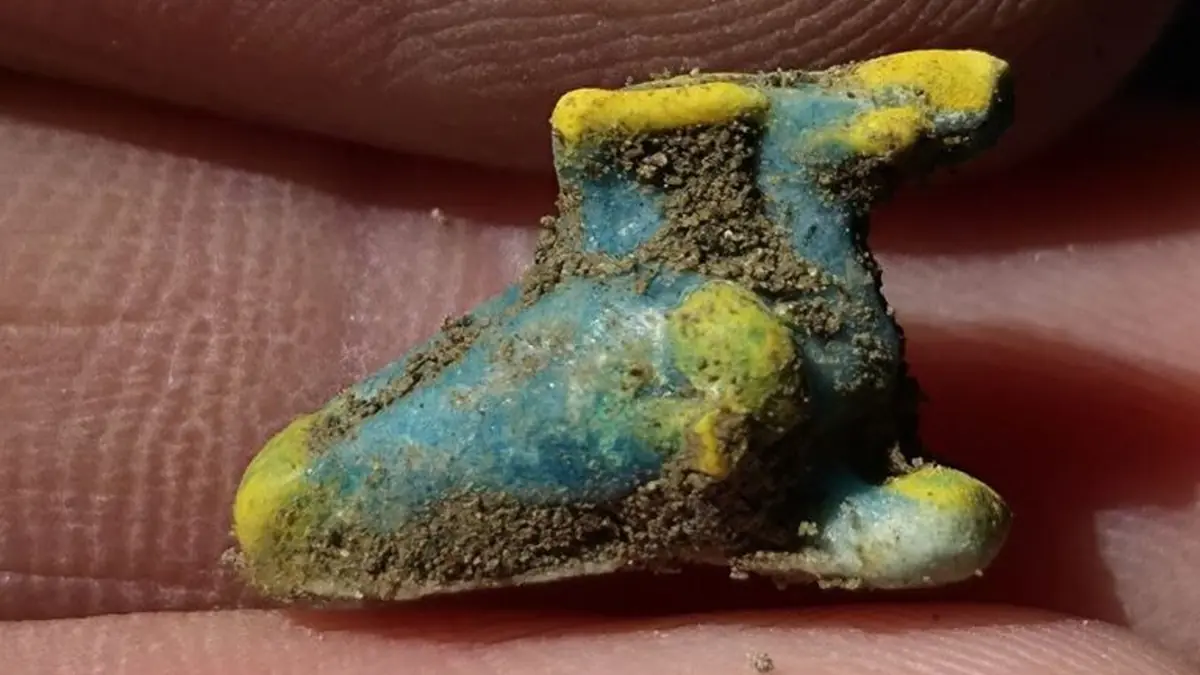
Among the tiny figures, archaeologists identified representations of deities such as Bes and Mercury, parts of the human body including hands and feet, and plant motifs such as pinecones and bunches of grapes. Other objects include beads and an astragalus, a small animal bone. One particularly interesting pendant takes the form of a winged shoe and is illustrated in the photographs published in the archaeological report.
These objects belong to a category known as crepundia, a Latin term derived from the verb crepare, meaning to rattle or make a sound. In the Roman world, crepundia were mainly associated with childhood and could be worn as ornaments, used as small rattling objects or carried as amulets intended to protect children. Their purpose was therefore not simply to provide amusement, since the figures of gods and other symbols were also believed to offer protection against dangers and harmful influences.
What makes the discovery particularly moving is the way these objects had been stored. The pendants were originally kept inside a small cloth bag, placed on one of the cupboard’s shelves. When the furniture collapsed during the eruption, the bag slipped towards the interior of the cupboard and tore open, scattering its contents among the debris carried by the volcanic flow.
Archaeologists were also able to identify traces of the fabric, which were subsequently examined under a microscope in the Archaeological Park’s laboratories. Preliminary analysis revealed a regular weave, with elements spaced approximately one millimetre apart, providing another rare example of the preservation of organic materials that would normally have disappeared over time.
The presence of crepundia in a household cupboard raises an intriguing possibility: these small amulets may have been kept long after childhood, when they no longer served their original purpose. For their owner, they could have become treasured possessions, associated with early memories, the people who had given them as gifts or places left behind many years earlier.
This interpretation is particularly meaningful when considered in the wider context of Roman society, where geographical and social mobility was common. Enslaved people, freedmen, merchants and many others might spend much of their lives far from their families or childhood homes, making even a modest object an important reminder of their personal history.
Childhood Memories in the Roman World: Plautus and Other Archaeological Discoveries
The study published in the E-Journal explores the meaning of crepundia through comparisons with Latin literature, where small personal objects sometimes play an important role in establishing someone’s identity and recovering lost family connections.
One particularly interesting example appears in Rudens, a comedy by the Roman playwright Plautus, in which objects preserved from childhood become essential to identifying a young woman named Palaestra and reconnecting her with her family. The recognition depends on material possessions that provide evidence of her past, showing how Roman literature could associate seemingly insignificant objects with memory, identity and family relationships.
A theatrical story cannot, of course, be treated as proof that every Roman family followed the same customs, but comparing literary accounts with archaeological evidence helps us better understand the meanings that personal objects could acquire in ancient society.
Pompeii itself has produced discoveries that bear similarities to the finds from Regio IX. In the House of Helvius Severus, archaeologists found amulets and pendants stored inside a cupboard, including representations of deities and other small ornaments. Another important comparison comes from the House of the Garden, where a wooden chest contained numerous precious objects and amulets made from a variety of materials.
Further evidence comes from the Necropolis of Porta Nocera, where small pendants were placed among the grave goods of an adult woman. This burial demonstrates that objects associated with childhood could continue to be treasured later in life, sometimes accompanying their owners even into the grave.
Together, these discoveries suggest that the twenty-four amulets found in the Pompeian cupboard may have carried a meaning that went beyond their religious or decorative purpose. Although we do not know who originally received them or how long they had been kept, their presence inside a carefully stored cloth bag suggests that they had retained a special significance for someone living in the house.
Thirty-Eight Coins and Eight Weights: Evidence of a Possible Business Activity
Alongside these personal possessions, the cupboard also contained a small reserve of money consisting of thirty-eight bronze coins kept inside a basket made from woven plant fibres. Only part of the basket’s base survived, but the recovery of its organic remains and their subsequent laboratory examination allowed researchers to identify some features of its construction and weaving technique.
The plant material may have been esparto grass, a fibre used in antiquity to produce baskets and other woven objects, while the technique appears compatible with a type of basketry known as wickerwork in a grid pattern. These identifications remain tentative, based on the characteristics of the surviving fragments and comparisons with similar Roman objects discovered in the Vesuvian area.
The numismatic study has provided particularly interesting information. Apart from two older and heavily worn coins, the collection consists of pieces minted during the reign of Emperor Nero. Most date from between AD 64 and 67, with a particularly strong concentration in AD 65, to which twenty-one of the coins can be assigned.
The collection included sestertii, dupondii and asses, and may have represented a small reserve of money intended for everyday expenses rather than savings accumulated over a long period. Its location inside the cupboard suggests the familiar practice of keeping a modest amount of cash somewhere in the house where it could be retrieved when needed.
Another significant discovery was a small wooden box, of which only fragmentary traces remain, containing eight lead weights, six fitted with iron elements. The weights vary in shape, size and value, suggesting that they could have been used not only for domestic purposes but possibly for professional or commercial activities.
Their presence becomes particularly interesting when considered alongside the house’s location on Via dell’Abbondanza and the changes made to some of its rooms over time. Archaeologists have identified evidence suggesting that certain parts of the building may have been adapted for commercial purposes, reflecting the close relationship between domestic life and economic activity in Roman Pompeii.
It is not yet possible to establish what kind of business might have operated there, or whether the weighing equipment and the coins belonged to the same person who kept the amulets and cosmetic tools. Nevertheless, the combination of finds offers an intriguing picture of a household in which private life and economic activities may have existed side by side.
A House Decorated with Peacocks, Dolphins and Other Animals
The excavations have also revealed new information about the decoration and architectural development of the house, which preserves traces of several different phases in its long history.
The room containing the cupboard was decorated with Fourth Style wall paintings, featuring large yellow panels, ornamental borders and representations of animals and plants. Among the motifs identified by archaeologists are peacocks, dolphins, flying birds, leaping panthers and elaborate vegetal compositions, arranged within a decorative scheme that was sophisticated in appearance but based on a fairly standardised repertoire.
Researchers have attributed these paintings to the workshop of the painters of Via di Castricio, a group of craftsmen active in Pompeii whose work can be recognised through characteristic stylistic and decorative features also found in other houses across the city.
The investigations also uncovered traces of earlier First Style decoration and floors that point to building phases dating back at least to the second century BC. The house had therefore undergone numerous changes over the centuries, with rooms altered, divided or adapted to meet the changing needs of its occupants.
Although the paintings suggest that some care and expense had been devoted to the appearance of the domestic spaces, archaeologists caution against using decoration alone to determine the social or economic status of the people who lived there. Even a relatively modest house could contain attractively decorated rooms, particularly when situated along one of the main streets of the ancient city.
Another important detail concerns the condition of the building when Mount Vesuvius erupted. The excavations revealed evidence of construction and maintenance work still in progress, together with repairs to roofs and walls that may, at least in part, have been connected with damage caused by the earthquakes that had affected Pompeii in the preceding years.
The house was therefore still undergoing changes, with everyday domestic activities taking place alongside repairs and alterations. These findings contribute to a picture of Pompeii as a living city where buildings were continually being maintained, renovated and adapted right up to the final moments before the eruption.
Two Young Mice Discovered Inside an Amphora
Among the more unusual findings was the discovery of the remains of at least two small rodents, recovered from the bottom of an amphora stored with other vessels on an upper-level storage platform in a room adjoining the one containing the cupboard.
The amphora belonged to a type of container used for transporting olive oil from North Africa, and laboratory analysis of its contents revealed 117 tiny bone fragments, which specialists were able to examine in order to identify the animals.
Their anatomical features allowed researchers to assign the remains to the genus Apodemus, with the most likely identification being Apodemus sylvaticus, commonly known as the wood mouse. Examination of the skeletal development also suggests that neither animal had yet reached full maturity.
It is impossible to establish exactly how the mice entered the amphora or what caused their deaths, although the researchers consider it possible that they became trapped accidentally or were attracted by organic residues inside the container.
The discovery provides a very tangible glimpse of everyday domestic life, reminding us that even houses decorated with fine paintings and furnished with valuable objects had to deal with practical problems such as food storage and the presence of unwanted animals. Similar remains have been documented in other Vesuvian contexts, including the servants’ quarters of the villa at Civita Giuliana and the drainage systems of Herculaneum, offering further evidence of the relationship between people, animals and the urban environment in antiquity.
What Happened to the People Who Lived in the House?
The contents of the cupboard raise a question that archaeologists cannot yet answer: what happened to the people who lived in the house, and why did nobody return to recover the possessions left behind?
The coins were still in their woven basket, the amulets remained inside their cloth bag, and numerous vessels and personal items had been left throughout the rooms. The presence of objects with possible financial or sentimental value suggests that the occupants were unable to take them to safety before the building was destroyed.
One possibility is that they attempted to escape during the eruption and, even if they survived, were never able to return to recover their belongings. Another is that they died during the catastrophe, as happened to many other inhabitants of the city.
The identity of the person who kept the tiny amulets also remains unknown. The cosmetic tools might suggest the presence of a woman, but they do not provide sufficient evidence to establish that the cupboard belonged to a female owner, or that all the objects were used by the same individual.
The title chosen by the Archaeological Park for its announcement, The Cupboard of a Woman Who Never Returned, captures the human dimension of the discovery and evokes a personal story interrupted by the eruption. It should, however, be understood as a possible narrative interpretation rather than a definitive archaeological conclusion, since the available evidence still leaves several questions about the occupants’ fate unanswered.
Pompeii and the Memories of Ordinary People
The discovery of the cupboard in Regio IX demonstrates how much even the simplest objects can reveal when they are studied in their original archaeological context and considered alongside the habits, beliefs and living conditions of ancient society.
While Pompeii’s great paintings and monumental buildings tell us about Roman art, architecture and social prestige, the smaller objects preserved inside its houses bring us closer to the personal experiences of the people who lived there, revealing a world shaped by everyday routines, practical needs and emotional attachments.
A perfume bottle, a small reserve of coins perhaps used for daily purchases or a cloth bag containing childhood amulets can tell stories that rarely appear in written historical accounts, yet must have been deeply important to the individuals who owned them.
This is what makes the discovery especially meaningful. We do not know the name of the person who kept those twenty-four tiny pendants, nor can we say what memories each one might have held, but their careful storage suggests that someone had chosen to preserve them because they continued to matter long after childhood.
The eruption of Mount Vesuvius interrupted that life and scattered the possessions inside the cupboard, leaving volcanic deposits to preserve their traces. Almost two thousand years later, the work of archaeologists has brought at least part of that story back to light, adding not simply another archaeological discovery to the history of Pompeii, but a small and deeply human fragment of the lives once lived within its walls.
Sources and Further Reading
This article is based exclusively on the following publications issued by the Archaeological Park of Pompeii:
-
L’armadio di una donna che non tornò più – The Cupboard of a Woman Who Never Returned. Official press release, 29 October 2026.
-
Lo scavo di una domus nell’insula IX 11: il rinvenimento di un armarium con crepundia – Excavation of a Domus in Insula IX 11: The Discovery of a Cupboard Containing Crepundia. E-Journal of the Excavations of Pompeii, 2026, No. 11, by Gabriel Zuchtriegel, Chiara Comegna, Saverio De Rosa, Domenico Esposito, Younes Naime, Giuseppe Scarpati and Ausilia Trapani.
Visitors wishing to explore the ancient city can also consult our interactive map of Pompeii’s buildings and archaeological sites.