



Beneath a green hillside covered with vineyards and fruit trees, just beyond Pompeii's Herculaneum Gate, lie the remains of one of the ancient city's most remarkable Roman residences. Known as the Villa of Cicero, the building became famous for its beautiful frescoes and mosaics discovered in the 18th century, yet it has remained almost entirely buried ever since. Now, a new archaeological survey carried out in 2026 has revealed that the villa may have been considerably larger and better preserved than previously believed. The findings offer a fascinating new perspective on this forgotten residence and on the earliest excavations of Pompeii.
A famous villa that probably never belonged to Cicero
Despite its name, there is no evidence that the Villa of Cicero ever belonged to Marcus Tullius Cicero, the famous Roman statesman, orator and philosopher. The name dates back to the early history of the excavations and has simply remained in use.
The villa stood outside Pompeii's north-western walls, in an area occupied by large and luxurious suburban residences. Nearby were the Villa of Diomedes, the Villa of the Mysteries and the Villa of the Mosaic Columns.
These properties offered something that wealthy Romans could rarely enjoy within the crowded city walls: plenty of space, extensive gardens and beautiful views across the surrounding countryside.
In Roman times, the landscape looked quite different from today. The coastline was much closer to Pompeii, and the villas' terraces overlooked the plain towards the Bay of Naples.
The Villa of Cicero appears to have been an especially impressive complex. A plan drawn in 1778 by the architect Francesco La Vega shows two large terraces arranged at different levels.
The upper terrace contained the main residential rooms, built around a spacious peristyle, or courtyard surrounded by columns. Below it ran a long cryptoporticus, a covered passageway, together with other rooms whose original purposes are not yet fully understood.
The villa probably combined elegant living spaces, designed for the comfort and enjoyment of its owners, with service rooms and areas connected with the management of the estate.
It was a place where the pleasures of Roman country life could coexist with the practical activities of a large property.
The Bourbon excavations and the villa that disappeared
The modern history of the Villa of Cicero began in 1748–1749, during the very first years of systematic exploration at Pompeii.
Work was initially interrupted partly because of dangerous volcanic gases trapped underground, which posed a serious threat to the excavators.
Excavations resumed in 1763 under Francesco La Vega and continued intermittently until 1778–1779.
Archaeology was very different in those days.
The main aim of the excavations sponsored by the Bourbon monarchy was to recover valuable works of art, including statues, frescoes, mosaics and precious objects for the royal collections.
Rather than carefully uncovering entire buildings, workers often dug large pits, trenches and underground tunnels to reach the most promising rooms.
The Villa of Cicero was explored using these methods.
Once the finest decorations had been removed, the excavated rooms were filled in again, and the land was returned to its previous use.
The villa effectively disappeared from view.
Fortunately, the 18th-century excavators left behind unusually detailed records, including excavation diaries, architectural drawings and plans.
These documents are now proving essential for understanding both the villa itself and the way Pompeii was explored more than two centuries ago.
The frescoes and mosaics that fascinated Europe
Although the villa was buried again, its discovery had an extraordinary influence on European art.
Some of the most celebrated paintings recovered from the building depicted graceful female dancers, maenads, satyrs, centaurs and cupids.
Their delicate movements and elegant compositions impressed Johann Joachim Winckelmann, one of the founders of modern art history, who visited the excavations in 1764.
The paintings were later reproduced in the engravings published in Le Antichità di Ercolano Esposte, an important illustrated collection of ancient discoveries.
These images travelled across Europe and helped inspire the development of Neoclassicism.
Motifs originating from the Villa of Cicero appeared on furniture, ceramics, porcelain, textiles and interior decorations, influencing artistic taste during the late 18th and early 19th centuries.
The villa also produced two remarkable mosaics, now preserved at the National Archaeological Museum of Naples.
The first, known as The Travelling Musicians, depicts a lively scene of musicians and figures inspired by ancient Greek theatre.
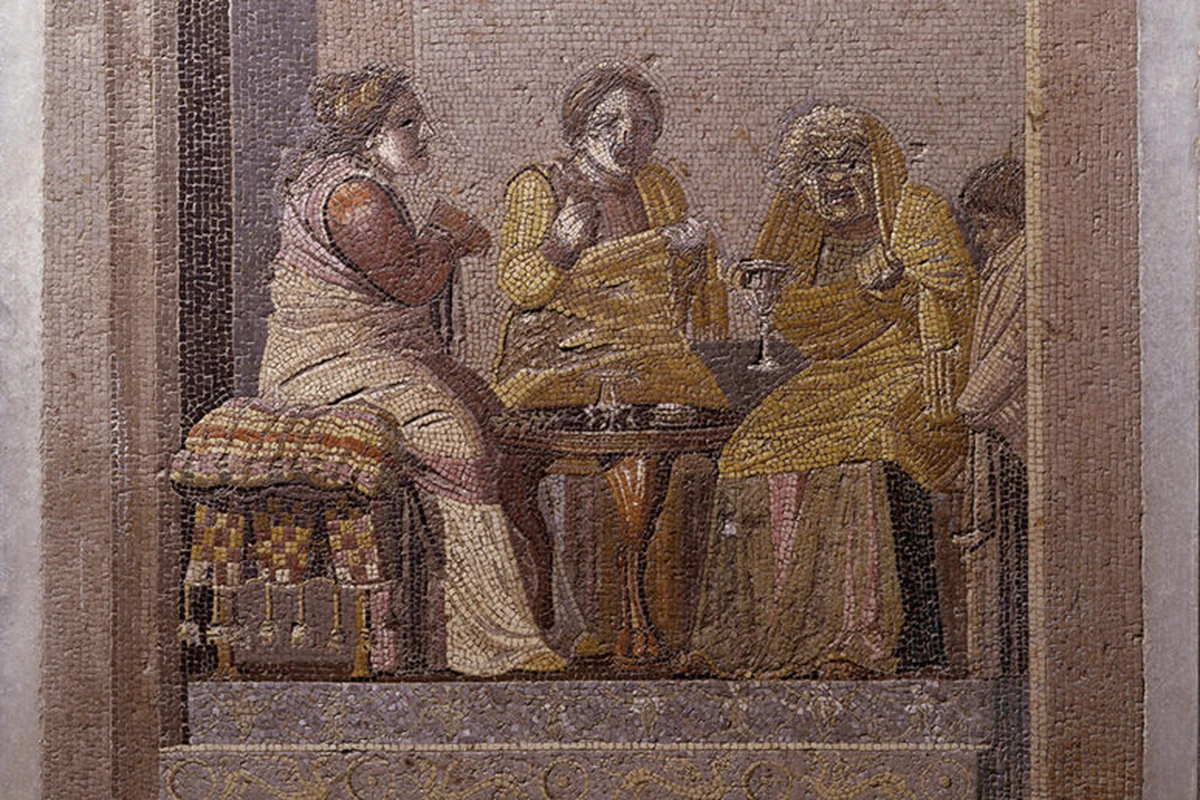
The second, The Consultation of the Sorceress, shows a group of figures gathered around a small table, in another scene with theatrical associations.
Both mosaics were created using extremely small tesserae, allowing the artist to achieve shading, facial expressions and details almost comparable to painting.
They also bear the Greek signature of Dioscurides of Samos, an artist whose exceptional skill makes these works especially important.
Museum records provide another interesting detail: the two mosaics originally decorated the floor of a large passageway within the villa's most luxurious residential quarters.
The Consultation of the Sorceress was discovered on 8 May 1764, when Winckelmann was present at the excavations.
These works are also mentioned in another Pompeii Excavations E-Journal study published in March 2026, which examines the production and circulation of Roman figurative mosaics.
What the new archaeological investigations have revealed
The latest discoveries come from the Villa of Cicero Project, an international research initiative involving several American universities in collaboration with the Archaeological Park of Pompeii.
In June 2026, researchers completed the first phase of a geophysical survey designed to investigate the buried villa without disturbing the archaeological remains.
Several modern technologies were used.
Ground-penetrating radar (GPR) sends electromagnetic waves beneath the surface to detect buried structures. Electrical resistivity tomography and magnetometry help identify differences in the underground deposits, while LiDAR records the shape and elevation of the landscape with great precision.
Together, these methods allow archaeologists to build a picture of what lies beneath the ground, even without excavation.
The preliminary results, published in the study Preliminary Results of an Integrated Geophysical Survey at the Villa of Cicero, are particularly promising.
The underground images correspond closely to the 18th-century plan produced by Francesco La Vega.
They confirm the location of the central residential area, the cryptoporticus and numerous other rooms.
Even more remarkably, some of the villa's walls appear to lie just 50 centimetres below the present ground surface.
Signals detected at greater depths suggest that substantial architectural remains may still survive beneath the fields.
This is an important finding.
Before beginning the survey, researchers feared that the repeated interruptions of the Bourbon excavations, followed by the refilling of the site, might have left much of the villa badly damaged.
Instead, the results indicate that significant parts of the building may have survived in much better condition than expected.
The survey also reveals a complex arrangement of rooms, courtyards, porticoes and open spaces.
In an area interpreted as a garden, one circular underground feature might even represent the remains of a fountain, although further investigation will be needed before this can be confirmed.
Could the Villa of Cicero have been even larger?
One of the most exciting questions concerns the villa's original size.
The new survey has identified structures that were never fully explored, or were only partially recorded, during the Bourbon excavations.
This raises the possibility that the Villa of Cicero was considerably larger and more luxurious than previously thought, perhaps rivaling the great suburban residences of Pompeii.
Another intriguing discovery comes from the western part of the surveyed area, towards the Villa of Diomedes.
Here, researchers have detected regular underground features that may belong to buildings not previously identified.
One possibility is that another Roman villa once stood between the Villa of Cicero and the Villa of Diomedes.
For now, this remains only a hypothesis.
Geophysical surveys can reveal the shapes and positions of buried features, but they cannot always establish exactly what those structures were or when they were built.
Nevertheless, the findings suggest that the suburban landscape beyond Pompeii's Herculaneum Gate may have been more densely occupied and architecturally complex than we currently imagine.
This possibility is particularly interesting when considered alongside an earlier E-Journal study of the Villa of the Mysteries, published in September 2025.
That research also discusses the ancient Via Superior, an early road whose alignment influenced the arrangement of several suburban villas.
The position of these buildings suggests that they were established before the construction of the later road system.
Together, the studies offer valuable clues about how the landscape outside Pompeii developed and changed over time.
A unique opportunity to understand the first excavations of Pompeii
The importance of the new investigations goes beyond reconstructing the ancient villa.
Researchers also want to understand how the Bourbon excavators worked during the 18th century.
When the villa was buried again, the soil used to fill the rooms preserved traces of earlier archaeological activity.
It may still contain evidence of the trenches, tunnels, collapsed structures and materials left behind by the first excavators.
By comparing these remains with the original excavation diaries and drawings, archaeologists hope to establish which rooms were explored, which objects were removed and which features were overlooked.
This could help answer questions that concern not only the Villa of Cicero but also the early history of archaeology at Pompeii.
Many parts of the ancient city were investigated during the Bourbon period, but detailed records of those explorations are often missing.
At the Villa of Cicero, however, the surviving documentation offers an exceptional opportunity to compare written evidence with the remains still preserved underground.
The site therefore holds two different archaeological stories: the history of a luxurious Roman villa and the story of its discovery, exploration and reburial more than 250 years ago.
Understanding both is essential to reconstructing its past.
What happens next for the Villa of Cicero?
The first phase of research has already provided an important starting point for a new digital reconstruction of the villa.
The aim is to create a three-dimensional model of the entire complex, bringing together the surviving architecture with the paintings and mosaics that were removed during the 18th-century excavations.
Such a reconstruction could allow researchers and visitors to see these famous artworks in their original surroundings.
Instead of admiring individual mosaics and frescoes in isolation, it may one day be possible to understand how the decorations were arranged within the rooms and how Roman residents and guests experienced them.
The project may also help identify the most promising areas for future archaeological excavations.
Any new digging, however, will require careful planning.
Uncovering ancient structures can expose them to weather, moisture and deterioration, so researchers must balance the desire for new discoveries with the need to protect what has survived.
For the moment, the Villa of Cicero remains buried and is not open to visitors as an archaeological attraction.
Those interested in its extraordinary artistic heritage can, however, discover works from the villa at the National Archaeological Museum of Naples, in its mosaic collection.
More than 250 years after its first discovery, the Villa of Cicero is once again attracting the attention of archaeologists.
The new investigations remind us that Pompeii still has much to reveal. Even beneath an apparently ordinary hillside, surrounded by vineyards and fruit trees, important chapters of Roman history may be waiting to be rediscovered.
Sources: Archaeological Park of Pompeii – The Villa of Cicero and E-Journal of the Pompeii Excavations, 2026.10, Preliminary Results of an Integrated Geophysical Survey at the Villa of Cicero.