



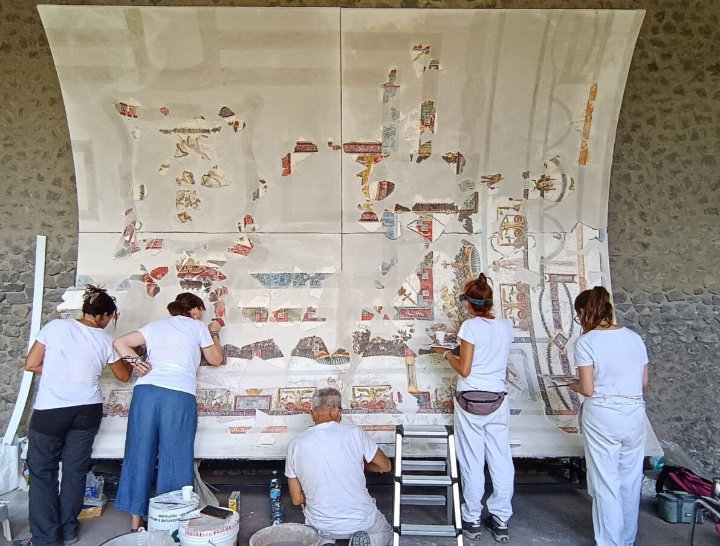
An ancient decorated ceiling, which collapsed during the eruption of Mount Vesuvius and was found in hundreds of fragments, is gradually revealing its extraordinary beauty once again. The Archaeological Park of Pompeii has presented the restoration of the vaulted ceiling from a banqueting room in the so-called House with a Bakery in Regio IX, one of the buildings involved in the most recent excavation campaigns.
The project has made it possible to reconstruct more than a quarter of the original composition, revealing an elaborate decorative scheme dedicated to Dionysus and his union with Ariadne.
A ceiling from an ancient banqueting room
The fragments recovered by archaeologists belonged to the vaulted ceiling of a room located on the upper floor of the house. It was probably a banqueting room, known in the Roman world as a cenaculum.
The location of the discovery was essential in identifying the origin of the fragments. The pieces of painted plaster were found exactly where the ceiling had collapsed, allowing researchers to link them confidently to the same room.
Even during the excavation, archaeologists began to recognise connections between the different pieces. This initial work led to the complex process of restoration and reconstruction.
More than a quarter of the original decoration reconstructed
The restoration project has allowed numerous fragments to be repositioned, reconstructing more than a quarter of the ancient ceiling.
The work was carried out with great care. Only fragments whose original position could be determined with sufficient certainty were used, avoiding any arbitrary reconstruction of the missing sections.
The project brought together several areas of expertise, including material conservation, archaeological research, decorative analysis and exhibition design.
The aim was not simply to recreate an image, but also to reproduce the curved form and spatial depth of the original vaulted ceiling.
A curved support designed for future discoveries
One of the most innovative aspects of the project is the support used to hold the fragments.
Instead of placing them on a traditional flat panel, restorers designed a structure that reproduces the original curvature of the ceiling. The shape of the vault was gradually defined as the fragments were studied and fitted together.
The support is also modular. This means that additional pieces can be added in the future without dismantling or damaging the work already completed.
The reconstruction should therefore not be considered final. Many fragments are still being stored separately, while further pieces may be discovered as excavations continue inside the House with a Bakery.
The restoration remains an open and evolving project, capable of developing alongside future archaeological discoveries.
A colourful and richly detailed decoration
The reconstructed section reveals just how refined the decoration of the room once was.
The composition was arranged around a large central panel, surrounded by painted architecture, ornamental borders, plant garlands and numerous decorative figures.
Among the surviving images are allegorical representations of the seasons, winged figures, flowers, fruit, theatrical masks and objects connected with libations and religious ceremonies.
The rich colours and complexity of the decoration demonstrate the high artistic quality of the room. It must have provided an elegant and impressive setting for banquets and for entertaining the household’s guests.
Dionysus and Ariadne at the centre of the scene
The main subject of the ceiling is the sacred union, or hierogamy, between Dionysus and Ariadne.
Although only part of the central scene survives, comparisons with other ancient artworks have helped scholars identify the subject.
Dionysus was shown reclining on a chariot in front of Ariadne, who was playing a harp. A small musical Eros appeared beside her, while the chariot was pulled by two centaurs who were also playing instruments.
The scene must once have been especially lively and spectacular, with divine figures, music and movement filling the centre of the vault.
This interpretation is supported by the many references to the world of Dionysus found throughout the decoration. Among the garlands of fruit and flowers are ritual symbols connected with his cult, theatrical masks, vessels used for libations and other elements celebrating the divine couple.
The cult of Dionysus in Pompeii’s latest discoveries
The recovery of the ceiling forms part of a wider programme of research into the importance of the cult of Dionysus in ancient Pompeii.
This subject has attracted particular attention following recent discoveries in the nearby House of the Thiasus in Regio IX.
Between 2024 and 2025, archaeologists uncovered a large decorative scene depicting a procession connected with the god Dionysus.
The discovery is considered one of the most important large-scale wall paintings found in Pompeii in recent years. It has helped researchers gain a deeper understanding of the rituals, beliefs and religious imagination of the city’s inhabitants.
The Dionysian theme has also been selected by the Archaeological Park as the main focus of several cultural events organised during 2026.
“Ecstatic Pompeii” and the Park’s cultural events
The mysteries of the cult of Dionysus will also be explored during the second edition of “Esopop – Stories in Festival”, entitled Ecstatic Pompeii.
The programme includes live theatrical performances at cultural sites across the Vesuvian area every Friday and Saturday from 28 August to 26 September 2026, during the Archaeological Park’s evening openings.
The initiative aims to create a dialogue between recent archaeological discoveries, scientific research and contemporary theatre.
Visitors will therefore be able to explore ancient cults and stories through performances that combine archaeology, entertainment and the cultural heritage of the local area.
A restoration that reveals the work of archaeologists
The reconstruction of the ceiling from the House with a Bakery shows that archaeological work does not end when an object is discovered.
Every fragment must be recovered, cleaned, preserved, studied and compared with the others. Only through cooperation between archaeologists, restorers and other specialists can an apparently disordered collection of small pieces become a readable composition once again.
The modular support will allow new fragments to be added whenever further connections are identified or additional pieces are uncovered during future excavations.
The ceiling may therefore continue to take shape over time, providing new information about the art, religion and daily life of the people who lived in ancient Pompeii.
Source: this article was prepared using information from the official Archaeological Park of Pompeii press release about the restoration of the ceiling from the House with a Bakery in Regio IX.