




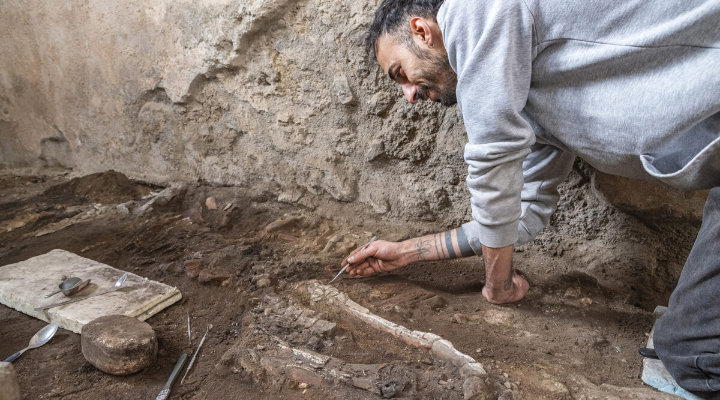
Pompeii never ceases to amaze, and sometimes the most moving discoveries come from simple "cleaning" operations in already known areas. This is exactly what happened recently in the Insula of the Chaste Lovers, where new excavations brought to light a story of death and a tender bond between humans and animals, buried for nearly two thousand years in a corner of an ancient bakery.
An Unexpected Discovery
During the archaeological cleaning of a room used for bread production, located just steps from the famous Via dell’Abbondanza, archaeologists uncovered the remains of two large equids. The discovery was surprising because the animals were not found in a stable, but in a workspace where dough was usually prepared.
But why were these animals there? Researchers have reconstructed that at the time of the 79 AD eruption, the large bakery was not in operation. The structure was a construction site: significant renovation work was underway, likely to repair damage from a strong earthquake that hit the area a few years earlier, between 68 and 69 AD. Because of these works, the animals had been temporarily moved into the production room, where the large worktable had been removed to make space for them.
The Final Moments: The Collapse and the Mystery of the Ash
Investigations using forensic techniques have allowed experts to pinpoint the dramatic final moments. Above the animal remains, a large carbonized maple beam, about two meters long, was found; it had collapsed from the upper floor.
A fascinating scientific detail revealed a new aspect of the eruption: no trace of lapilli (the small porous lava fragments typical of the early phases of the eruption) was found under or around the animals' bodies. This suggests that the two equids died during the very first stages of the catastrophe, not buried by falling stones, but by the violent collapse of the ceiling caused by the intense earthquakes that accompanied the start of the eruption. The fractures found on the bones confirm they were crushed by a heavy load falling from above.
A Bond Beyond Work
Beyond the scientific data, what makes this find particularly touching is a small detail found during the excavation of the first animal, an adult aged about 10-12 years. Near its neck, archaeologists recovered three glass paste beads (one blue and two white), which were likely tied to its mane or harness.
These objects, along with the remains of iron harness elements, tell a story of familiarity. Although these animals were the tireless workforce of the bakery, this small ornament suggests a gesture of care and an "affective" bond between the inhabitants of the house and their companions in misfortune.
The Science Behind the Story
Reconstructing this story required a team of specialists: archaeozoologists to study the bones, archaeobotanists to identify the wood of the beam, and anthropologists for forensic consultation. This multidisciplinary approach transforms Pompeii into an open-air laboratory, where every small fragment—from the ash to the micro-details of the bones—helps give a voice back to those, human or animal, who have remained silent for centuries.
Source: Pompeii Archaeological Park