




Sculpture played an important role in the public and private spaces of Pompeii. Statues, reliefs, herms, fountain figures and decorative bronzes were displayed in temples, the Forum, palaestrae, houses and gardens, where they contributed to religious practice, political representation and domestic decoration.
The surviving works show that sculpture in Pompeii was extremely varied. Large statues were used in public and sacred contexts, while smaller bronzes and marble figures were especially well suited to the courtyards, gardens, fountains and reception rooms of private houses.
The materials were equally diverse. Pompeian sculpture includes works in marble, bronze, limestone, tuff and terracotta, ranging from large public monuments to small decorative figures.
Many sculptures found at Pompeii were inspired by celebrated models of Greek art. Roman patrons did not simply regard these images as old-fashioned copies. Greek sculpture remained a prestigious visual language, and reproductions or adaptations of famous Greek works were displayed in houses, public buildings and sanctuaries throughout the Roman world.
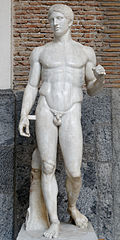
One of the most famous examples is the Doryphoros, or “Spear Bearer”, discovered in the so-called Samnite Palaestra at Pompeii.
The marble statue is a Roman version of a celebrated work created in the 5th century BC by the Greek sculptor Polykleitos. The original bronze has not survived, but the Pompeian statue became fundamental to the modern reconstruction of the lost masterpiece.
In 1863, the German archaeologist Karl Friedrichs identified the statue from Pompeii as a copy of Polykleitos' Doryphoros. This identification marked an important stage in the development of the comparative study of Roman copies of lost Greek originals.
According to the Archaeological Park of Pompeii's E-Journal, more than fifty replicas and variants of the Doryphoros are currently known. The Pompeian example became one of the principal reference points for understanding Polykleitos' artistic system and the proportions associated with his famous Canon.
The importance of the sculpture therefore goes well beyond Pompeii itself. It has played a major role in the history of the study of Classical Greek art.
Another of Pompeii's most famous sculptures is the small bronze traditionally known as the Dancing Faun, discovered in the House of the Faun.
The figure stood at the centre of the impluvium of the principal atrium. Its dynamic pose and carefully modelled body created a striking contrast with the geometric architecture of the surrounding space.
The statue became so closely associated with the residence that the modern name House of the Faun derives from it. The original bronze is now preserved in the National Archaeological Museum of Naples, while a copy is displayed in the house.
The same residence contained one of the greatest masterpieces recovered from Pompeii, the Alexander Mosaic, illustrating how sculpture, mosaics and architecture could work together to create an exceptionally luxurious domestic environment. More information on this work can be found in Mosaics in Pompeii.
Gardens were particularly important settings for sculpture. Statues could be positioned among plants, fountains and water channels, creating carefully designed landscapes in which art and nature interacted.
Bronze and marble figures representing gods, mythological characters, animals and idealised human bodies were especially suitable for these spaces.
Water was frequently incorporated into the display. Fountain figures could direct jets of water into basins and pools, adding movement and sound to the visual effect of the garden.
The sculptures found in Pompeian houses should therefore not be studied as isolated museum objects. Their original position within atria, peristyles, dining areas and gardens was fundamental to their meaning.
A statue placed beside a fountain, for example, functioned very differently from the same object viewed today inside a museum display case.
Sculpture could also communicate the cultural aspirations of the owner. Possessing works derived from prestigious Greek models demonstrated familiarity with a shared artistic tradition and could contribute to the image that a wealthy household wished to present to its guests.
This relationship between art and social display is particularly evident in the larger houses of Pompeii, where sculpture formed part of a broader decorative programme including wall paintings, mosaics, water features and landscaped gardens.
Public sculpture served different purposes. Statues erected in the Forum and other civic areas could commemorate emperors, members of the imperial family, magistrates and local benefactors.
Their location was itself significant. A statue placed in one of the principal public spaces of the city transformed personal honour into a visible statement addressed to the entire community.
Temples and sanctuaries also contained cult statues and other sculptural decoration. At the Sanctuary of Apollo, for example, bronze statues of Apollo and Diana formed part of the sacred setting; the originals are now preserved at the National Archaeological Museum of Naples.
Religious sculpture cannot always be separated sharply from decorative art. Images of gods also appeared inside houses, gardens and domestic shrines, showing how mythology and religion permeated everyday visual culture.
Terracotta was another important material. It was used for architectural decoration, small figures and religious objects, while local stones such as tuff could be employed for architectural sculpture and funerary monuments.
The exceptional preservation of Pompeii also helps us understand sculpture in its architectural setting. In many other ancient sites statues survive without precise information about where they were displayed. At Pompeii, excavation records can often connect an object with a specific room, courtyard, garden or public building.
Many originals recovered during the early excavations were removed from the site and transferred to what is now the National Archaeological Museum of Naples. The museum therefore preserves an essential part of Pompeii's sculptural heritage, including the Dancing Faun and the Doryphoros.
Visitors who want to see many of the original works recovered from Pompeii can therefore complement a visit to the archaeological site with the National Archaeological Museum of Naples.
Recent research continues to change the way Pompeian sculpture is studied. The 2026 study devoted to the Doryphoros and the Canon of Polykleitos is a particularly important example.
Rather than treating the statue merely as a Roman reproduction of a lost Greek masterpiece, current research examines the entire history of the work: the Greek model, its Roman reception, its discovery at Pompeii and its decisive role in the development of modern Classical archaeology.
Sculpture in Pompeii therefore provides evidence at several different levels. It tells us about religion, social status, domestic decoration, public honour and Roman admiration for Greek culture, but it also reveals how the rediscovery of Pompeii transformed modern knowledge of ancient art.
From monumental public statues to small bronzes placed beside fountains, Pompeian sculpture was an integral part of the visual environment of the ancient city.
Essential sources and bibliography
Zuchtriegel G. et al., 2026, Il Canone di Policleto: dalla scoperta del “Doriforo” di Pompei a una nuova ricostruzione dell'originale greco di V sec. a.C., E-Journal degli Scavi di Pompei.
Kreikenbom D., 1990, Bildwerke nach Polyklet. Kopienkritische Untersuchungen zu den männlichen statuarischen Typen nach polykletischen Vorbildern.
Parco Archeologico di Pompei, A Guide to the Pompeii Excavations, House of the Faun and Samnite Palaestra.
National Archaeological Museum of Naples, collections from Pompeii.