Maps of Pompeii
 |
 |
| Street Locator | Building Locator |
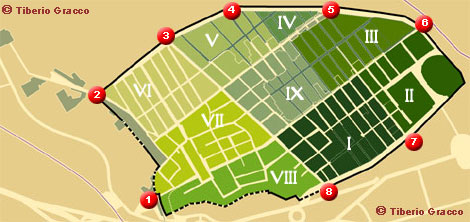 The principal axes consist of Via di Nola - the major decuman
road - and Via Stabiana (the main cardinal road. With the expansion
of the city, two other streets were added to support the urbanistic
layout and run almost parallel to the former: these are Via
dell'Abbondanza, which became the town's new main decuman road, and
the Via del Foro, which wound its way parallel to Via Stabiana to
make a second cardinal road. Both were linked to the large civic
Forum, and constituted the centre of the town's political and
economic life.
The principal axes consist of Via di Nola - the major decuman
road - and Via Stabiana (the main cardinal road. With the expansion
of the city, two other streets were added to support the urbanistic
layout and run almost parallel to the former: these are Via
dell'Abbondanza, which became the town's new main decuman road, and
the Via del Foro, which wound its way parallel to Via Stabiana to
make a second cardinal road. Both were linked to the large civic
Forum, and constituted the centre of the town's political and
economic life.
Two important crossroads - the Orpheus crossroads and the Holconius
crossroads - were the junctions for the main axes in Pompeii. Around
these axes a close network of streets sprang up, which served to
mark off entire blocks of houses (insulae). The urban centre, with
the exception of the Forum area, which lies on a flat piece of land,
is characterized by a remarkable difference in level caused by the
lava terracing which spread across the lower slopes of the mountain.
The layout of the city is rectangular in form. Around it runs the
elliptical perimeter of the walls which extend for about 3 km along
the edge of the basaltic terracing: several stretches date back to
the Samnite era, others to the expansion which took place in the
Roman age. Various gates open into the defensive boundary wall:
their names are Marina, Ercolano, Vesuvio, Nocera, Capua and Sarno.
The most ancient centre in Pompeii is the part massed around the
Triangular Forum. The new Forum, on the other hand, was built in the
vicinity of Porta Marina out of the centre, when the city, which by
now had increased remarkably, felt the need for a larger space. The
Theatre, the Amphitheatre and the Gymnasium were built in the
peripheral area. Thermal Baths were set up in several parts of the
city so that they might answer more adequately the needs of the
citizens by serving the various urban areas. Outside each gate a
large burial ground with sepulchral monuments grew up. As evidence
of the city's enormous urbanistic expansion, a vast urbanized
peripheral area was discovered outside Porta di Ercolano: it
contains houses, workshops and superb villas such as that of
Diomedes and the Villa of the Mysteries.
Another of the suburban villas which characterized the period of
maximum expansion of Pompeii is the one located in the vicinity of
Porta Marina, known as the suburban villa of Porta Marina. The
houses can be dated back to various historical periods: those
belonging to the pre-Samnite period are simpler in their layout and
almost always made of tuff; those of the Samnite period are more
elaborate; without doubt those from the Roman age show the greatest
degree of perfection. The temples in Pompeii are concentrated in the
area of the large Forum and the Triangular Forum and reproduce
traditional Greek designs.
Plentiful examples of workshops can be found throughout the city:
there are numerous fullonicae (places for the treatment of cloth), a
fundamental sector in Pompeii's economy, to the extent that the
Dyers' Guild had its own building in the Forum (the so-called
Building of Eumachia) containing shops and warehouses for the
storage of goods. There are a good many "thermopolia", that is
refreshment rooms (the equivalent of modern-day bars), intended for
the serving of drinks and recognizable from the counters with holes
in them used to hold amphorae. In addition we find bakeries and
mills, often attached to warehouses for storing grain. In general
all the workshops are adjacent to the house of their owner, thus
making it more convenient for him to do his job and allowing him to
involve his entire family and servants in the enterprise as well.
Pompeii had a supply of hotels and rooms to let: several buildings
bear inscriptions which are advertisements for leases. Private baths
were also frequently let out. Furthermore there were plenty of
gambling dens and houses of pleasure (lupanari). Among the
curiosities worthy of note are the pedestrian crossings located at
the road junctions: these consist of very large stones placed
crosswise along the streets: people were able to walk on them and so
avoid getting their feet wet in case of rain. Attention is due to
the signs on the shops, often in the form of painted pictures and
depicting the activity carried out there and the name of the owner.
The walls of the houses are dotted with inscriptions: these are
public announcements of performances or advertisements for rooms to
let, as well as electoral propaganda messages and words of a lewd
nature referring to various people or situations.