




The walls of Pompeii preserve thousands of written messages that offer an extraordinary insight into the everyday life of an ancient Roman city. Political slogans, advertisements, declarations of love, jokes, insults, names, greetings, drawings and comments about gladiators were written or scratched onto walls throughout the city.
These inscriptions are particularly valuable because they do not record only the activities of emperors, magistrates and wealthy families. They also preserve the voices of people who rarely appear in ancient literary sources: workers, freedmen, women, travellers, customers, spectators and ordinary inhabitants of Pompeii.
The eruption of Mount Vesuvius in AD 79 preserved many of these writings together with the buildings on which they appeared, transforming the streets of Pompeii into an exceptional archive of ancient communication.
Graffiti and painted inscriptions
Not all writing found on the walls of Pompeii should technically be called graffiti.
Archaeologists generally distinguish between graffiti, which were scratched or incised into plaster and other surfaces, and dipinti, inscriptions painted directly onto walls, usually with red or black pigment.
This distinction is important because the two types of writing often served different purposes.
Painted inscriptions were commonly used for electoral campaigns, advertisements and public announcements. They were usually larger and more visible and could be produced by people accustomed to painting lettering on walls.
Graffiti, by contrast, were generally informal. They could be scratched with a pointed object by anyone who wanted to leave a name, message, drawing or personal comment.
Together, these different forms of writing reveal how widespread written communication was in the streets, houses and public buildings of Pompeii.
Electoral campaigns on the walls
Political campaigning was highly visible in Pompeii.
Thousands of painted electoral notices, known as programmata, have been recorded on façades throughout the city. More than 2,600 electoral inscriptions are known, making Pompeii one of the richest sources of information about local elections anywhere in the Roman world.
The notices generally asked citizens to support a candidate for one of the principal municipal offices, particularly aedile or duumvir.
The language was often formulaic. Candidates could be described as worthy of public office or as good men, while individual supporters or groups might publicly recommend them.
These inscriptions appeared where they could attract attention: along busy streets, near crossroads and on the façades of houses, shops, workshops, taverns, baths and other frequently visited places.
The location of an electoral notice was therefore part of the campaign itself. A message positioned on a heavily travelled street had a much greater chance of being seen.
Recent excavations continue to reveal new examples. In Regio V, for instance, exceptionally well-preserved electoral inscriptions were discovered supporting candidates including Helvius Sabinus and Lucius Albucius.
The surviving programmata provide names not only of candidates but also of their supporters, making it possible to reconstruct aspects of Pompeii's political networks and social relationships.
Professional signwriters
Many painted public inscriptions were probably produced by skilled signwriters, sometimes working with assistants.
Creating large, clearly legible letters on a wall required considerably more preparation than scratching a short message into plaster. The surface might first be prepared or covered, and the text then painted so that it could be read by people passing through the street.
Some inscriptions preserve traces of the people involved in producing them, providing rare evidence for the practical organisation of political advertising in an ancient city.
The walls were also repeatedly reused. Older painted notices could be covered by new plaster or replaced by more recent electoral messages as political campaigns changed.
Pompeii's streets should therefore be imagined not as the bare stone surfaces often seen today, but as lively urban spaces covered with colour, signs, advertisements and political slogans.
Everyday graffiti
Informal graffiti provide a very different perspective on the inhabitants of Pompeii.
People scratched their names, recorded that they had visited a particular place, greeted friends, expressed affection or hostility and commented on events around them.
Some inscriptions contain only a name or a few words. Others preserve short poems, fragments of literary quotations or more personal messages.
Love is one of the recurring themes. Pompeian walls contain declarations of affection, complaints about lovers, sexual comments and expressions of jealousy.
Other inscriptions are humorous, insulting or deliberately provocative. Some would have been considered crude even in antiquity.
Taken individually, many of these messages may appear insignificant. Considered together, however, they provide an extraordinary record of how ordinary people communicated outside the formal world of official monuments and literary texts.
Names and identities
A remarkable number of Pompeian graffiti consist simply of personal names.
At first sight these may seem less interesting than a political slogan or a love poem, but they are extremely valuable to historians.
Names can reveal the presence of people who are otherwise almost invisible in the archaeological record and can sometimes provide clues about social status, origin or connections between individuals.
Women appear frequently in Pompeian wall inscriptions, including women who did not belong to elite families and who would rarely have been mentioned in formal public inscriptions.
Names associated with slaves and freedmen also appear, helping scholars investigate the complicated social structure of the city.
For this reason, graffiti can complement information from funerary inscriptions, official records and household objects, allowing researchers to reconstruct fragments of individual lives.
For more about the people who occupied some of the lowest positions in Roman society, see The Life of Slaves in Pompeii.
Love, humour and insults
Some of the most memorable Pompeian graffiti concern love and personal relationships.
Men and women recorded attraction, disappointment, rivalry and desire on the walls around them. Others left jokes or insults aimed at specific individuals.
The direct language of these messages is one of the reasons Pompeian graffiti feel so modern. Their authors were not writing for historians two thousand years later; they were communicating with people living around them.
A message scratched into a wall could be answered by another writer, creating something resembling a conversation.
Graffiti therefore reveal an informal layer of urban communication very different from monumental inscriptions commissioned by officials or wealthy citizens.
They remind us that Roman writing was not restricted to formal documents and stone monuments. It could also be immediate, personal and spontaneous.
Gladiators on the walls
Gladiators appear repeatedly in both written and figurative graffiti.
Fans recorded the names of fighters, celebrated victories and drew images of gladiatorial combat. These inscriptions demonstrate the enormous popularity of arena spectacles among the inhabitants of Pompeii.
The phenomenon was not limited to adults.
Recent excavations in the Insula of the Chaste Lovers revealed drawings made in charcoal by very young children, estimated to have been around five to seven years old. The images include gladiators and hunting scenes associated with spectacles in the arena.
These drawings are particularly important because they demonstrate how deeply the imagery of public entertainment had entered everyday life, even among children.
Read more about the discovery in Pompeii: House of the Chaste Lovers.
For the wider history of arena entertainment, see Gladiatorial Games in Pompeii.
Drawings as well as words
Ancient graffiti were not limited to writing.
The inhabitants of Pompeii also scratched or drew human faces, animals, ships, geometric shapes and gladiators onto walls and other surfaces.
Some drawings are extremely simple sketches, while others contain enough detail to identify weapons, clothing or particular kinds of spectacle.
The distinction between writing and drawing was not always clear. Text and images could appear together, while letters themselves could be transformed into decorative forms.
These modest images provide valuable evidence for visual culture outside the highly skilled world represented by Pompeian wall paintings and mosaics.
A professionally painted mythological fresco and a roughly scratched drawing of a gladiator belonged to very different artistic contexts, but both formed part of the visual environment experienced by Pompeii's inhabitants.
Writing in houses and public spaces
Graffiti have been discovered almost everywhere in Pompeii.
They occur along streets and façades, but also inside private houses, public buildings, baths, shops, entertainment venues and other spaces.
Their location is often as important as their content.
An inscription inside a house might have been intended for members of a relatively small social group, whereas a message beside a busy street could reach a much larger audience.
Particularly high concentrations of graffiti are known from places such as the Basilica, the Large Palaestra and the theatre area, demonstrating that public spaces encouraged informal writing and interaction.
Researchers now increasingly study inscriptions together with their precise archaeological context rather than treating every message as an isolated text.
This approach can reveal who was likely to see a message, how people moved through a building and whether groups of inscriptions developed through interaction between different writers.
The theatre corridor: new discoveries
Research into Pompeii's graffiti continues to produce new discoveries.
A recent international project has focused on the corridor connecting the theatre area with Via Stabiana, a space containing an exceptionally dense collection of ancient graffiti.
Research campaigns carried out in 2022 and 2025 combined traditional epigraphy with photogrammetry, digital imaging and Reflectance Transformation Imaging, a technique that makes shallow incisions on ancient plaster easier to examine.
The project identified 79 previously unpublished inscriptions in addition to the graffiti already known from this area.
Researchers are studying approximately 200 graffiti from the corridor as a connected group rather than as isolated inscriptions. This makes it possible to investigate relationships between texts, drawings, locations and the people who moved through the space.
Among the newly studied material are fragments of personal messages and representations connected with gladiatorial combat.
The project demonstrates that Pompeii's walls still contain information capable of changing our understanding of the ancient city more than two centuries after their excavation.
More information is available in the Archaeological Park's research project “Bruits de couloir”: Shedding New Light on Ancient Graffiti.
Graffiti as historical evidence
The importance of Pompeian graffiti lies precisely in their apparently ordinary character.
Official inscriptions tell us about institutions, magistrates and public honours. Graffiti tell us about individual voices.
They reveal people expressing love, anger, pride, humour, political enthusiasm and fascination with popular entertainment.
At the same time, these inscriptions must be interpreted carefully. A sentence scratched on a wall cannot automatically be assumed to represent the opinions of Pompeian society as a whole, and identifying the writer is often impossible.
Their archaeological context is therefore essential.
When graffiti are studied together with the building, street or room in which they were written, they can contribute to our understanding of literacy, social relationships, mobility and the use of urban spaces.
Preserving fragile voices
Graffiti are among the most fragile remains preserved at Pompeii.
Many were scratched into thin layers of plaster and were never intended to survive for centuries. Exposure after excavation subjected these surfaces to rain, sunlight, temperature changes and other forms of deterioration.
Some inscriptions recorded by early archaeologists are now damaged or lost, making historical drawings, photographs and publications particularly important.
Modern documentation techniques make it possible to preserve extremely detailed digital records and sometimes reveal marks that are difficult to see with the naked eye.
The continuing study and conservation of these inscriptions is essential because even the shortest message may contain information about people whose lives left almost no other trace.
The voices of Pompeii
The extraordinary importance of Pompeii's wall inscriptions comes from the combination of formal and informal communication preserved across an entire ancient city.
Painted electoral notices reveal political campaigns and civic competition. Advertisements document entertainment and commerce. Scratched graffiti preserve names, jokes, affection, hostility and personal memories. Drawings record everything from ships and animals to gladiatorial combat.
Together they transform Pompeii from a collection of ruined buildings into a city filled with individual voices.
The people who wrote on these walls could never have imagined that their casual messages would still be read almost two thousand years later. Yet precisely because they were informal and spontaneous, the graffiti of Pompeii provide one of the most immediate connections we have with the inhabitants of the ancient Roman world.
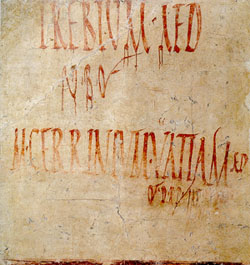 Electoral inscription
This fragment of painted plaster comes from Via Consolare, near shops VI.17,7–8, along one of the main roads leading into Pompeii.
The inscription urges voters to support Aulus Trebius Valens and Marcus Cerrinius Vatia for the office of aedile, one of the principal municipal magistracies responsible for aspects of public order, streets, public buildings and markets.
The surviving text describes Trebius as a good man and Cerrinius Vatia as worthy of public office. Similar electoral inscriptions supporting the same candidates were found elsewhere in Pompeii.
The fragment, painted in red and dating to the Flavian period, is now preserved in the National Archaeological Museum of Naples.