





Pompeii, unlike the other towns in Campania founded for the most part by Greek colonists, was built by the Oscans, probably around the 9-8th century B.C., even if the evidence now available does not go back beyond the 6th century.
The town developed on lava terracing formed many centuries earlier. It constituted an important natural defence against the threat of invasion by neighbouring peoples. At the same time the volcanic nature of the land meant the territory of the Sarno valley was particularly fertile, thereby allowing for the rapid development of the agricultural economy. Pompeii soon made contact with the nearby Greek colonies, whose culture, way of life and the religion of Magna Graecia it quickly absorbed. Evidence of this is to be found in the shape of the Doric temple which stands in the Triangular Forum. The city was subject to the Etruscans for almost fifty years (until 474 B.C.) when the latter occupied part of inland Campania. Immediately afterwards it came back under the Greek sphere of influence. It then became part of the Samnite area of expansion (5th century), under whom it saw remarkable growth, forming that historical centre whose remains are still visible. This can be identified in part of the most ancient boundary wall, in the architecture of several houses (those characterised by a Tuscan-type atrium), in the public buildings in the Triangular Forum and in the Temple of Apollo in the Civic Forum.
Meanwhile Rome had begun its gradual advance towards southern Italy and had started to overcome the resistance of the Italic peoples. As a consequence even the Samnites were forced to surrender to the Eternal City, though only after three long and bitter wars, the last of which was fought in the years between 298 and 290 B.C. As a result of the conquest of Campania, Pompeii also ended up under Roman dominion, becoming an "associate", a status which allowed for the maintenance of a relative local autonomy. From that time on its history was closely connected with that of the Eternal City and only on the occasion of the social war waged by the Italic peoples in a final attempt to defend their freedom, did it ally itself with the insurrectionary movement (91 B.C.). In 89 B.C., however, it was besieged by Sulla, taken by storm and thus brought back under the aegis of Rome. In 80 B.C. it became a Roman colony with the name of Colonia Cornelia Veneria Pompei. As in the past, Pompeii continued to expand and develop in every sector, in the economic field in particular, greatly helped by its fertile hinterland and its advantageous position. All the activities linked to trade and maritime traffic saw a period of growth. This remarkable development had immediate results: outside, it led to an increase in the level of prestige of Pompeii compared with other Campanian towns; within, as a consequence of growing wealth, there was a general increase in the standard of living for many of the social classes. As a result the "middle-class", that is to say the class of merchants and entrepreneurs who had built Pompeii's fortune and had reaped their reward, was able to establish itself in an increasingly prominent way.
Pompeii's flourishing economy led to a decisive population increase, widespread affluence and in addition the remarkable embellishment of the town. It is true to say that the middle-class derived great pleasure from competing with the nobility in the construction of splendid villas.
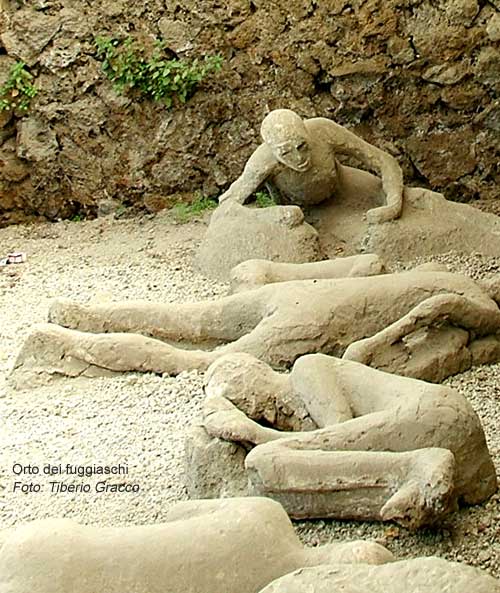
The nouveaux riches, in their desire to outdo the aristocratic class who traditionally held power, vied in displaying their own wealth through the opulence of their houses and the preciousness of their ornaments and jewellery. The urban building expansion took place for the most part along Via dell'Abbondanza, a symbolic centre of the new emerging class. However, the life and splendour of Pompeii was destined to come to an end. The first inklings of the tragedy were felt in about 62 A.D., when a violent earthquake devastated the city and the surrounding countryside. It was no mean feat to recover from this blow. The least well-off class suffered the most serious consequences, having seen their houses destroyed. Most of the public and private buildings were still at the strengthening and restoration stage when Vesuvius became active, and in the space of a few hours sowed death and destruction on the city. It was the 24th August in the year 79 A.D. A heavy shower of ash, lapilli and lava from the volcano began to rain down onto the city and onto nearby Herculaneum and Stabiae. All was buried beneath a thick blanket of volcanic material to a depth of several metres. The inhabitants, who for the most part fled in the direction of the coast, were suffocated by the fumes of the gases, others met death in their own homes.
Where is Pompeii located and what is its geographical setting?
Pompeii lies in Campania, on a volcanic plateau on the southern slope of Mount Vesuvius, about 30 meters above sea level and near the mouth of the Sarno River. Its panoramic and strategic position, overlooking the Bay of Naples, gave it a key role in trade and maritime connections for centuries.
Who were Pompeii’s first inhabitants?
The city was founded by the Oscans, although its name may have Greek origins. Over the centuries, Pompeii came under the influence of various peoples, including the Greeks, Etruscans, Samnites, and finally the Romans.
Why did Pompeii become an important city in ancient times?
Its proximity to the sea made it a vital port for goods coming from inland Campania. Pompeii became a thriving center of trade and production, especially known for its wine and olive oil, which were exported across the Mediterranean.
What are the must-see historical buildings in Pompeii?
Highlights include the Temple of Apollo, the Stabian Baths, the Temple of Jupiter, the Basilica, the Amphitheater, the Odeon, the House of the Faun, the Building of Eumachia, and the Temple of Fortuna Augusta. Each reflects different periods of the city’s history, from Etruscan influence to the height of Roman rule.
How big was Pompeii and how many people lived there?
Before the eruption in AD 79, Pompeii covered about 64 hectares (158 acres) and had an estimated population of around 20,000. Its size made it one of the most important cities in Roman Campania.
How was the city organized?
Pompeii’s layout was inspired by the Greek urban planner Hippodamus of Miletus, with a regular grid of streets and blocks. The roads were often narrow, lined with raised sidewalks, and had stepping stones for crossing, as rainwater ran along the center.
How did Pompeii’s water system work?
An aqueduct from Serino, about 26 km inland, supplied water to public fountains, baths, and private homes through a network of lead pipes. This advanced hydraulic system can still be seen in parts of the archaeological site today.
How many gates and defensive walls did the city have?
Pompeii was protected by a strong city wall with twelve towers and seven gates, five of which connected to major roads leading to other cities in Campania. It remains one of the most impressive pre-Roman fortifications in Italy.
Where were the necropolises and what do they reveal?
The cemeteries were located outside the city walls, as Roman law forbade burials within the urban area. Some monumental tombs included dining rooms for commemorative banquets, a sign of the close connection between the living and the dead in Pompeian culture.
What happened to Pompeii in AD 62 and AD 79?
In AD 62, a powerful earthquake destroyed much of the city, starting a long reconstruction process. In AD 79, while many buildings were still being rebuilt, the eruption of Vesuvius buried Pompeii under layers of pumice and ash, preserving it for centuries.
Why visit Pompeii today?
Visiting Pompeii is like stepping back in time. Walking through its streets, exploring houses, shops, temples, and theaters offers a rare chance to experience an ancient Roman city almost exactly as it was 2,000 years ago. Recognized as a UNESCO World Heritage Site, it is one of the most fascinating archaeological destinations in the world.