






The wall paintings of Pompeii are among the most important surviving examples of Roman painting. Preserved by the eruption of Mount Vesuvius in AD 79, they decorated private houses, villas, temples, baths, shops and public buildings, offering an exceptional view of Roman artistic taste and domestic life.
The paintings were not simply decorative. In wealthy houses they formed an essential part of the architecture, transforming rooms through colour, imaginary buildings, landscapes and mythological scenes. Walls could appear to be covered with precious marble, opened onto distant architectural views or divided into elegant panels containing small painted pictures.
Many Roman wall paintings were executed on carefully prepared plaster. Colours were applied while the plaster was still fresh, while some details could also be added later on a dry surface. Ancient painters used mineral and artificial pigments including red and yellow ochres, carbon black, cinnabar and Egyptian blue. The preparation of the wall itself was extremely important: several layers of plaster could be applied before the final painted surface was created.
The development of Roman wall decoration in Pompeii and the surrounding Vesuvian area is traditionally divided into four Pompeian Styles. The dates are approximate, and different decorative systems sometimes overlapped, but the classification is still useful for understanding how Roman wall painting changed between the late Republican period and the eruption of AD 79.
 |
 |
 |
 |
| I style | II style | III style | IV style |
First Style – Masonry Style
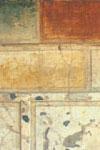
The First Pompeian Style, approximately 200–60 BC, sought to imitate walls faced with expensive coloured stone and marble.
Instead of depicting deep spaces or complex scenes, painters and plasterers divided the wall into architectural sections resembling large blocks of masonry. Raised stucco was often used to reinforce the illusion of stone slabs, cornices and architectural mouldings.
The effect reflected the influence of Hellenistic architecture and allowed the owners of a house to reproduce the appearance of costly marble decoration using plaster and paint.
Colours could be strong and varied, with areas of red, yellow, black and green arranged to suggest different types of stone. This style was particularly widespread before and during the early phases of Pompeii's integration into the Roman world.
Examples of early decoration survived in a number of Pompeian houses even after newer fashions had appeared. In some cases, owners deliberately preserved older First Style rooms while redecorating other areas of the same house according to more modern tastes. The Archaeological Park has documented precisely this coexistence of different decorative phases in Pompeian residences.
Second Style – Architectural Style
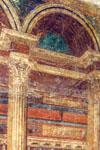
During the Second Style, which developed during the 1st century BC, Roman painters began to dissolve the apparent solidity of the wall.
Painted columns, porticoes, doors, windows and architectural structures created the illusion that the room extended far beyond its real boundaries. Perspective was used to suggest imaginary buildings, gardens, sanctuaries and landscapes located behind the actual wall.
The result could be extraordinarily theatrical. Instead of standing in front of a flat decorated surface, the viewer was visually surrounded by an imaginary architectural world.
One of the greatest masterpieces associated with this period is the decoration of the Villa of the Mysteries, just outside the walls of Pompeii. Its celebrated room contains a monumental sequence of almost life-size figures against an intense red background. The paintings belong to the Second Style and are generally interpreted in connection with the world and rituals of Dionysus, although the precise meaning of the entire cycle continues to be discussed. The Archaeological Park also compares the Second Style paintings of nearby Boscoreale, dated around 40–30 BC, with those of the Villa of the Mysteries.
Read more about the Villa of the Mysteries and its extraordinary fresco cycle.
Third Style – Ornamental Style
Around the end of the 1st century BC, the illusionistic architecture of the Second Style gradually gave way to a very different decorative approach.
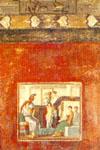
The Third Style, approximately 20 BC–AD 20, emphasised the flat surface of the wall rather than attempting to make it disappear. Large monochrome backgrounds, often red, black or white, were divided by extremely slender columns, candelabra, vegetal motifs and delicate architectural elements.
At the centre of the wall there might be a small mythological painting or landscape, treated almost like a framed picture suspended within a much larger decorative composition.
The architecture became intentionally fantastic. Thin columns and delicate structures could support forms that would have been impossible to construct in reality. This highly refined decorative language was particularly fashionable during the age of Augustus.
Some of the finest surviving examples come from the imperial villa at Boscotrecase, near Pompeii. Its famous black and red rooms, painted during the last decade of the 1st century BC, combine monochrome backgrounds with slender architectural structures and small landscapes.
Third Style decoration has also been identified within the Pompeian area itself, including paintings from the Villa Imperiale and other residential buildings.
Fourth Style – Intricate Style
The Fourth Style developed during the 1st century AD and remained in use until the destruction of Pompeii in AD 79.
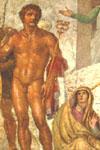
It combined many elements of the preceding styles. Architectural illusion returned, but it was more fantastic and elaborate than in the Second Style. Walls could contain several levels of imaginary architecture, large mythological scenes, small decorative panels, landscapes, still lifes, ornamental borders and delicate architectural details.
The overall effect was often extremely rich. The surface of the wall became a complex composition in which large central paintings were surrounded by fantastic architecture and numerous smaller decorative elements.
Mythology played a particularly important role. Episodes involving Dionysus, Hercules, Achilles, Theseus, Perseus, Ariadne, Venus and other gods and heroes appeared repeatedly in Pompeian houses. These images were part of the cultural language of the Roman elite and could also reflect the function and atmosphere of the rooms in which they were displayed. The MANN collection preserves many such paintings removed from Pompeii and other Vesuvian sites during the early excavations.
One of the most spectacular examples of Fourth Style decoration is the House of the Vettii, whose rooms preserve exceptionally rich mythological and architectural paintings. The same workshop responsible for some of its decoration also worked in the nearby House of the Dioscuri.
For an overview of some of Pompeii's most important residences, see Houses of Pompeii.
Mythology, landscapes and everyday life
Pompeian painting was not limited to mythological stories. The walls also preserve landscapes, gardens, animals, architecture, still lifes, portraits and scenes from everyday life.
Painted gardens could visually extend real gardens and porticoes, creating an impression of vegetation continuing beyond the walls. Birds, trees, fountains and garden architecture were represented with extraordinary attention to detail.
Still-life paintings depicted fruit, food, vessels and other objects. Portraits provide some of the most immediate images of the inhabitants of the Vesuvian area, while paintings from lararia reveal important aspects of domestic religious practice.
Erotic imagery was also widespread and was not confined to the famous Lupanar. Erotic and sensual subjects appeared in private houses, baths and other settings and could have mythological, decorative or symbolic meanings very different from modern interpretations.
The paintings of Pompeii today
When Pompeii began to be systematically excavated in the 18th century, many of the most important wall paintings were cut from the walls and transferred to the royal collections in Naples. This practice preserved many masterpieces but separated them from the architectural settings for which they had originally been created.
For this reason, some rooms visible today at Pompeii contain only part of their original decoration, while many important paintings are preserved at the National Archaeological Museum of Naples (MANN).
The museum's fresco collection provides one of the most complete surveys of Roman wall painting from the Vesuvian area, covering techniques, decorative styles and subjects from the 1st century BC to the 1st century AD. Among the works are paintings from the House of the Tragic Poet, House of Meleager, House of the Dioscuri, villas around Vesuvius and many other contexts.
Visitors interested in Pompeian painting can therefore gain a much fuller understanding by combining a visit to Pompeii, where the decorations can still be experienced within Roman houses and architectural spaces, with a visit to the museum in Naples, where many of the original masterpieces removed during the early excavations are preserved.
Explore the official Frescoes Collection of the National Archaeological Museum of Naples.